admin
admin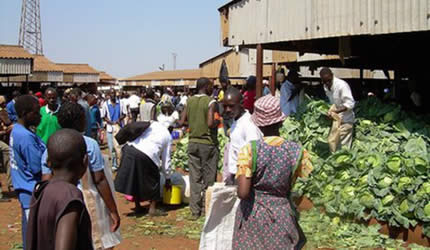
Tanaka Mahanya Features Writer
Harare’s downtown is an intriguing place. The area is dotted with tuckshops famous for selling groceries that are relatively cheaper in cash or United States dollars only.
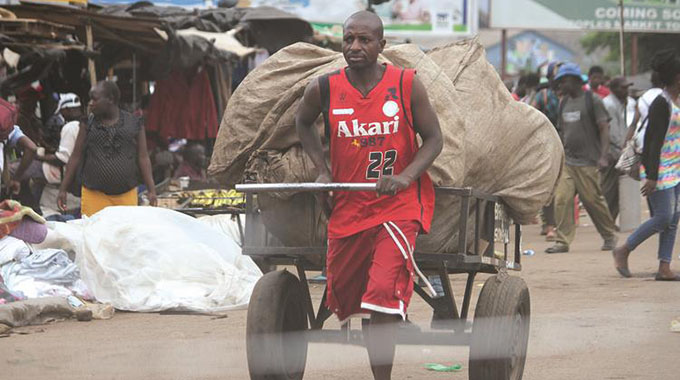
With taxis being expensive and beyond the reach for many, “majega “enhova” (men who carry luggage on their heads and shoulders for a fee) prowl retail and wholesale shops along Bute Street with the hope of getting customers.
They transport goods at a much lower cost, making them a hit in downtown Harare. As a result, being a jega has become a fluid occupation for many, the merchants of power and energy.
The word “jega” is derived from wheel jack, denoting their capacity to lift heavy loads anywhere around town for a “thank you” token.
The men carry from the smallest parcels to huge sacks of groceries.
A visit to downtown Harare, revealed the ways majega go about their trade. There are more majegas than there are customers.
“We arrive in town at around 8 in the morning, and sometimes finding customers during this time of the day is a struggle.
“But because we cannot risk missing that one customer, we also come much earlier,” said
Tinashe Foroma, who has been plying the trade since 2016, says business is at its peak from 1pm to 2pm when most customers are in town.
Business is brisk during holidays and the back to school season.
To work effectively, the majegas say early each morning they take drugs and beer, which includes mutoriro and an illicit spirit, Musombodhia.
“Sister pamasvika ndanga ndisati ndabatwa, ndazorova mutoriro (I had not taken drugs yet when you first came, I am okay now)”, said one of the jegas Glen Muyengwa (28).
His eyes are bloodshot. His hair is tinted brown, kinky and barely combed.
Muyengwa is wearing a former T-shirt which now looks like a ripped cloth tied with several knots. His jeans are caked with grease.
But who cares, on the street, he is the boss?
Another jega, Courage Matola has struck gold so early in the morning.
A woman has hired him to carry two boxes of groceries. He immediately stacks the two boxes on his head and takes off. The woman has to run after him and increase her pace or it will be difficult to find him on the crowded street.
He walks, then looks back, walks again and looks back to see if the woman is catching up.
“We cannot wait because of the heavy weight we will be carrying. If people do not move out of the way, we simply push them aside,” said Matola.
As he walks he shouts “munorutsirwa (you will be puked on)” to clear the way.
“If you just ask them to move, they do not comply. So the trick is to tell them that I will puke on them. If you do that, the way clears fast,” he says with a grin.
Trips to Simon Muzenda bus terminus, Copa cabana and Market Square cost $15, $10 and $5 respectively.
According to Matola, charges are determined by weight and distance to be covered.
The maximum weight they carry is 50kg for a distance of approximately 2 kilometres or less.
“Sometimes we suffer back and arm pains, but we have become used to them, I have been here for 5 years,” said another jega Trymore Manyuchi.
He added that when the load is too heavy, they hire workmates’ push carts which are expensive.
Manyuchi said: “Pushcarts are hired for 60 percent of the amount charged for the carried goods, which leaves us with peanuts.
“Business is better for those with their own carts. Some of us are usually left with nothing.”
A female jega at Mahomed Mussa wholesale identified as Boss Mucha said the going has been tough for her in the male-dominated industry.
She has had to prove to customers that she can do the job as well as men.
“Life was not easy during my first days here. Customers would choose men, but I tried hard to convince them. I have secured some regular customers along the way,” she said.
Sometimes fights for customers erupt.
Most importantly, if one does such a job that requires energy, good food should be top of the list.
“We cannot afford to buy sadza. Where do we get $30 to buy a plate of sadza and beans in supermarkets? Instead we drink freezits, maheu, and eat popped maize and doughnuts,” revealed another jega Mike Ziko.
Ziko said municipal police officers mostly confiscate their pushcarts, and to avoid this, they pay $10-$20 which is not receipted.
According to statutory instrument 108 of 2016 Harare (Cycle licensing), pedal cycles and hand carts can operate freely when they are licensed. But most in Harare’s downtown operate illegally.
Their networks have become so well entrenched that, despite repeated “operations” by the Zimbabwe Republic Police and Harare City Council to restore order, majega have been impossible to stem.
Sally Mugabe Hospital (formerly Harare Central Hospital) senior resident medical officer Dr Chrispen Madzinga said what the jegas are doing negatively impacts on their health.
He said people should not carry luggage exceeding 20 percent of their weight up to a distance of less than a kilometre or more.
The effects of carrying heavy weights, he added, mainly affects the cervical spine and cause fractures on some bones on their back which lead to imminent death.
“Because of carrying heavy weights, they develop osteo-arthritis of the spine and pelvic bones of the knees and hips. The disease has not found cure yet,” he said.
At around 5pm, when the tuck-shops close, the jegas also wind up their business and rush to join the Zupco bus queues.



 Online Reporter