


 admin
admin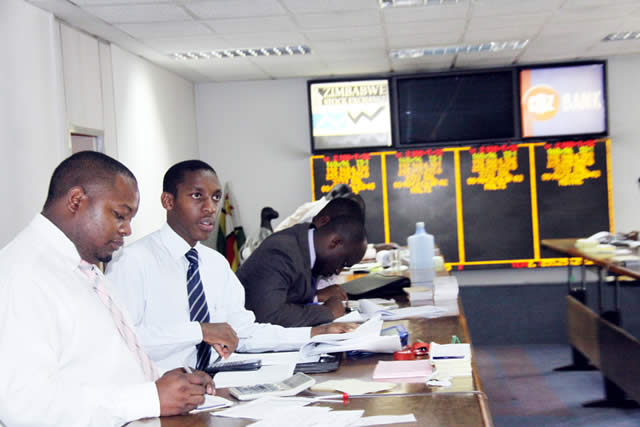

THE Zimbabwe Stock Exchange (ZSE) shed more than US$395 million since the beginning of the year as local economic growth begins to slow, but some investors are shifting their portfolio to bonds in order to find succour.
In January, the total market capitalisation, which tallies the value of ordinary shares listed on the local bourse, stood at US$4,4 billion and by Wednesday last week the value had dropped to US$3,96 billion.
By the end of the first quarter, total market capitalisation had dipped 10 percent to US$4,1 billion compared to the comparative period a year earlier on weak foreign participation and illiquid market conditions.
A monthly economic review report prepared by the African Development Bank (AfDB) recently indicated that the ZSE was the worst performer in Africa in March as the industrial and mining indices retreated 5,4 percent and 19,5 percent respectively.
The value of shares bought by foreign investors in March fell to US$6,4 million from US$14 million in the prior year, showing weak investor appetite for local stocks.
The ZSE has had no new listings in the past five years, barring the listing of Masimba Holdings’ subsidiary, Proplastics, on Monday through a dividend-in-specie.
Proplastics’ listing came after a restructuring exercise that resulted in the group unbundling the plastics manufacturing subsidiary from the construction business.
On its first day of trading, only 60 000 shares changed hands at US3 cents each.
However, on Wednesday the three-day old stock led decliners on the ZSE, tumbling 44 percent to US0,8 cents.
Until then, Padenga Holdings, which also listed through a dividend-in-specie following its unbundling from Innscor Africa Limited in 2010, was the last company to be listed.
Analysts say the bearish market is troubling most investors.
A bearish market is generally defined as a period of negative returns in the broader market of between 15 to 20 percent, or more.
In bearish market conditions some investors often reduce their exposure to the stock market by shifting their investments to alternative instruments such as short-term government bonds.
Others tend to funnel their investments into big counters with strong balance sheets and a long operational history.
Such counters usually weather negative market conditions.
Market watchers last week said bonds are currently outperforming equities.
EFE Securities researcher Mr Respect Gwenzi told The Sunday Mail Business that there is an increase in demand for debt securities as returns on the bond market are currently more than returns on the ZSE.
“On average the bond yields are priced at an average of 10 percent per annum and this return overshadows the equities market with a negative yield of -6 percent year to date.
“However, investment in equities is a long run game and current depressed prices create a value case for long run focused investors.
“It also has to be noted that investment into other avenues besides stocks require a capital outlay that is significant, hence, beyond the allure of retail investors with minimum discretionary income,” said Mr Gwenzi.
However, there is concern that the present conditions do not give investors enough legroom and headroom.
It is believed that there is little to choose from the alternative markets.
“Whilst there is a lot of potential, there is no depth in terms of alternative markets. For example, there is no ready market for bonds and derivatives,” noted Ms Yvonne Saiti, a senior investment analyst with FBC Securities.
A derivative is an arrangement or product (such as a future, option, or warrant) whose value derives from and is dependent on the value of an underlying asset, such as a commodity, currency, or security.
There is however consensus that the stock market is a preferred avenue for investors to acquire valuable assets.
IH Securities director Mr Lloyd Mlotshwa indicated last week that the stock market usually attracts long-term investors.
“In Zimbabwe, where investment alternatives are very limited versus more developed economies like our neighbours in South Africa, the stock market is a prime way for investors to save and hopefully capture value.
“However, as you have mentioned, given the poor performance of the stock market here, other alternative investments in Zimbabwe which have formal structures, are properly regulated and have some level of accessibility would be fixed income (money market) , this allows investors to place their savings with financial institutions at an agreed upon and fixed rate of interest over a specified period of time.
“Duration is typically ranging from 7 days, 30 days, 60 days to 90 days in Zimbabwe where there is usually a preference to invest on the more short-term side,” said Mr Mlotshwa.
However, he also noted that some local banks offer rates of between 7 percent and 10 percent while foreign banks tend to be a “lot lower down the spectrum, often at sub 5 percent levels”.
Unit trusts are mainly favoured by risk-averse investors.
Mr Mlotshwa said there are several derivations of unit trusts, with the pure equity unit trusts allowing investors to invest in a basket of listed shares.
Similarly, fixed income unit trusts allow the investor to invest in a basket of fixed income products.
There are also blended unit trusts that pool both equities and fixed income and these are typically offered by institutions with fund management capabilities such as Old Mutual, Zimnat and Datvest.
Added Mr Mlotshwa: “Outside these products, unfortunately, Zimbabwe is still fairly unsophisticated in terms of offering.
“To put it in perspective, in more developed markets there is a wider range of instruments and products. For instance, an investor wanting exposure to real estate but without the resources to buy or sell or develop properties at a wholesale level can buy property unit trusts very similar to the above product offering.
“An investor wanting access to commodity markets can buy investments which are linked to specific metals that is gold, silver or grains that is maize, wheat.
In addition, there are margin products which allow investors to use leverage to increase their exposures.
“These are examples of products which would be very exciting to have here, some of which we have had at various points historically, and which in the long term as the economy evolves will create broader optionality for local investors as they hopefully begin to be introduced.”



 derick.khumalo
 Online Reporter