Online Reporter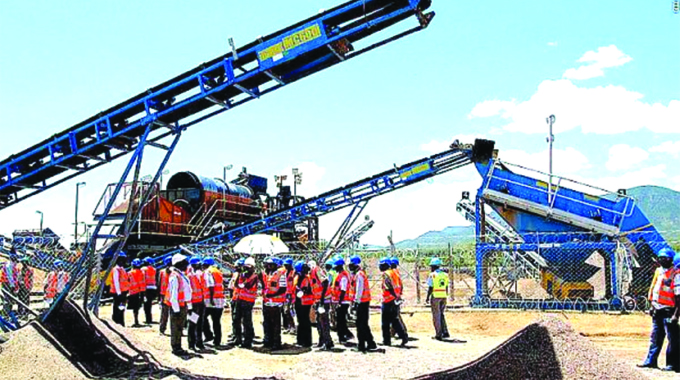
Thupeyo Muleya
Beitbridge Bureau
Deep within Zimbabwe’s southern district, along the banks of the Limpopo River, stretches a landscape rich in history and resources.
For over 200 kilometres, this region, known as Beitbridge, appears unassuming at first glance, with its vast grasslands and cattle grazing peacefully under the African sun.
For long the area has been celebrated as a cattle region, thriving due to the favourable climatic conditions of agricultural Region 5, but below the surface lies a treasure trove of mineral wealth waiting to be unearthed.
As one delves deeper into the earth, they discover a stunning array of precious minerals, that range from diamonds and gold to copper, magnesite, and coal.
With the global demand for these resources soaring, Beitbridge is on the brink of transformation.
Now the once humble district, known for its searing heat, is set to become Zimbabwe’s next big mining hotspot, attracting attention from local and international investors alike.
President Mnangagwa recently led a groundbreaking ceremony for the Palm River Energy and Metallurgical Special Economic Zone.
This ambitious US$3,6 billion industrial park, located just 20 kilometres west of Beitbridge town, symbolises hope and opportunity for the region.
“This project is a testament to the many successful partnerships between the Government and the private sector, as we work together to ensure the development of our country,” said the President.
“This ceremony follows hard on the heels of other projects which are at various stages of implementation, since the advent of the Second Republic. The progress we are seeing here is also a positive result of my Government’s Engagement and Re-Engagement Policy that has led to growing confidence in Zimbabwe as a favourable investment destination”.
The energy and steelworks initiative has already employed 400 local workers in its first year, with the expectation that it will ultimately employ over 2 000 people once it becomes fully operational.
The establishment of the park as an integrated mining and energy hub follows discussions between the chairman of Palm River Energy, Mr Xong Xi Dong, and President Mnangagwa and upon completion, it will cover 5 100 hectares within a Special Economic Zone and is expected to make substantial contributions to Zimbabwe’s mining and energy sectors.
The park comprises a coking plant that will have an annual capacity of producing one million tonnes of coke, a ferrochrome smelting plant that will produce 100 000 tonnes of high-carbon ferrochrome and a 1 200MW coal-fired thermal power plant.
The project is being carried out in four phases over 12 years and already the first phase of the project is being carried out through a joint venture between the Government, Xintai Resources and Tuli Coal.
It is understood that as part of this massive undertaking, any surplus electricity will be transmitted to the national grid, while the ferrochrome plant will facilitate the production of special and stainless steel and castings.
Coal supply to the project is being obtained from Tuli Coal Mine and there are plans to export coal products to international markets, a development set to yield significant foreign currency earnings.
The role of the mining sector in Zimbabwe’s economy cannot be overemphasised, considering it represents over 60 percent of the country’s export receipts and attracts more than 50 percent of Foreign Direct Investment (FDI).
A few kilometres adjacent to the Palm River Project are huge diamond deposits in a kimberlite pipe, owned by Limpopo Mining Resources (Pvt) Limited (LMR), which in July 2012, was put under voluntary liquidation.
RANI Investments LLC, the majority shareholder in Limpopo Mining Resources (Pvt) Limited (LMR), has since filed an application with the High Court seeking removal from liquidation due to a change in circumstances that initially led to the proposed dissolution of the firm.
Beitbridge Rural District Council’s acting chief executive officer, Mr Peter Ncube said they are already engaging the Ministry of Mines and Mining Development to come up with a mineral data baseline for the district.
“We have rich investment opportunities in the mining sector which have great potential to change the face of our area in terms of rural transformation,” said Mr Ncube.
Some of the minerals including coal, chrome, diamonds, corundum, and magnesite, exist in the district. Coal is mainly prevalent in Ward 8 (West of the town) and Ward 1 (Tshitirupasi area) as per previous exploits.
“There is potential for power generation and production of coal-related products for use by local and international markets. And we have diamonds at the Auridium Mine (owned by Limpopo Mining Resources (Pvt) Limited) which is currently closed and we have clinker deposits commonly used for production of cement which is also found in Ward 7”.
He said the area was also rich in investment opportunities for agricultural plantations, especially citrus, amacimbi, baobab fruit (various product lines, coffee, juices, powders, jam, etc), ilala (baskets, mats, brooms, natural vegetables, wild fruits and value chain for Non-Timber Forestry Products (NTFPs) such as crafts.
Some 40km east of the town lies rich deposits of magnesite at the now-closed Pande Mine which was known for its large-scale production, with over 800 000 tonnes produced.
The mine was primarily focused on extracting magnesite, a mineral used in various industrial applications. It is understood that while magnesite was the main focus at Pande Mine, the area also has potential for other economic minerals like crystal corundum, limestone, and uranium. Further in the east lies huge deposits of coal at the Bubye Coalfields some 120km east of the border town which is now set for a new mining venture under the Beitbridge Colliery Company (BCC).
This follows the closure of the mine in 1962 following an underground explosion that killed seven people earning the mine the native name ‘Belavhatu’ (where people perished).
The arrival of BCC which intends to carry out mining some 700 metres from the old shaft has raised hopes for the community.
According to recent geological surveys, the coal mine which is owned by a wholly indigenous consortium led by Messrs Tinashe and Rodwell Kamuriwo and one Thabiso Mofokeng, a South African has a life span of over 60 years.
“To drive mining development in Beitbridge we need to attract direct foreign investment so that the benefits translate into rural transformation, and infrastructural development in the area,” said seasoned Beitbridge-based development worker, Mr Enock Kwinika.
“In addition, banks should be keen to provide loans for local investors especially those operating as consortiums so that they may be able to take off considering that mining development is capital intensive”.
Beitbridge RDC chairperson, and councillor Oscar Chiromo said the district’s rich in mineral deposits will enhance rural transformation and industrialisation.
He said it was also critical for the Government to simplify licensing procedures and streamline the process of obtaining mining licenses and permits to drive mining development in the district and nationally.
He added that there is a need for a robust engagement of communities and stakeholders to understand policy guidelines for mining operations which will also make it easier to enforce environmental regulations to ensure responsible mining practices.
“We need to also promote Beitbridge’s mining potential to attract local and international investors and to provide access to funding options, such as loans or grants, to support small-scale and large-scale mining operations. At the same time, let’s encourage joint ventures between local and international mining companies so that we tap into our natural resources and carry along everyone in the value chain,” said Cllr Chiromo.
A local journalist, Miss Muvhuso Chibi said some recent investments in Beitbridge’s mining were a step in the right direction to awaken a sleeping mining giant.
She said although there is an active national mining policy, local leaders needed to contextualise it to attract investment, and develop and promote small-scale mining.
“In addition, there is a need to sensitise communities about the importance of mining, and its benefits and maybe even have some short courses around mining.
“This can be achieved through career guidance tours for students at existing and operating mines,” said Miss Chibi. “Mining is a huge sector that can drive women empowerment in our district and hence we all line stakeholders should work together to create an optimal environment for women and the youth to actively participate and take up opportunities.
“Where mining is properly done, we expect to see a lot of downstream benefits including the coming up of good infrastructure, the electricity availability and growth in other businesses”.
Mines and Mining Development Minister, Winston Chitando said during the groundbreaking ceremony at Palm River Project (Beitbridge) that the Government remains fully committed to facilitating investment in the mining sector through policy reforms, enhanced ease of doing business, and infrastructure development.
“Our engagement with global investors continues to strengthen, ensuring mutually beneficial partnerships that drive sustainable economic growth,” said the Minister.
“This groundbreaking ceremony is a testament to the Second Republic’s ability to attract large-scale investments and execute transformative projects. Mining is a critical pillar of Zimbabwe’s economy, contributing 13,3 percent to GDP and more than 65 percent of export receipts.
“Despite challenges such as fluctuating commodity prices and global economic headwinds, the mining sector has demonstrated remarkable resilience, with projected growth of 5,6 percent in 2025, led by increased output in platinum group metals (PGMs), gold, chrome, and diamonds”.
He added that a US$ 500 000,00 Palm River Fund which will run for 10 years will be established to focus on youth education as part of corporate social responsibility around Beitbridge.