Online Reporter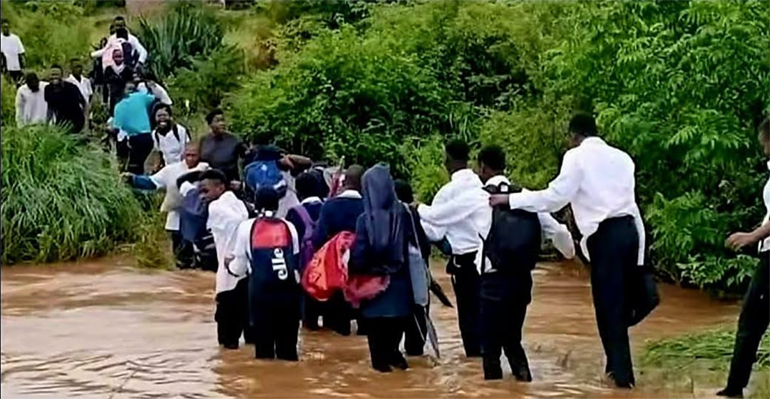
Lovemore Kadzura
Post Reporter
AS schools across Zimbabwe opened for the first term of the year, authorities and stakeholders have issued urgent calls for vigilance to safeguard learners during the ongoing rainy season.
The appeal seeks to prevent tragic incidents in which children — the nation’s future — become victims of weather-related calamities.
Reports indicate that heavy rains have already battered several parts of the country, including Manicaland Province, where flash floods, damaged bridges, collapsed footbridges, and swollen rivers pose serious risks to children commuting to and from school, particularly in rural and low-lying areas.
With rains expected to persist into March, officials are emphasising a united approach centred on child safety.
Even urban schools and parents have been reminded to remain on high alert and to conscientise children about weather hazards. The warning comes against the backdrop of a tragic incident in 2024, when three children in Mutare City were swept away by seasonal rivers.
Concerns have also been raised about ageing school infrastructure, which is increasingly vulnerable to hailstorms and heavy rainfall. Stakeholders have urged school authorities to repair and reinforce weak buildings to withstand weather-related pressures and protect both learners and teachers.
Manicaland Provincial Civil Protection Committee chairperson, Mr John Misi, underscored the importance of precautionary measures as rains continue to pound the province.
He stressed the need for coordination and communication between schools and parents regarding the movement of learners during the rainy season.
“We are making a passionate appeal to school learners not to cross rivers at any level. They should use bridges. Schools must not release learners to their homes when it is raining. The same applies to parents, who should not send children to school during heavy rains. It is better for a child to miss one school day than to be swept away,” said Mr Misi.
He revealed that weather-related incidents have already claimed lives this year.
“Two people have died due to drowning and lightning in Makoni and Chipinge respectively. In Nyanga, three bridges—including a footbridge—were damaged by heavy rains, while four houses were destroyed. Nyamidzi Clinic in Makoni District had its roof blown away. In Chimanimani, a school roof was blown off and a bridge was damaged,” he noted.
Mr Misi further cautioned parents against allowing children to be crammed into overcrowded buses and pirate taxis, warning that such practices are dangerous during the rainy season.
“Drivers must exercise extreme caution when approaching areas where learners board transport in large numbers. Safety must always come first,” he emphasised.
Recently, the Officer Commanding Police Manicaland Province, Commissioner Charles Nhete, urged parents to accompany their children to school during the rainy season, warning that learners may attempt to cross flooded rivers on their own.
“The Zimbabwe Republic Police Manicaland Province would like to warn members of the public that the rainy season is in full swing. There are dangers of drowning and lightning electrocution. People must not cross flooded rivers and should avoid swimming in natural water bodies such as dams and rivers,” said Commissioner Nhete.
He further cautioned against risky behaviour during storms.
“Do not walk in the open during storms. Escort children to school if their route involves crossing a river and ensure they cross safely. Secure children from open water bodies. Avoid dangerous fishing practices, including fishing while in water or using unsafe boats. During storms, seek shelter in buildings or vehicles rather than standing under trees,” he added.
Meanwhile, the president of the Zimbabwe Rural Teachers Union, Mr Martin Chaburumunda, highlighted the urgent need to strengthen school infrastructure to withstand climate shocks.
He noted that hailstorms frequently damage school buildings, blowing off roofs and causing collapses that endanger both teachers and learners.
“The Government and other school owners should prioritise the construction of strong, weather-resistant classroom blocks. Many rural schools have suffered structural damage due to ageing and the use of cheap materials when they were built years ago. We have schools with walls cracking and roofs blown off each time there is a hailstorm,” said Mr Chaburumunda.
He emphasised that dilapidated infrastructure, not only threatens lives, but also disrupts learning.
“Leaking roofs destroy furniture and books. We should not wait for disaster to happen before attending to ageing infrastructure. A school must be a safe place for learners and teachers alike. We encourage the Government and the corporate world to support school infrastructure development through public-private partnerships and community-led initiatives,” he added.