Online Reporter
Prosper Ndlovu, [email protected]
ON the margins of the recent 57th Session of the United Nations Economic Commission for Africa (Uneca) in Addis Ababa, Ethiopia, policymakers, business leaders and development partners discussed at length on how African businesses can successfully trade under the African Continental Free Trade Area (AfCFTA) while fostering inclusive growth and decent work.
Organised by the Uneca sub-regional office for Southern Africa, the Africa Trade Policy Centre and the sub-regional office for northern Africa, and the International Labour Organisation (ILO), the event underscored both the transformative potential of the AfCFTA and the pressing need for action to ensure businesses, particularly micro, small and medium enterprises (MSMEs), reap its benefits.
As the outgoing chair of the African Ministers of Finance, Planning and Economic Development, Zimbabwe, which was represented by Professor Mthuli Ncube, reported that a lot of ground was covered during its tenure as it led from the front in pushing the momentum towards refining the global financial architecture to ensure Africa benefits equally with other regional peers.
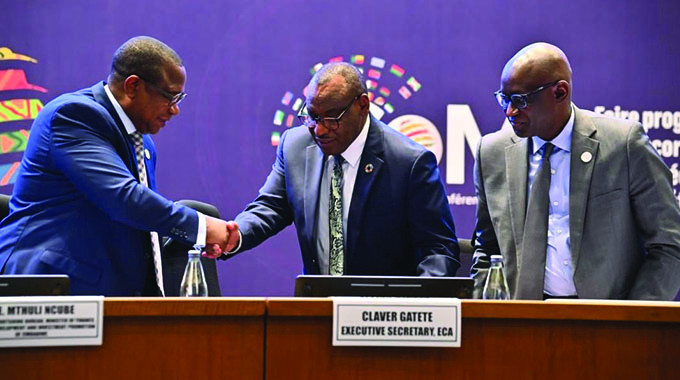
Zimbabwe has further emphasised the need to accelerate domestic resource mobilisation, and enhance climate change mitigation strategies, among others. Despite limited implementation progress due to several barriers, it is encouraging that stakeholders at the meeting were able to scrutinise the shifting global economic landscape, which is characterised by rising geopolitical tensions and increased trade protectionism, and agreed that embracing the AfCFTA and regional integration are the panacea.
This holds the key in providing the required spring board of resilience towards driving solid economic transformation of Africa. With a market of 1.4 billion people and a combined Gross Domestic Product (GDP) exceeding US$3.4 trillion, the AfCFTA holds massive potential for Africa and if fully embraced, this could boost intra-African trade by 45 percent by 2045, experts noted.
They emphasised the need to address implementation gaps that result in uneven progress due to structural barriers, inadequate infrastructure, and limited access to trade finance. Of course, African economies are not immune to the growing threat of tariff escalations and evolving trade restrictions, which have heightened, than ever before, the importance of regional trade blocs and the quest for a vibrant regional integration agenda.
Calling on the African continent to rethink its strategic focus on this matter, Prof Ncube said the time has come for the region to come up with home-grown solutions on how to rebuild “the Africa we want” for future generations.
Buttressing the conference theme, “Advancing the implementation of the agreement establishing the African Continental Free Trade Area: Proposing Transformative Strategic Actions”, Prof Ncube said the prevailing challenges must be seen as opportunities for Africa, which must collectively take advantage of the AfCFTA to accelerate supportive economic reforms.
“The AfCFTA serves as a power tool at our disposal for addressing some of these global challenges. The AfCFTA offers a critical pathway for Africa to build resilience, reduce dependence on external markets, and drive sustainable industrialisation,” he argued.
“The speed of success of the AfCFTA partially depends on the reform of the global financial architecture to make it responsive to the needs of the continent and other developing countries in general.”
Concerning stubborn food security gaps, which have been worsened by climate change, the conference stressed that the AfCFTA could provide a rapid pathway to achieving greater regional food security through facilitating enhanced intra-regional food trade, particularly in processed agri-food products. Already, simulations undertaken by Uneca suggest that intra-continental food trade could increase by more than 60 percent by 2045 if the AfCFTA is fully implemented. This calls for greater regional co-operation in removing the remaining barriers to intra-African trade to offer a sustainable path to supply chain resilience in the sector, and ultimately better food security, acting director of ECA in Eastern Africa, Andrew Mold, said.
Regarding limited fiscal space to drive formidable development across the continent, the African Tax Administration Forum (Ataf) suggested urgent harmonisation of tax systems and advocating for revenue-generation mechanisms that would sustain government finances while fostering trade liberalisation.
Beyond trade transactions and profits for individual businesses, the conference underscored that the ultimate goal for implementing the AfCFTA must be transformation of ordinary people’s livelihoods, a point that was strongly emphasised by Eunice Kamwendo, director of ECA’s sub-regional office for Southern Africa.
She stressed that MSMEs, which account for 90 percent of businesses and 80 percent of employment, must have the tools to succeed, as they are key drivers of economic transformation in Africa. Melaku Desta, a senior ECA expert concurred, highlighting that so far AfCFTA implementation strategies have remained largely public-sector focused, leaving MSMEs with limited direct support.
This prompted Teddy Soobramanien from the Comesa Business Council to challenge the continent to move beyond policy discussions, urging the private sector to “turn AfCFTA from paper into action.”
He called on businesses to actively leverage the agreement for regional trade expansion, ensuring that AfCFTA’s potential is fully realised. Executive director of the Africa Labour Research and Education Institute chief economist, Hod Anyigba, delved deeper with a challenge for Africa to ensure that the AfCFTA “serves people, not just profits.”He called for stronger labour protections, corporate accountability, and due diligence in AfCFTA implementation, warning that without these safeguards, trade liberalisation could lead to informal employment and deteriorating working conditions.
While AfCFTA includes some labour provisions, he pointed out that critical gaps remain, particularly in addressing issues like modern slavery, human trafficking and workplace safety. This includes embracing technology, integrating environmental, social and governance (ESG) issues, as well as amplifying the discussion to the role of women, and youth entrepreneurs to ensure inclusive outcomes and bringing the marginalised groups on board.