admin
adminsuccess. It did not, and it is clear now, in retrospect, that it could not possibly have done so.
Colonial rule, as a government model, was closer to a dictatorship than a democracy.
Nigeria was a young nation, created in 1914, as Nigerian children would learn in history class in the endlessly repeated sentence: “Lord Frederick Lugard amalgamated the northern and southern protectorates to form one country and his wife gave it the name Nigeria”.
It is debatable whether, at independence, Nigeria was a nation at all. The amalgamation was an economic policy; the British colonial government needed to subsidise the poorer North with income from the resource-rich South.
Lugard, a theorist of imperial rule, believed in the preservation of native cultures as long as they fitted his theories of what native cultures should be. In the North, the missionaries and their Western education were discouraged, to prevent what Lugard called their “corrupting influence” on Islamic schools. Western education thrived in the South. The regions had different interests, saw each other as competitors, and became autonomous at different times; there was no common centre.
A nation is, after all, merely an idea. Colonial policy did not succeed in propagating the idea of a nation: indeed, colonial policy did not try to. In the North colonialism entrenched the old elite; in the South it created a new elite, the Western-educated. This small group would form the core of the nationalist movement in the 1950s, agitating for independence.
They tried to establish the idea of “nation” and “tribe” as binary, in opposition to each other, a strategy they believed was important for the exercise of nation-building. But the politicisation of ethnicity had already gone too far. After independence a vicious regional power struggle ensued. The “fear of domination” of one region by another was everywhere. Elections were rigged.
The government was unpopular. Only six years later a group of army majors carried out a coup and murdered top government officials. In the North the coup was seen as an Igbo coup, a plot by the southern Igbo to gain dominance. It didn’t help that the new head of state, in a clumsy attempt to calm the nation, instituted a unitary decree. Instead of regional civil services Nigeria now had a single civil service. A second coup by northern officers saw Igbo officers hunted down and murdered.
Then the murders became massacres. “Massacre” may seem melodramatic. But perhaps because the events leading to the Nigeria-Biafra war are so often eclipsed by the war itself, so little remembered, it seems an apt word for the thousands of Igbo civilians in the North who were killed between May and September 1966, their homes ransacked and set on fire: Nigerian civilians killed by Nigerian civilians. Had the massacres not occurred, or had they been dealt with differently, the south-eastern region would not have seceded and declared itself the independent nation of Biafra.
The darkest chapter of Nigeria’s history
The Nigeria-Biafra war left a million people dead, towns completely destroyed and a generation stripped of its innocence. On the Biafran side, intellectuals actively participated in the war, buoyed by their belief in the secessionist cause. They drafted press releases, served as roving ambassadors, made weapons.
The best known and most influential African poet in English, Christopher Okigbo, joined the Biafran army.
He was a romantic, unsatisfied with the administrative or diplomatic roles his fellow intellectuals took on; Chinua Achebe, his close friend, describes him as a man about whom there was a certain inevitability of drama and event. Mere months into the war, he died in battle.
Achebe’s recollection of Okigbo’s death in There Was a Country is brief, and no less moving for that. Achebe hears the announcement on his car radio and pulls up at the roadside: “The open parkland around Nachi stretched away in all directions. Other cars came and passed. Had no one else heard the terrible news?
“When I finally got myself home and told my family, my three-year-old son, Ike, screamed: ‘Daddy don’t let him die!’ Ike and Christopher had been special pals.
“When Christopher came to the house the boy would climb on his knees, seize hold of his fingers and strive with all his power to break them while Christopher would moan in pretended agony. ‘Children are wicked little devils,’ he would say to us over the little fellow’s head, and let out more cries of feigned pain.”
In the years since the war, Okigbo has become an icon to writers throughout the continent: venerated, enmeshed in myth, his death a striking example of the great tragedy of the war.
Achebe almost died too. Before the war started, when Igbo people were under siege in Lagos, soldiers raided his house and only just missed him. Later, his home and his office were bombed, and later still the Biafran army set up an armoury in his porch overnight; his family woke to the sound of shelling and knew it was time to flee. His story is a story of near-misses, of deep scars left by what could have been.
After an air raid in Enugu at the beginning of the war, Achebe stares at the ruins of what had been the office of Citadel Press, a publishing company he had started with Okigbo, and thinks: “Having had a few too many homes and offices bombed, I walked away from the site and from publishing forever.”
Achebe is the most widely read African author in the world, and was already a known and respected writer in 1967, when he joined the Biafran war effort. He served as an ambassador for Biafra, travelling to different countries to raise support for the beleaguered nation, and participating in various committees, one of which came up with the Ahiara declaration, a moving, if starry-eyed, document that was the new nation’s intellectual foundation.
He has written poems and short stories about Biafra. Girls at War (1972) is a magnificent collection of stories set there. But many have waited and hoped for a memoir, for his personal take on a contested history.
Now at last he has written it. Although it is subtitled “A Personal History of Biafra”, There Was A Country is striking for not being very personal in its account of the war. Instead, it is a Nigerian nationalist lament for the failure of the giant that never was; Achebe is mourning Nigeria’s failures, the greatest and most devastating of which was Biafra.
This is a book for Achebe’s admirers, or for those not unfamiliar with his work. Parts are similar to passages from previous essays, and interspersed in the narrative are poems which, even if tweaked here, have been published before. Keen followers of Achebe will be interested in some of the new material about his life in the first section of the book. But the second section, about the war itself, mostly forgoes personal memory.
In writing about the major events, Achebe often recounts what he was told rather than what he felt and the reader is left with a nagging dissatisfaction, as though things are being left unsaid. There are a few glimpses.
On a visit to Canada as a Biafran ambassador, one of his hosts at the Canadian Council of Churches made a joke, and in the middle of the loud laughter that followed, it occurred to Achebe that Biafra had become different from other places, where laughter was still available.
And, later, hearing a plane take off from Heathrow, he instinctively wanted to dive for cover. There are other small details, but all tantalisingly brief, sometimes oblique. I longed to hear more of what he had felt during those months of war — in other words, I longed for a more novelistic approach.
The book’s first section is much more satisfying in this respect: more involved and personal. There is his happy childhood, his close-knit family, with portraits of his father, an upright missionary teacher, and his mother, about whom he writes: “It is her peaceful determination to tackle barriers in her world that nailed down a very important element of my development — the willingness to bring about change gently.” The first section is also a celebration of the richness of Igbo philosophy and cosmology and its inclusive culture.
In recounting his memory of how welcoming his people were to early white missionaries, he writes about “how whole-heartedly they embraced strangers from thousands of miles away, with their different customs and beliefs”. Although he grew up in a Christian household, with regular Bible readings, he was also drawn to Igbo religion, which he found more “artistically satisfying”.
Much of his work is rooted in this tension between old and new, between the Christian religion of his parents and the retreating older religion of his ancestors.
He began to write Things Fall Apart after a British lecturer told him an earlier story he had written lacked “form”, but was then unable to explain to him what form meant. “I was conscripted by the story”, he writes, “and I was writing at all times — whenever there was any opening. It felt like a sentence, an imprisonment of creativity.”
He is, famously, one of the writers who “wrote back” to the “West”, who challenged, by writing his own story, the dominant and reductive Western images of his people. In his essay “The Novelist as Teacher” he wrote that he would be happy if his work did nothing more than show his people that theirs had not been a life of darkness before the advent of the Europeans.
“The writer”, he says, “is often faced with two choices — turn away from the reality of life’s intimidating complexity or conquer its mystery by battling with it. The writer who chooses the former soon runs out of energy and produces elegantly tired fiction.” On the other hand, his work never sinks under this burden of responsibility.
He describes the situation in eastern Nigeria in the months leading up to war. In Nigeria’s urban mythology, the war would not have happened had it not been for the personal ambition of the Biafran leader, Ojukwu. It is now known that the British high commissioner, David Hunt, wrote a memo to London describing Ojukwu as an over-ambitious man who had engineered the secession and manipulated his people into supporting him.
Many others have repeated this view. Achebe vigorously disputes it: “I believe that following the pogroms, or rather, the ethnic cleansing in the North that occurred over the four months starting in May 1966, which was compounded by the involvement, even connivance, of the federal government . . . secession from Nigeria and the war that followed became an inevitability.”
To him it is self-evident that an ethnic group known for its independence of mind could not easily be manipulated into supporting a war. He writes about the reaction among Igbo people after the Northern massacres:
“One found a new spirit among the people, a spirit one did not know existed, a determination in fact. The spirit was that of a people ready to put in their best and fight for their freedom . . . But the most vital feeling Biafrans had at that time was that they were finally in a safe place . . . at home. This was the first and most important thing, and one could see this sense of exhilaration in the effort that the people were putting into the war. Young girls, for example, had taken over the job of controlling traffic.
“They were really doing it by themselves — no one asked them to. That this kind of spirit existed made us feel tremendously hopeful.”
One gets the sense from Achebe’s memoir of a man who is effortlessly himself, who will keep silent rather than say what he doesn’t believe. He is meticulous and sincere in his expressions of praise and gratitude — to fellow writers, to people who helped him or helped Biafra.
He has a sense of humour, but very little cynicism. Today, when many Western male writers of a certain age are mythologised for their bad manners — rudeness and selfishness — as though great male talent must be accompanied by boorishness, it is refreshing to encounter a great male talent of a certain age who feels no need for posturing.
Source: London Review of Books.


Online Reporter
- Herald
- July 31, 2026
- 3 views
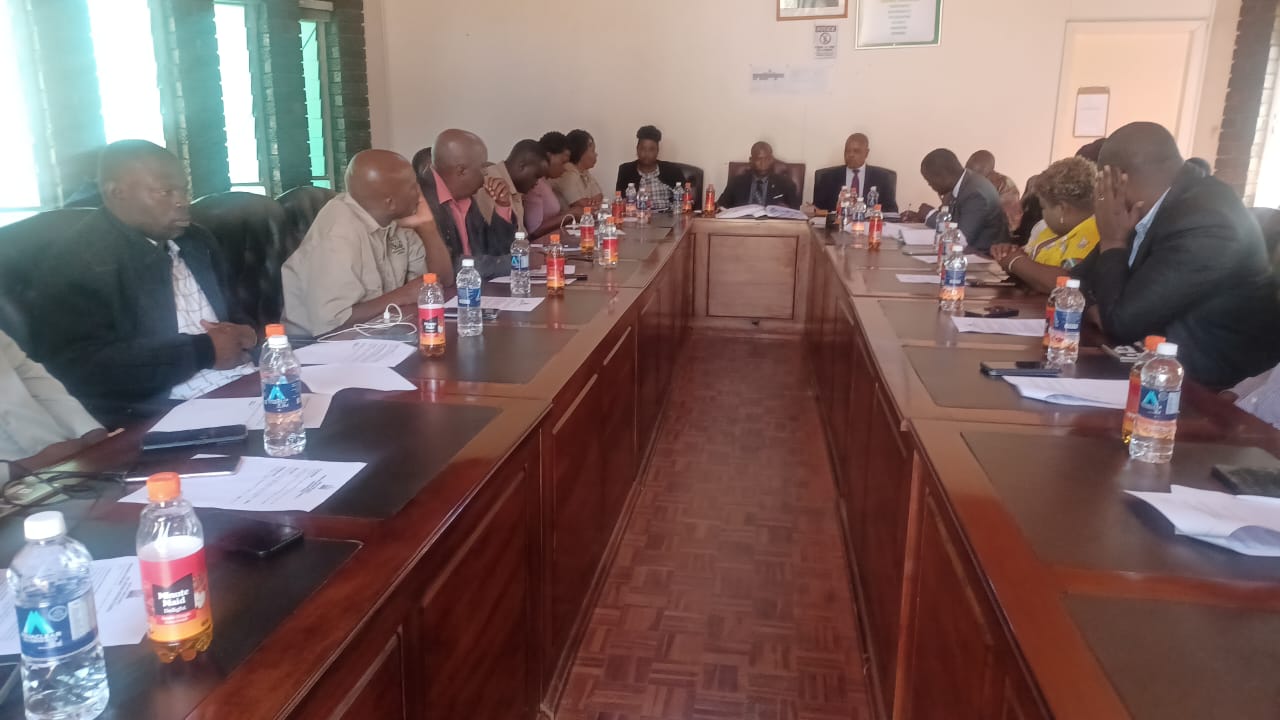
Norton Town Council renews integrity pledges
Diana Nherera Norton Town Council councillors and management on Thursday renewed their integrity pledges as part of the local authority’s commitment to promoting ethical conduct and combating corruption. Speaking…