

 admin
admin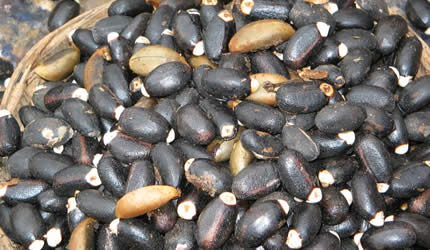
The bio-diesel plant, built about four years ago, is the first of its kind in Africa and only one of the few in the world.
It was designed to mainly process oils extracted from jatropha seeds as the main feedstock.
The project is the brainchild of joint efforts between the Reserve Bank of Zimbabwe and Korean investors.
Apart from oils from jatropha seeds, the plant can also processes oils from sunflower, vegetable, cotton and soyabeans.
Plans by Government to transform various farm lands into “oil fields” hit a brick wall due to financial constraints.
In an interview yesterday, Science and Technology Development Minister Professor Heneri Dzinotyiwei said the jatropha plants cannot, at least for now, be grown on a commercial viable basis.
The minister said experiments have shown that to achieve optimal yields, jatropha plants should be at least three metres apart, thus growing it on a commercial basis could compromise farm land for food crops.
He added that the variety of the available seeds does not produce good yields.
“We have done a research and realised we cannot have any meaningful jatropha production,” said Professor Dzinotyiwei.
“It is not as we previously thought. It does not just work. There is nowhere in the world where it is produced commercially even in India and Brazil where they did some experiments.”
The minister said it was “premature” for Zimbabwe to have a plant of that nature.
The plant has a capacity of producing up to 100 million litres when fully integrated, supported by availability of sufficient feedstock.
It has never operated on a commercial basis largely due to inadequate supplies of feedstock in the form of oils from cotton, soyabeans, jatropha and cotton.
Analysts say the success of the biodiesel programme hinges on the production of adequate jatropha feedstock.
Estimates are that in order to meet the 10 percent bio-diesel production target, 120 000 hectares of jatropha must be planted.
The national bio-diesel feedstock production programme was run by the then National Oil Company of Zimbabwe and the Forestry Commission of Zimbabwe.
According to bio-energy experts, at least one tonne of seed oil is required to produce up to 300 litres of bio-diesel.
Analysts said several issues were overlooked prior to the establishment of the plant with the major one being the ability of local farmers to grow and supply enough oil seeds for the plant.
The sources also noted that little investment was also made to capacitate farmers.
On the way forward, Prof Dzinotyiwei said there was need to look for alternative sustainable sources of feedstock.
“I think the way forward is for the owners of the plant to figure out potential and sustainable sources of alternative feedstock,” he said. “There is need to encourage cultivation of soyabeans and other oilseeds.”
Agriculture, Mechanisation and Irrigation Development Minister Dr Joseph Made said yesterday said while a programme was put in place to transform various farmlands into “oil fields”, the major challenge was the shortages of financial resources to finance potential oil seed farmers.
The introduction of the jatropha plants coupled by a ready market and perceived benefits saw a jatropha fever grip Zimbabwe.
Government also made a deliberate effort to entice communal and resettled farmers to diversify into growing jatropha to produce feedstock for bio-diesel production.
The central bank said the original strategy was that the plant was going to have significant backward and forward integration synergies with jatropha and other oilseed farmers and end-users of diesel.
Bio-diesel holds great promise for African nations as over-reliance on fossil fuels has long drained national budgets.
Fuel prices are constantly rising, stressing the need for African governments to consider bio-fuels as an alternative.
In the developed world, the EU targets member states to generate at least 10 percent of their energy from biofuels by 2020.
In Zimbabwe, the Government has proposed a new biofuels policy that seeks to promote the use of sorghum and oilseeds as biofuel feedstock, in addition to jatropha and sugarcane that is promoted under the current policy.



 Online Reporter