


 Online Reporter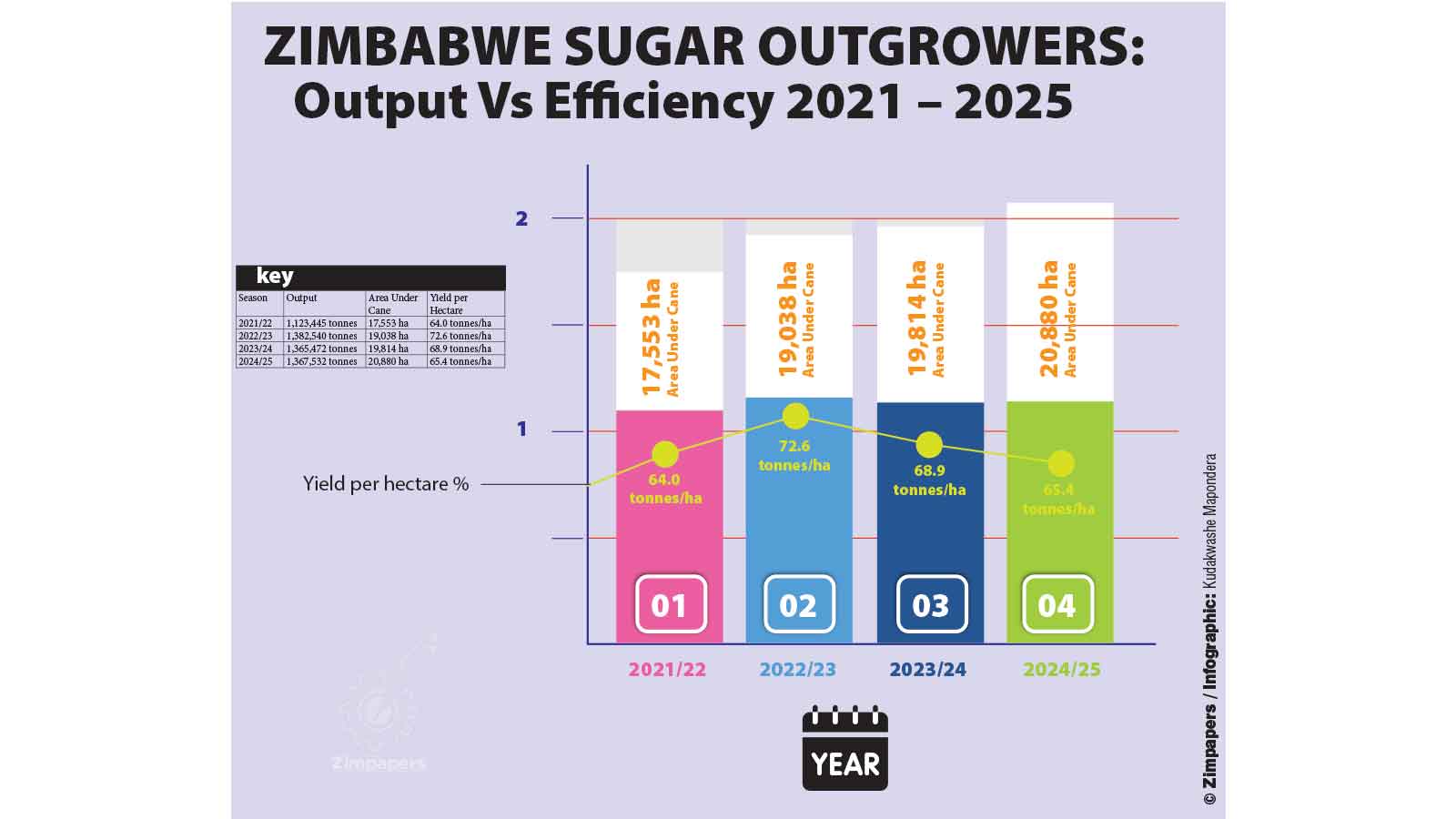
George Maponga in MASVINGO
IN the sweltering heat of Chiredzi in Zimbabwe’s Lowveld, Mr Charles Dzingirayi, a small-scale commercial farmer, looks at the partially withered sugarcane that he will be harvesting in two months.
Mr Dzingirayi’s crop, in Subdivision 6 of Jatala, under Triangle Ranch, has apparently been affected by a shortage of fertilisers and irrigation water.
Weeds seem to be competing with the crops, a sign that he did not apply enough herbicides, while yellow aphids have also left the leaves ashen.
Mr Dzingirayi is obviously worried about prospects of another poor harvest, especially given his indebtedness.
While he does not entertain the idea of giving up, he laments the increasingly unfavourable conditions plaguing some of the farmers who got sugarcane farms under the Land Reform Programme.
‘’We are borrowing from banks to finance our operations and we also have to grapple with high costs of power to irrigate our sugarcane, coupled with development levies and statutory payments to the National Social Security Authority and the Zimbabwe Revenue Authority,’’ said Mr Dzingirayi.
His situation illustrates how farmers are struggling with low productivity in an environment characterised by very high input costs.
A bag of urea or ammonium nitrate — essential fertiliser for sugarcane — retails between US$38 and US$42 per 50kg.
Overall, one hectare of sugarcane requires 12 bags before the crop reaches maturity.
Farmers are producing barely two-thirds of what profitable farms should produce.
“I don’t struggle with inputs alone but also the high cost of fuel and transport to ferry our cane to the mill,” he added.
Most farmers in Triangle and Hippo Valley are approximately 25 kilometres from the mill.
Those at Mkwasine are 52 kilometres away. However, they transport cane by rail at a lower cost.
Low yields by farmers are also impacting negatively on household incomes.
For Mrs Mavis Hlaisi of Mkwasine, poor yields for cane farmers mean she has to help her husband to supplement the family income.
“My husband works at a sugarcane farm here in Mkwasine, but what he gets is barely enough for our family because sometimes he is not paid at all after all revenue is chewed up by costs, so I have to supplement the family income by going to Mozambique to buy second-hand clothing bales for resale in Chiredzi,” she said.
“We are now used to a scenario where my husband fails to get a salary at least four months per year from January to April, when the sugar mill will be off-season because his employer’s revenue is always used on rising operational costs.”
The consequences for embattled Lowveld sugarcane farmers reach beyond the farm gate.
A 2kg packet of Huletts SunSweet sugar retails between US$2,50 and US$3 on the local market, compared to approximately US$0,90 in Malawi for the same quantity. That price gap — driven in part by high production costs rooted in low yield efficiency — leaves Zimbabwean sugar uncompetitive on the regional export market.
The United States Department of Agriculture 2023/2024 forecasts note that Zimbabwe’s sugar exports have been declining, falling from 25 692 tonnes in 2022/2023 to a projected 25 000 tonnes in 2023/2024, partly due to restrictive trade policies in destination markets such as Kenya.
Zimbabwe’s Lowveld sugarcane outgrowers have crossed the one million-tonne mark for four consecutive milling seasons, a milestone that industry figures celebrate as evidence of a thriving sector.
But a closer reading of the numbers tells a more complicated story: Output is rising because land is expanding, not because farmers are producing more from what they already have.
Statistics from Tongaat Hulett Zimbabwe show that total outgrower production climbed from 1 123 445 tonnes in 2021/2022 to 1 367 532 tonnes in 2024/2025, a cumulative rise of 21,7 percent over four seasons.
Over the same period, land under the crop expanded from 17 553 hectares (ha) to 20 880ha, an increase of 18,9 percent.
Yet average yields per hectare barely moved, creeping from 64 tonnes to 65,4 tonnes.
Output grew. Efficiency did not.
The most significant growth in the dataset occurred in 2022/2023, when outgrower production jumped from 1 123 445 tonnes to 1 382 540 tonnes, a year-on-year increase of 259 095 tonnes, or 23,1 percent.
The area under the crop rose to 19 038ha that season and yields improved to 72,6 tonnes per hectare, suggesting that both land expansion and genuine productivity gains were briefly working together.
That momentum did not hold.
Output declined to 1 365 472 tonnes in 2023/2024, before edging marginally upwards to 1 367 532 tonnes in 2024/2025 despite continued land expansion.
Yields followed the same downward path from 72,6 tonnes per hectare in 2022/2023 to 68,9 tonnes in
2023/2024 and further to 65,4 tonnes in 2024/2025.
More land was being farmed each year but less was being produced from each hectare.
The two main outgrower clusters tell different stories within that broader trend. Hippo Valley outgrowers increased production from 678 523 tonnes in 2021/2022 to 749 734 tonnes in 2022/2023, a rise of 10,5 percent.
Triangle outgrowers recorded a sharper jump over the same period — from 444 922 tonnes to 632 806 tonnes, a 42,2 percent increase.
Triangle’s share of total outgrower production shifted from 39,7 percent to 45,7 percent, while Hippo Valley’s share fell from 60,3 percent to 54,2 percent, narrowing a gap that had defined the sector for years.
Declining yields
The fall in productivity becomes significant when measured against industry benchmarks.
Zimbabwe Sugarcane Outgrowers Apex Council secretary-general Mr Blessing Mahwerera said the raw output figures do not reflect what is actually happening at the farm level.
“The increase in raw cane output by outgrower farmers is not telling the complete story. The hectare under cane continues to increase, but yield per hectare is not improving significantly,” he said.
He also said farmers are producing barely two-thirds of what profitable farms should produce.
At the current outgrower average of 65,4 tonnes per hectare, farmers are leaving thousands of dollars’ worth of potential harvests in the field every season.




The buck stops with the cane farmers. Masvingo has the biggest water volumes for irrigation. As usual they are waiting for government to come up with ideas and support on how to harness the water. The trend of inputs support that government established has created a dependency syndrome in the agricultural industry and will put farmers into a trap where they will always believe that it is the role of government to bail them out of everything farming.