Lovemore Kadzura
Post Reporter
THE odds are still stacked against the black race across the world order because of the effects of unjust and subhuman conditions that were inflicted on people of African descent, and the world must address them to bring equality and justice.
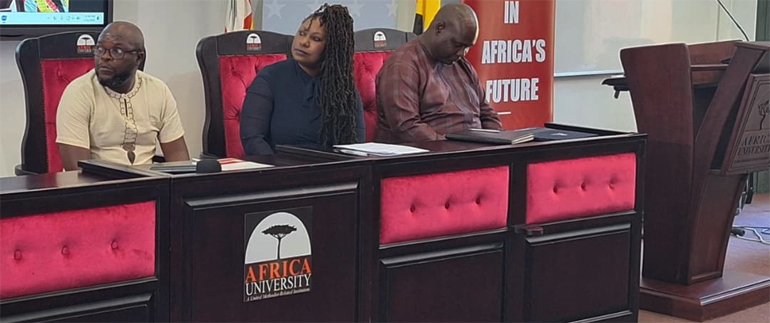
This was said by Africa University Vice‑Chancellor, Professor Reverend Peter Mageto in a speech read on his behalf by the university’s registrar, Dr Pedzisai Mangezo, during the Black History Month commemorations hosted by the Professor Rukudzo Murapa Institute of Peace, Leadership and Governance on Wednesday.
Professor Mageto said black people and history still struggle to command equal recognition, respect and value in the global order, despite the abolition of slavery and political independence.
Professor Mangeto added that the commemorations provide the world with an opportunity to confront and address the uncomfortable truths that continue to hold back black people’s progress.
“Black History Month is a ceremonial observance. It is a profound intellectual and moral undertaking. It is about recovering memory, restoring dignity and reclaiming agency. It is about correcting historical distortions and confronting uncomfortable truths. It is about ensuring that the struggles, sacrifices and contributions of black people across the globe are neither forgotten nor diminished.
“A century of Black History commemorations tells a story of persistence against erasure. It tells of a people who refused to be written out of history, who insisted on narrating their own experiences and who transformed pain into power, exclusion into resistance and marginalisation into movements for justice.
For centuries, systems of domination were constructed to dehumanise black people, to delegitimise African knowledge systems and to disconnect black communities from their roots. The consequences of this historical injustice are still with us today in global inequalities, in racialised structures of power and in persistent narratives that undervalue Black history,” said Professor Mangeto.
Counselor for Public Affairs at the United States Embassy, Mrs Melinda Crowley said that black people across the world should be involved in economic activities and at the forefront of the digital revolution, not merely as consumers but as core‑creators.
“As we commemorate the centennial of Black History Month, it speaks directly to today’s challenges. Economic empowerment remains central to democratic participation. Black entrepreneurs in America have reached historic heights, yet gaps in access to capital and markets persist – challenges mirrored across Africa. Today’s challenge is ensuring that the next generation of black entrepreneurs, whether in Atlanta, Accra or Mutare, has access to the capital and mentorship they need to succeed. Technology and digital equity present both opportunity and risk. Black communities in America and across Africa face a digital divide in access to technology, digital literacy and representation in the tech sector. As we stand at the threshold of an AI revolution, we must ask: who will shape this future? Will black voices be reflected in the algorithms that increasingly govern our lives? Will African nations be consumers of technology or co‑creators? History teaches us that technological revolutions have lasting consequences. The United States and Africa must work together to ensure that the digital future is equitable and accessible to all,” she said.
Director of the Professor Rukudzo Murapa Institute of Peace, Leadership and Governance, Dr Alexander Rusero said Africa must reflect deeply on its historical struggles to inform its governance trajectory, leadership ethos and institutional frameworks.
“A century of Black history commemorations represents more than the passage of time. It reflects a sustained struggle for recognition, dignity and justice. Black history has been a site of contestation, where narratives have been suppressed, distorted and reclaimed. At the same time, Africa University institutional theme challenges us to draw lessons from Black American experience, particularly in relation to struggle for civil rights, justice and democratic accountability. The struggle underscores a critical point – democracy without accountability is hollow and leadership without ethical grounding is unstainable,” he said.
Black History Month: Confronting uncomfortable truths