admin
admin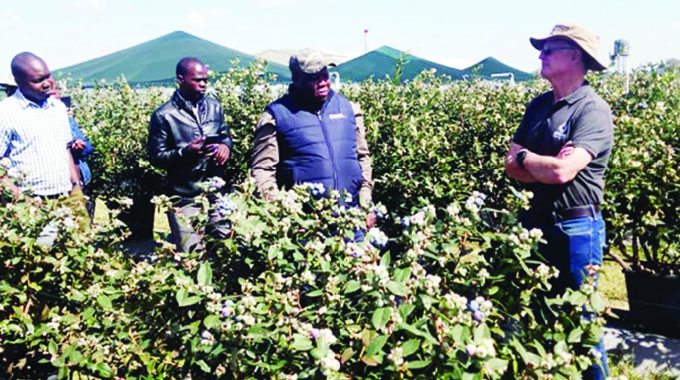
Edgar Vhera
Agriculture Specialist Writer
WITH the fruits of Government’s Horticulture Recovery Growth Plan (HRGP) and other support programmes beginning to show, the berries sub-sector has recorded a phenomenal growth in export earnings from US$1 million in 2018 to US$14 million in 2022, marking a progression of 810 percent as the entire horticulture sector’s resurgence continues.
The sector is composed of flowers, vegetables, berries, citrus, nuts, avocados, deciduous and other fruit, cuttings and plants, spices and herbs as well as tea and coffee.
The berries product group classification consists of cranberries, bilberries and other fruits of the genus vaccinim, strawberries, raspberries and blackberries as well as other dried fruits.
Bilberries or blueberries are a primarily Eurasian species of low-growing shrubs in the genus vaccinium, bearing edible, dark blue berries.
Stakeholders in the industry say blueberries are the main contributor of the increased berries export volumes.
Statistics from Zimbabwe National Statistics Agency (ZimStats) show that value export earnings from the berries’ sub-sector grew 810 percent from US$1 285 686 in 2018 to US$11 704 732 in 2022.
In volume terms it rose 769 percent from 527 134 kilogrammes in 2018 to 4 582 185 kilogrammes in 2022.
Within the horticulture group classification, the berries sector’s export earnings jumped from being on number eight out of 11 in 2019 to second spot by end of 2022 — a position they still hold.
Total export earnings from the horticultural sector grew 14 percent from US$72 million in 2020 to US$82 million in 2022, a figure below the berries sub-sector growth.
The berries export volume has once again surged 40 percent from 2 305 688 kilogrammes in the period January to August 2022 to this year’s 3 225 674 during this last quarter of 2023.
In its quarterly seasonal update of September 2023, the country’s horticulture promotion body, the Horticultural Development Council (HDC) indicated that the sector had remained resilient in the face of high production cost pressures and the impact of the uncertain global economic environment on export markets.
“New and exciting growth opportunities in sectors such as citrus, berries and avocados are emerging. Zimbabwe is capable of exploiting these opportunities but only through positive policy changes to encourage increased investment into production. Blueberry output is expected to reach 7 000 tonnes from an area of over 570 hectares up against last year’s 3 500 tonnes under 500 hectares,” the report said.
The report said there were no significant new blueberry plantings in 2023, as growers recovered from a tough 2022. However, an additional 100 hectares is anticipated next year.
“If market access to China and India are secured, an expansion to 1 500 hectares will result in increased production of 30 000 tonnes, but this will depend on an improvement in the policy environment. Progress in completing the protocols for market access to China and India is slow and Government intervention is required. Unless policy issues are resolved, this promising industry risks stagnation and Zimbabwe will miss out on a strong opportunity to position itself as a leader on the global stage,” added the report.
The report said growth remained limited due to a lack of long-term financing and where finance is available, interest rates are too high and tenure is too short.
The blueberry marketing season runs between April and October with 60 percent of the product harvested between August and October.
Zimbabwe’s unique selling proposition (USP) in the blueberry industry was quality, taste and production time. The country’s blueberry reaches the market in winter before its arch-rival Peru floods the market with its product.
Recent reports from horticulture news website, FreshPlaza.com said the blueberry market was hot, with high prices in China due to lower and delayed volumes coming from the world leaders in the exports of this fruit, namely Peru.
“Agrovision are the biggest exporters of blueberries to China from Peru. We produce, pack and export our own fruit. We also have farms in other countries of Mexico, Morocco and the USA (Oregon). We have shipped 1 600 containers last season, this 2023 season the volumes will be a little bit lower due to the weather conditions in Peru, but we will be pushing the sales, that is our job here in China,” said Yanitza Curonisy, business manager of China operations for the Peruvian grower and exporter Agrovision.
China is Peru’s third biggest blueberry export market absorbing 13 percent of total exports of about 37 000 tonnes in the 2022/23 season and on average pays more per kilogramme than other large markets of the US and Europe.
In another report from FreshPlaza.com titled “Blueberries seeing triple the pricing of 2022” it is said that the free on board (FOB) pricing on imported blueberries was approximately triple what it was in 2022.
“It has been US$58 to US$$60 FOB, so pricing has been very high and I see it holding for the foreseeable future,” said Ricky Armata of C and J Brothers.
He said the spike in pricing was due to an inventory of blueberries from Peru that has been very scarce.
“There is only a very little bit coming out of there. I can’t say if it’s El Nino for sure though the growers in Peru did say that the weather was having a major impact on early production. It has been like this for at least a month or so and they are saying that this will stay like this until December to January,” Armata continued.
What triggered the 810 percent berries subsector growth?
The National Development Strategy (NDS) 1 (2021-2025), which is being operationalised has among others the following key strategies to restructure and re-invigorate the horticulture sector through developing a unique competitive brand for Zimbabwe’s horticultural products, promoting the export of value-added horticulture products, reduce post-harvest losses and raise export earnings, diversifying and scaling up production of blueberries, raspberry and macadamia nuts and improving ease of doing business.
Government’s fiscal and monetary measures
The Government classified the horticulture sector as a low hanging fruit capable of turning around the country’s fortunes in terms of increased foreign currency earnings, employment creation and economic development in a short period of time.
At the inaugural horticulture investment forum in November 2021, the Reserve Bank of Zimbabwe (RBZ) governor Dr John Mangudya said the horticulture sector was one of the low hanging fruits with the capacity to turn around the country’s economy in less than three years.
“The horticulture sector is labour-intensive, as it instigates activities like sorting, grading, and packaging. Horticultural revolution is pro-poor as it generates additional employment opportunities in rural areas where labour is abundant, which is critical for achieving widespread and equitable growth,” said Dr Mangudya.
Dr Mangudya said the RBZ supported horticultural production through provision of foreign currency through the auction system for importing of key raw materials and equipment, arranging facilities that include letters of credit (LC) to finance essential imports such as fuel, equipment, chemicals and herbicides among others.
Ministry of Finance and Investment Promotion last year launched the US$30 million horticulture export revolving fund (HERF) that was meant to capacitate horticulture export growth.
Minister Mthuli Ncube said the HERF had the potential to close the funding gap and spearhead increased productivity.
“It will finance bankable projects with a focus on value addition to restore Zimbabwe’s position, as one of the leading horticultural exporting countries in the region,” said Professor Ncube.
The Government has put among other things the following incentives that exporters are benefiting from — suspension of duty on agriculture capital equipment (SI 6 of 2016), anchor farmer incentive, value added tax zero rating of farm inputs.
Rebate of duty is also granted on materials used in the preparation and packaging of fresh produce for export [Section 132 of the Customs and Excise (General) Regulations].
Joint Venture system
Former Lands, Agriculture, Fisheries, Water and Rural Development permanent secretary Dr John Basera said Government had initiated the joint venture (JV) system for increased production then.
“The Government has instituted a good policy environment and is promoting access to land through issuance and allocation of land to investors to be, with the smartest option being the JV framework as promulgated in 2019 and operationalised in 2020. Almost 2 000 JVs have been approved on about 200 000ha with interest being on the protection of investment, investors and land holders,” Dr Basera said in 2022.
Blueberry Joint Venture success story
A beneficiary of the JV arrangement who is into the blueberry exporting business, Drip tech founder and managing director Mr Robert Bob Henson of Palmlife chronicled his success story at Ivanhoe farm in Goromonzi last year.
“We started the project in 2020 as a Greenfield investment under 10 hectares. We added another 20ha to close the year on 30ha. Fifteen hectares were developed in 2021 and another 15ha in 2022 to bring the total area under blueberry to 60ha. As blueberry is a super food, the success of our venture was the establishment of an off-taker arrangement with a well-known blueberry buyer in South Africa riding on the fact that Zimbabwean berries are the best berries in the world,” said Mr Henson.
Mr Henson attributed the success of the project to incentives such as the joint venture agreements, incremental incentives and duty-free imports of capital agriculture equipment offered to investors.
To emphasize the profitability and labour intensity of blueberry, Mr Henson said: “By planting 45ha of blueberry we are able to achieve income greater than that from 4 000ha of irrigated tobacco and employing about 100 times more new labour.”
He said the farm’s operations were benefitting from labour provided by Juru growth point and surrounding areas with plans afoot to increase the area to 200ha in areas where there is adequate manpower.
“We export 75 percent of our blueberries via the cheap sea route while 25 percent is air bound to maximise on earnings and take advantage of the window period when prices are high,” said Mr Henson.
Zimbabwe Berry Growers Association vice chairman Mr Stuart Torr last year said blueberry cultivation was the major cause of the increased export earnings from the berries sector.
“Yields from blueberry plants increase as they mature from year one, doubling the output in year two, reaching their optimal in year three and maintaining that yield from year four subject to good management. As new varieties and market demands change, the current crop of established plants may be removed before they reach 10 years of age,” said Mr Torr.


 Online Reporter