Online Reporter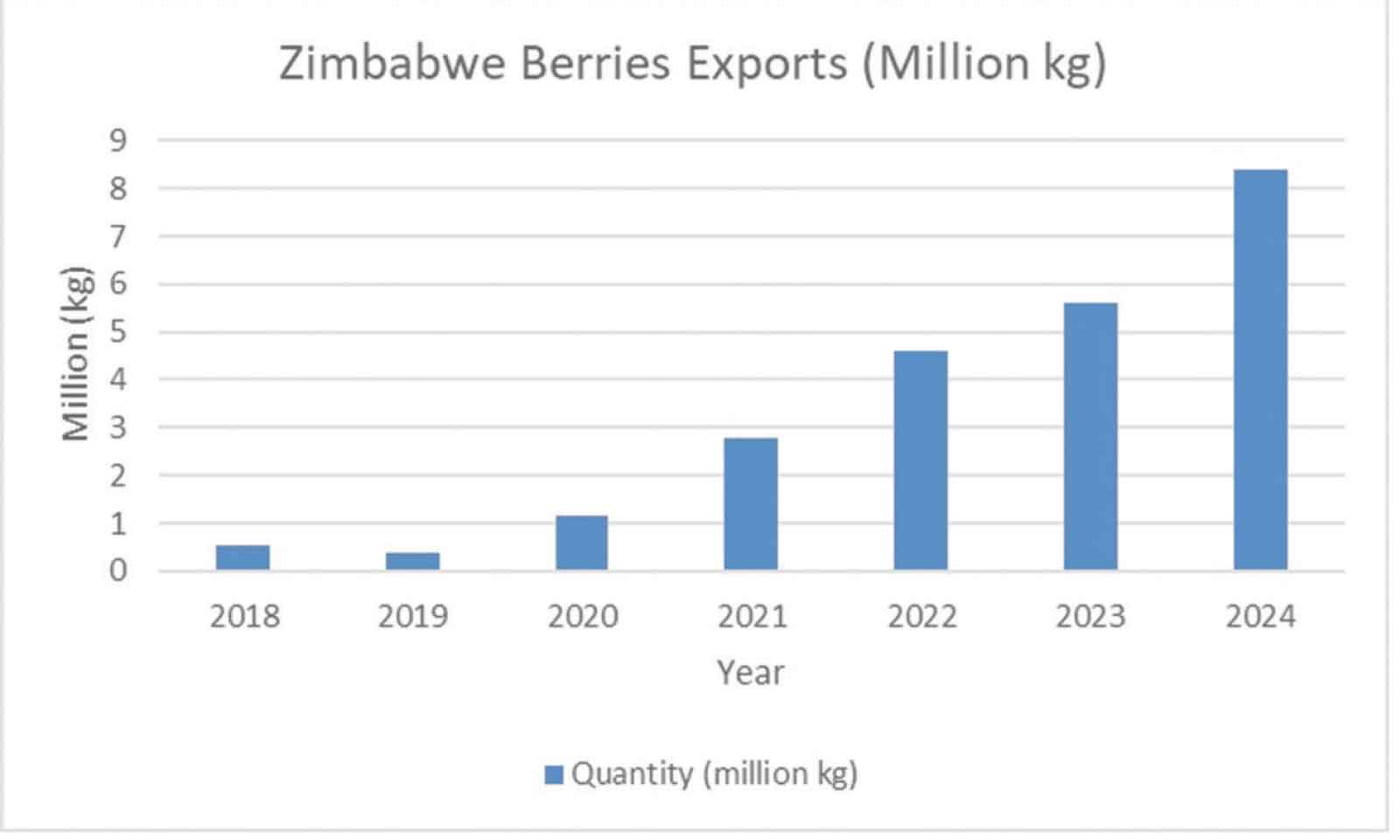
Edgar Vhera
Specialist Writer – Agribusiness
BLUEBERRY, a globally acclaimed superfood, has anchored the resurgence of Zimbabwe’s horticulture sector whose exports surged 74 percent from US$101 million in 2016 to US$176 million in 2024.
Zimbabwe boasts the fastest growing berry sector in the world, fuelled by a demand for the product in the United Kingdom and European markets.
Locally, blueberries are the fastest-growing export crop since 2018 and are well-known for precision farming in frost-free zones.
Riding on the basis of Agriculture Food System and Rural Transformation Strategy 1 (AFSRTS 1), National Agriculture Policy Framework (NAPF) and Horticulture Recovery and Growth Plan (HRGP), the sector now aims to grow into a US$2,5 billion one by 2030.
Government has been spearheading horticulture growth with the signing of citrus, avocado and the recent blueberry trade protocol with the most lucrative Chinese market.
The country’s new agriculture roadmap, the Agriculture Food Systems and Rural Transformation Strategy 2: 2026-30 (AFSRTS 2), which replaces AFSRTS 1 which ends this year said Zimbabwe’s horticulture sector had undergone a resurgence since 2017, transforming from a low performing industry into a dynamic growth engine.
“From a 1999 peak of US$140 million to a US$20 million low, the sector has rebooted to over US$120 million annual exports from 2023.
“This rebound has been fuelled by policy support, investments in high value crops such as blueberries and avocados, export market diversification and resuscitation of conventional horticulture development and better sector coordination,” read AFSRTS 2.
AFSRTS 2 disclosed that under rural development 8.0 initiatives, further growth of the domestic and export horticulture is anticipated.
“From experimental plantings of blueberry in 2008 and first commercial exports in 2017, production skyrocketed from US$1 million in 2018 to US$50 million by 2024, with volumes surging by 351 percent since 2020,” continued AFSRTS 2.
National Trade Development and Promotion Organisation of Zimbabwe (ZimTrade) director operations, Mr Similo Nkala said horticulture exports were increasing with blueberry playing a part in this growth. He was representing his chief executive officer Mr Allan Majuru at the 13th edition of the Annual National Agribusiness Conference (ANAC) at this year’s Zimbabwe Agriculture Show. Mr Majuru said demand for the country’s most sought-after horticultural products was growing on the global market due to the country’s conducive environment, production practices and climate.
“Zimbabwe’s blueberries are on high demand in the whole world due to their taste, production practices and time.
“According to mirror data from Trade Statistics for International Business Development (TradeMap), the country exported horticulture products worth US$176 million last year with berries accounting for US$58 million,” he said.
He called on the country to exploit trends in global markets such as e-grocery, QR codes, branded packs, ocean freight, cold chain reliability, alternative routes and risk management under logistics and resilience.
Statistics from ZimStats show that horticulture exports have been on a growth path since 2016.
Mr Majuru said contributions to horticulture exports from the berries sector have been increasing from US$14 million in 2020 to a pole position of US$58 million last year.
Zimbabwe celebrated the World Blueberry Day in style as it marches towards 2030 goal of 30 000 tonnes with an anticipated 50 percent growth from 8 000 tonnes last year to 12 000 this year.
Statistics from the Zimbabwe National Statistics Agency show that the country’s export volumes of berries rose by 1 493 percent from about half a million kg in 2018 to over eight million kg in 2024.
Horticultural Development Council chief executive officer, Mrs Linda Nielsen said World Blueberry Day was a moment to celebrate a super fruit that has become one of Zimbabwe’s most promising horticultural success stories.
“Over the past decade, blueberries have emerged as a high-value export crop, driven by rising global demand and the dedication of our skilled growers. This season, we expect to produce 12 000 tonnes of blueberries up from last year’s 8 000,” she said.
The HDC boss said while this was a commendable increase from last year, it was important to note that it was being driven largely by improved yields from existing fields rather than a major expansion in hectarage.
“This highlights the need to accelerate policies that encourage investment in new trees. Looking to 2030, we are cautiously optimistic, our vision is to expand production area to 1 500 hectares from the current 650 in order to reach up to 30 000 tonnes in annual production,” Mrs Nielsen said.
She added that achieving this depended on how quickly current barriers to investment and growth are overcome.
“Some of the challenges to be addressed relate to issues of a supportive exchange rate policy, including a review of retention thresholds so as to improve farmer viability.
“Investment in infrastructure, especially cold chain and logistics, would help our produce get to markets more efficiently,” Mrs Nielsen added.
Other cost drivers include utilities such as energy and water, which are negatively impacting viability.
Mrs Nielsen said proactive engagement with Government and relevant stakeholders was continuing on these and other matters affecting the industry.
Zimbabwe offers unique climatic conditions that give her berries a distinct advantage in size, flavour and texture. This makes them popular in many markets around the world. Blueberries are rich in antioxidants.
They are also low in calories and high in vitamins C and K, making them a key part of a healthy diet. Zimbabwe’s blueberry harvesting season runs from May to October.
“Our early-season window gives local growers a competitive edge, allowing them to enter global markets ahead of other producers. As harvesting reaches its peak, farmers must take proactive steps to manage frost risk, including investment in frost fans, irrigation systems, and monitoring,” urged Mrs Nielsen.
Currently, blueberries are being produced in several areas in the three Mashonaland provinces and Manicaland.
“Overall, Zimbabwe has very good climate conditions for high-quality berry production. The bulk of Zimbabwe’s produce is currently airfreighted with producers always looking at the most viable routes to market,” said Mrs Nielsen.
This growth is driven by rising global demand for healthy fruits and increased commercial farming and investment. The industry has been experiencing a compound annual growth rate of 34.3 percent over the period.
HDC board member and blueberry farmer, Mr Willard Zireva said Zimbabwe’s horticulture sector was capable of being a US$2,5 billion industry in value by 2030 if hectares under production rose from the current 90 000 to 145 000 hectares.
“Such a growth in production will create 586 650 new jobs and transform rural livelihoods across the nation. A total investment of US$795 million is required to expand production area by 62 percent (55 720ha), targeting high-value crops like blueberries (US$108 million), fresh produce (US$340 million), banana(US$90 million), macadamia (US$69 million) and citrus (US$48 million) among others,” he said.
Mr Zireva said the critical success path to achieving this 31-fold export growth required coordinated investment in infrastructure, technology adoption, value chain development and strategic market positioning of Zimbabwe’s premium horticultural products.
Investment in the fresh produce sector alone can create 400 000 jobs.
The horticulture sector is composed of flowers, vegetables, berries, citrus, nuts, avocados, deciduous and other fruit, cuttings and plants, spices and herbs as well as tea and coffee.
The berries classification consists of cranberry, mulberry, blueberry, strawberry and raspberry.