

 admin
admin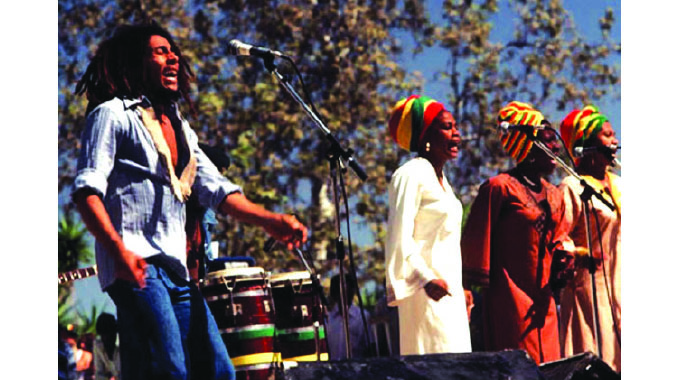
Just before midnight 43 years ago on April 18 at Rufaro Stadium in Harare (formerly Salisbury), Bob Marley – a musical spiritual and revolutionary hero of all time, stepped on to the stage with his band The Wailers to help precede Zimbabwe’s independence from British rule, prophetic and conscious songs lit up the atmosphere. Zimbabwe’s homecoming celebration after a 16 –year protracted armed struggle against colonialism, brought together thousands of people, guerillas and dignitaries from Africa and across the world. This was a historic and epic moment in the history of Zimbabwe. The unforgettable performance by Bob Marley – a sui generis of his time and global musical icon highlighted his fight against colonialism and injustice and his revolutionary and motivational message of resistance, love and humanity. Marley identified himself with the guerrilla struggle and the masses and on his 1979 album Survival largely seen as one of the most defiant and politically charged albums he included the songs Africa Unite and Zimbabwe. He compiled the track Zimbabwe in support of the guerrillas and masses fighting the rebel Ian Smith regime. He debuted the tracks at the Amandla concert which was held in Boston, US, to support the South African anti-apartheid struggle. In this report, Sifelani Tsiko (ST), a senior writer speaks to Dr Gibson Mandishona (GM), a renowned innovator, scientist, mathematician and musician about how he supported Bob Marley to compose the song ‘Zimbabwe,’ the influence of reggae on the revolutionary struggle and how Marley’s historic performance opened the doors of reggae music in Africa.
ST: Your love for music led you to an unexpected encounter with Bob Marley, a global musical super star in the late 1970s. Can you tell us more about this momentous occasion?
GM: Well that is a long story, Sifelani. In the 1970s I was working for the United Nations Economic Commission for Africa in Addis Ababa, Ethiopia. I was one of the consultants there and there were many Africans working there. At the time, it was a centre of excellence in terms of the distribution of academically talented Africans in various fields.
Apart from work, it was music, food and Pan African cultures that united us and led me, together with several colleagues who had a passion for music, to form a band The United Nations Jazz Band.
ST: Which year and month did you first meet Bob Marley?
GM: It was in February 1979. It was at that time that Bob Marley had come to visit Ethiopia to pay homage to the Rastafarian community that stayed in Shashamane a settlement on a piece of land that was donated by His Majesty Emperor Haile Selassie I to Rastafarians that had chosen to come back home to Africa. He was staying at the Hilton Hotel. While at the hotel, he asked people around about musicians in the city of Addis Ababa. Some of cause, mentioned some Ethiopian groups which were part of the usual discourse, but they also said at the United Nations we hear that there is Dr Mandishona, who leads a UN band which usually gets a good crowd.
ST: What was the name of the band? Do you still remember some of the prominent band members?
GM: There were only three Zimbabweans in that band, Dr Herbert Murerwa, former finance minister who used to play drums, the late Cephas Mangwana who used to play the double bass guitar and myself. Herbert Murerwa joined the band later after the two of us.
I was in Addis since 1975 when Mengistu Haile Mariam took power. I used to be a lecturer in London, specifically at the North London University where I taught mathematics and statistics.
I then discovered that the African continent needed my skills more than the UK, that is when I decided to go and work at UNECA in Addis Ababa. I was very happy that I found Cephas Mangwana, the only Zimbabwean I got to interact with at the time.
ST: What was Cephas Mangwana doing there?
GM: He was in the economic department at UNECA. You see, the UN Economic Commission for Africa was like a university with different departments. It attracted all kinds of professionals from all over Africa.
ST: So did you get a call from Bob Marley? Just how did he contact you?
GM: When he was at the hotel he asked if there were local bands that he could collaborate with and learn more about music in Africa. Since I was made the leader of the UN band after collaborating with other Africans, I got colleagues who could play different instruments.
I was multi-talented, I could do three things, play the piano, sing and play the guitar. It was a pan African band and we could play sounds from different countries. For example, we could play sounds from Sierra Leone, South Africa, Zimbabwe and many other African countries.
So when Bob Marley came he was trying to assess what musical activity was taking place in Addis Ababa. When people told him that there was a UN band made up of Africans from various parts of the continent led by Dr Mandishona, he asked: “Who is Dr Mandishona? He was told about me and the band. He then picked up the phone and called me. He said: “I hear that you are a Zimbabwean leading the UN band and you like music a lot. Let us have a chat.” So, I drove to the Hilton Hotel.

Bob Marley and The Wailers on stage.
ST: How did you feel about this life-time opportunity?
GM: I was very excited, I felt very elated because we used to hold Bob Marley in high esteem. His music was at the top of our charts at the time. So I went to meet with him. We had a chat. He was very sober. He asked me if I had been to Jamaica and I told him that I had never been there.
He then invited me and said it was a beautiful country to be in. Then I said when the time comes I will let you know. Then he went further to say: “I have been thinking that Zimbabwe will become independent very soon. I can feel it. So I have been rehearsing this tune – (Zimbabwe). I asked him, how does it sound?
It was typically a reggae tune and told him that we can modify it to have some Zimbabwean sound to it so that Zimbabwean people can relate or dance to it. This is where my contribution came in. I contributed on the drum side rhythmically and added a bit of Jerusalem there.
So that was the origin and the basis of my interaction with Bob Marley. In the end I was not very conversant with playing reggae music on the guitar so he showed me that there were a few chords, four basic one which I mastered by ear. For me, I play from the ear although I tried to learn music, but at a very late stage. I bought musical books for six-year-olds when I was over 70 years old (laughs).
ST: So which particular track did you share your conversation with Bob Marley?
GM: The Zimbabwe tune by that time did not have the full lyrics. Yes, I gave him a few words which he put in the lyrics to polish up the Zimbabwe track which he later released on his 1979 Survival album. So this was my modest contribution to this track which is still a global anthem and loved by many people across the world. He was very interested in my musical work although I was not a reggae brought up musician. I was not much into reggae music, but being an artiste and under the mentorship of the legend himself I found myself throwing in my ideas so as to add the African sound to the song. So while we were practicing the song I would add my ideas both in the instrumentation and lyrical bit of the song until it was complete. He asked me to join him on a tour the rest of Africa but I told him it was not possible because I had a permanent job. I had my family here in as much as I was going to be excited to tour with him. So I could not travel with him.
ST: So how did you feel about your contribution to the song Zimbabwe?
GM: Well, my feeling was that it was a contribution to his song and that was the end of it. I never knew that this particular tune would be sung at Zimbabwe’s independence. It was never meant for that, I thought.
ST: When you met him did you in any way feel or anticipate that Zimbabwe would be independent in 1980?
GM: Yes, that is why I had the zeal and courage to participate in the struggle for Zimbabwe. I just felt this guy (Bob Marley) was actually getting into prophetic mode, when he told me that Zimbabwe was going to be independent soon. He showed a very serious face which astounded me and I felt as if Zimbabwe was going to be independent tomorrow not knowing it was going to be the next year.
Full interview on www.herald.co.zw
ST: After that what happened?
GM: We parted ways. I never met Bob Marley again. I thought I was going to hear the tune on tape or vinyl. I never thought that this song would be sung by him on the eve of our independence at Rufaro Stadium in 1980.
I never knew that this track would go on to become a world anthem. It was quite unbelievable, yes!
ST: When Bob Marley and the Wailers came to perform in Zimbabwe to mark the birth of a new nation after a 16-year brutal warfare and to celebrate the victory of the revolutionary forces of the Zimbabwean people over brutal white colonial rule, were you back?
GM: No, I only came after independence.
ST: How did you feel about his performance at independence day in Zimbabwe?
GM: I felt elated. I was so excited about his performance. After he died, I enjoyed good relations with his wife and she could send me Christmas cards. Unfortunately, the trend died with time, but we used to communicate. She had good memories and I think Bob Marley told her that I met a good Zimbabwean musician, who could play reggae and who could imitate it.
Of course, I could not match his excellent musical talents as I had not taken music seriously as I mentioned to you earlier on. I started playing guitar when I was 13 or 14 years old in Mbare. My mother used to worry a lot about me because women in the neighbourhood used to tell her that I was going to be a tsotsi (thief). They would tell her that I was going to play guitars in the streets and get money then go to South Africa and she would not see me again. So that used to worry my mother a lot.
ST: So when you heard about Bob Marley’s performance on independence day in 1980 what were your thoughts and how did you feel about this?
GM: Each time I heard the tune I used to be over excited and I could recall the time we used to rehearse the tune in Addis Ababa.
ST: What do you have to say when you think about Bob Marley, Zimbabwe and Africa?
GM: Bob Marley was an artistic statesman who wanted to see Africa free and get its freedom, through his musical messages. He was emotional about Zimbabwe’s struggle for independence. He wanted our country to be free and independent. He wanted any other country which was still in bondage to be free and independent too. He was very emotional about that. Apart from that he was a very likeable person, as a teacher he used to show me codes to play on my guitar for the tune and he used to do it patiently with a smile and you could see that he was a very good teacher. After that session he just shook my hand and said Zimbabwe will be independent soon!



 Online Reporter