admin
admin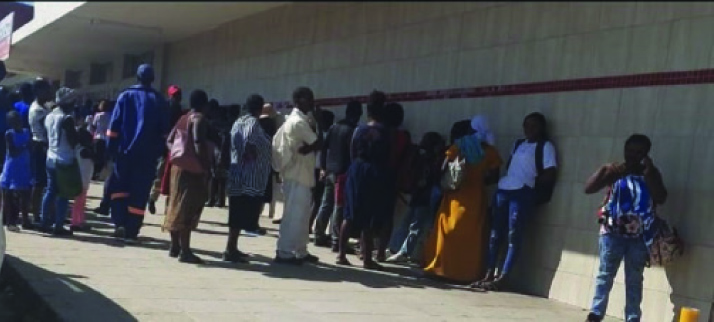
Ray Bande
Senior Reporter
IT appears consumers in Zimbabwe now have a full understanding of the old concept that money is a terrible master, but an excellent servant, if the long and winding queues witnessed in stationery retailers, is anything to go by.
Indeed, it is no longer the money in their wallets that is some sort of a master pushing them to spend, but rather the push factor in spending trends is now the knowledge of what and how to use the servant called money.
For once, the spending trends during the festive season have shown that unlike in the past that many now have money in their head, but not in their heart.
A cursory check by this newspaper just before and after Christmas Day in Mutare Central Business District revealed that there were long winding queues in most bookshop and stationery retail outlets compared to those witnessed in some grocery retail shops.
Renowned stationery retail outlet, Mutare Computers shop located in downtown Mutare, widely popular for relatively cheaper items had long queues that are normally witnessed a few days before schools reopen.
Consumer Council of Zimbabwe (CCZ)’s Manicaland provincial consumer protection officer, Mr Barnabas Masamvu conceded that this is a new narrative in the country’s consumerism trends.
“I think that is a positive move where parents are putting more value on their children’s education rather than merry making. It is a new narrative. Parents usually make last minute rush to get stationery for their children. High flow of consumers at book shops two, three to four days before the beginning of a new term is what we had been accustomed to,” said Mr Masamvu.
Zimbabwe National Consumer Protection Commission chairman, Dr Mthokozisi Nkosi weighed in saying: “This is a welcome development. It is a sign that we are gradually moving towards an enlightened, wiser and forward looking consumer.
“In recent years, irresponsible and impulse buying behaviour associated with the festive season has had devastating effects on most families with respect to January obligations such as rentals, school fees, uniforms, books and others.
“Experience is the best teacher. Consumers have realised that there is life after the festivities. The year-after-year ‘January Disease’ pain is unbearable. Hence, we witnessed the majority of consumers spending wisely. This is a departure from the past.
“They are buying essentials and more importantly paying the New Year expenses such as school related expenses in advance. As the Consumer Protection Commission, we continue to encourage our consumers to spend wisely.”
Dr Nkosi urged consumers to make full use of their rights to choices and bargaining power.
“They must shop around, bargain and exercise their rights. They must voice concern each time they feel ill-treated. This is not only good for them, but it helps business to innovate, attract more customers, have a competitive edge and assist in the general development of the country as the country moves towards the attainment of the 2030 vision.
“As from next year, the Commission will intensify its education and awareness campaigns on consumer rights, vigilance on deceptive and unconscionable business practices and associated prohibited conduct by service providers,” he said.
The need to ensure that children will get back to school in January with less financial headaches has seen many parents ignoring the usual shopping sprees in supermarkets and opting to secure stationary for learners.
Since time immemorial, some wants, like festive season goodies, felt like needs, the very way of thinking that left middle and low income earners spending recklessly during the festive season.
Such warped consumerism trends have left the poor getting poorer.
No wonder rich people have small television sets and big libraries, and poor people have small or no libraries at all, but with big television sets!
However, the enlightened in communities in recent years have long taught us that, to the wise, end of year means experience, learning, restarting, refocusing and the beginning of a new dawn.
But to the unwise it means over drinking, overspending and over speeding time.
The Manica Post caught up with some parents and guardians who were buying stationery for their children.
Mr Paul Sigauke of Chikanga said: “If one does not have, they don’t have. Let us not get ourselves into unnecessary debts, but rather be focussed, fully knowing our time will surely come.
“For now, it is wiser to focus on that which is important and that is to ensure that we make life comfortable for our children when back to school comes.”
Mr Stephen Checha of Zimta Park said: “I would rather sacrifice the joys of one or two-day event for long term comfort when schools eventually reopen. It is of no use for me to overspend in these two days and later regret when children ask for the obvious things they need at school.”
For some reason, folks now really understand that Christmas is simply 24 hours that will tick on the clock and it is hardly a day to please anyone.
After all, the festive season will pass, but reality of back to school will soon come!


 Online Reporter