Online Reporter
Robin Muchetu in Osaka, Japan
ZIMBABWE’S health sector is set for a major boost in skills transfer and education following Japan’s invitation for Zimbabwean students and professionals to pursue advanced medical training, particularly in the field of regenerative medicine.
The development was announced during Vice-President Kembo Mohadi’s tour of the Nakashima Qross Medical Complex and the Osaka Metropolitan University Hospital yesterday.
The Nakashima Qross, a pioneering facility specialising in regenerative medicine, is recognised as a global hub for innovative medical research and practice.
VP Mohadi said the exposure and scholarships being extended to Zimbabwean students would significantly transform the country’s healthcare system.
At Osaka Metropolitan University, Japan’s largest public university, he proposed collaborations to facilitate the training of Zimbabwean health professionals using the latest technologies.
“There are opportunities for us to partner or send our students here, either through scholarships or, ideally, through Presidential scholarships granted by Japan. Our focus is on postgraduate students, not undergraduates,” said VP Mohadi.
“We aim to twin this university hospital with one of our major hospitals such as Parirenyatwa or Mpilo, facilitating exchange programmes. Zimbabwean students will come here to learn and then return to apply their knowledge in our healthcare system, thereby strengthening our health services.”
VP Mohadi further indicated that discussions are ongoing with Zimbabwean experts in Osaka, who will advise on feasible study areas for Zimbabwean learners.
Speaking through an interpreter, Osaka Metropolitan University Hospital’s deputy director, Dr Toshiyuki Sumi, welcomed Zimbabwean students and expressed Japan’s openness to hosting them.
“We are very pleased to have Zimbabwean students, whether undergraduate or postgraduate. Feel free to contact our administration for arrangements,” he said.
Vice-President Mohadi expressed gratitude to Japan for its willingness to train Zimbabwean students.
“We appreciate that you are even prepared to take undergraduates and support them from the beginning to graduation. We will consider this when we return home,” he said.
Meanwhile, Zimbabwean students already in Osaka shared their aspirations to contribute back home.
Mr Zichito Jomane, a graduate student in Geosciences at the university’s Graduate School of Science, shared his aspirations.
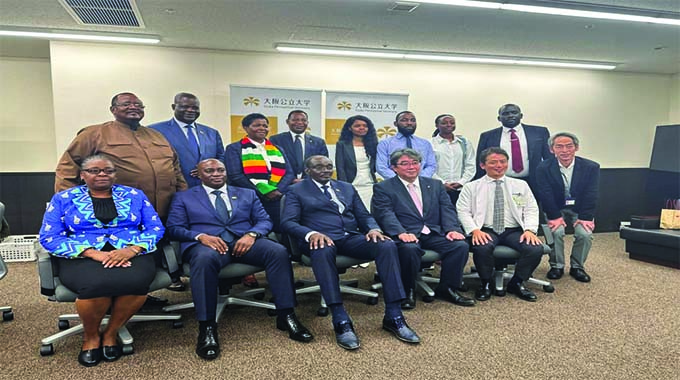
“I am pursuing my Master’s degree in Geosciences, a field that involves GIS and location-based technologies. The skills I am acquiring are highly advanced and I am planning to contribute to our institutions back home through teaching and knowledge transfer,” he said.
Another Zimbabwean researcher, Dr Ashley Pencil, a post-doctoral fellow, stressed the importance of lifestyle interventions in tackling non-communicable diseases (NCDs).
“Zimbabwe faces high rates of hypertension and diabetes. My research focuses on nutrition and Japan’s high longevity and health standards. We can learn from their diet and health practices to reduce NCDs back home,” she said.
Vice-President Mohadi said Zimbabwe stands to benefit from collaborations centred on future medicine, which is an evolving field expected to provide healthcare solutions.
“It’s essential that we engage with more advanced nations. Japan is ahead in regenerative medicine, which is still in its infancy in Zimbabwe. Exchange programmes will enable our people to acquire vital knowledge and return home to improve our healthcare systems,” he said.
Future medicine refers to innovations poised to define the next era of healthcare, emphasising adaptability to technological and environmental changes. Regenerative medicine, a subset of this field, aims to repair or replace damaged tissues and organs caused by age, disease, trauma or congenital conditions.
Unlike traditional treatments that focus solely on alleviating symptoms, regenerative approaches utilise tissue engineering, cellular therapies, medical devices and artificial organs.
These multidisciplinary efforts bring together experts from biology, chemistry, engineering, genetics, robotics and medicine, striving to solve some of medicine’s most daunting challenges.
The Nakashima Qross is at the forefront of translating these innovations into practical healthcare solutions, demonstrating Japan’s commitment to global health advancement.