Online Reporter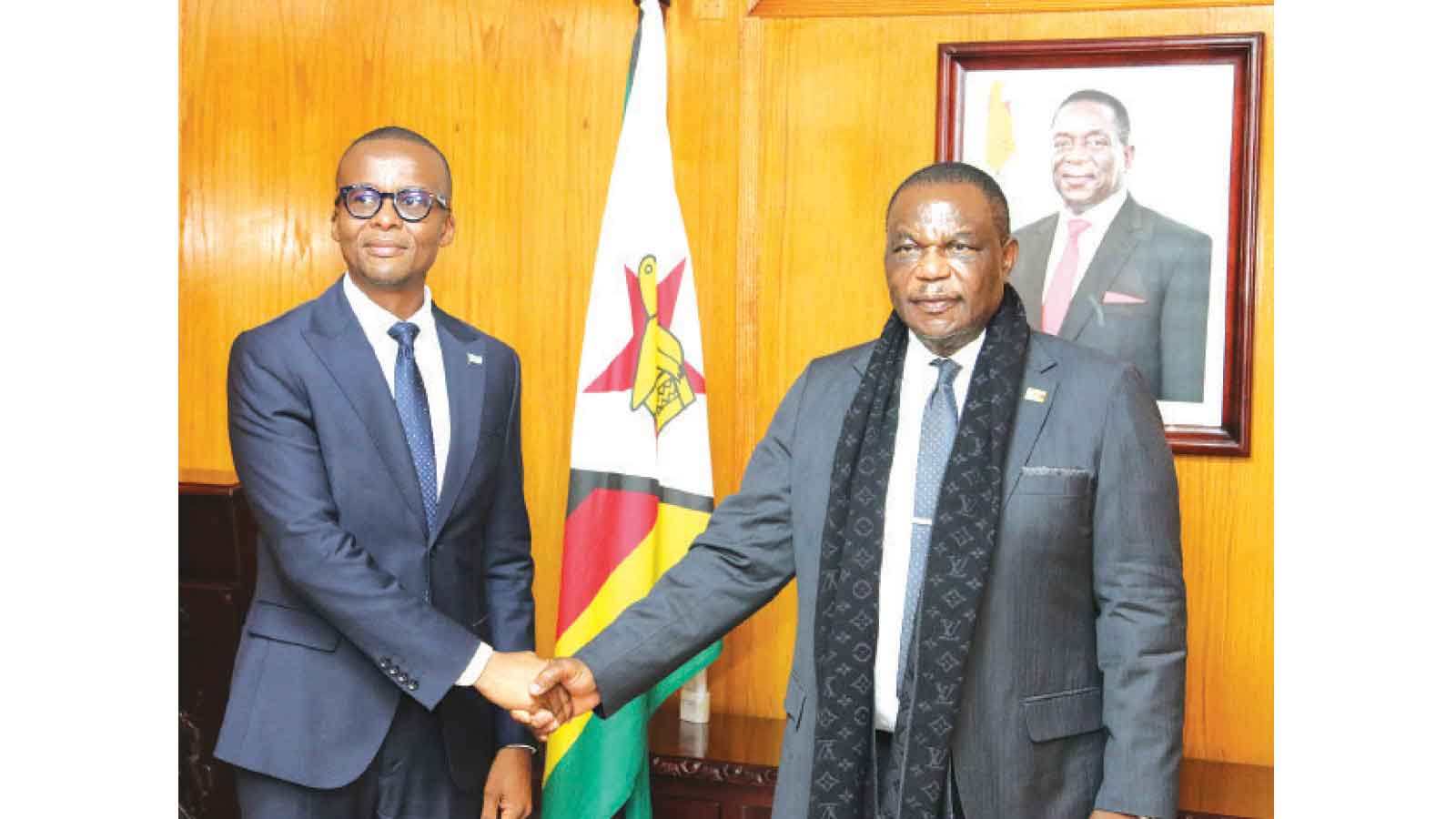
Mukudzei Chingwere-Senior Reporter
BOTSWANA has reached out for an enhanced economic partnership with Zimbabwe at a time when the Tswana nation is undergoing a seismic economic shift away from an over-reliance on diamonds towards new growth pillars, including ranching and value-added industrial capacity.
Botswana Vice President Ndaba Gaolathe is in the country and yesterday paid a courtesy call on Vice President Dr Constantino Chiwenga, where he outlined Botswana’s focus on execution-led transformation, increased cross-border business linkages and joint investment opportunities.
Economic diversification sits at the heart of VP Gaolathe’s message. He said Botswana had long discussed broadening its economy, but recent pressures in the diamond market had forced the country to accelerate reforms from policy discussions to measurable implementation.
He said the transformation programme is designed to build execution capacity at scale, enabling Botswana to translate available opportunities into investable projects, particularly in sectors such as solar energy and technology, while creating space for regional firms to participate.
Zimbabwe can benefit from Botswana’s progress in strengthening cattle ranching and related value chains by adopting proven production, animal health and market-linkage models to improve volumes, quality and profitability in the meat and leather industries.
The country can also draw lessons from Botswana’s investment in vaccine production capacity, using that example to accelerate Zimbabwe’s own manufacturing capability and build a more reliable regional supply of veterinary products.
This has helped Botswana cushion its economy against volatility linked to diamonds while creating a platform for downstream value chains such as meat processing and related services.
“It was a great privilege to be here. We in Botswana believe that Botswana and Zimbabwe are one people; we share a common history and a common destiny,” said VP Gaolathe.
“Both countries are endowed with immense natural and human resources, and the onus is on us as leaders, and on the people of the two countries, to collectively co-create, co-invest and bring out the best.
“We have long admired what Zimbabwe has been able to achieve in building a renowned, high-quality education system. Many may not know that Zimbabwe has also succeeded in creating a manufacturing base that many other countries, particularly African countries, aspire to build.
“Zimbabwe has also nurtured successful entrepreneurs, including those in telecommunications and financial services. This creates a platform and opportunities for Zimbabwe and Botswana to co-create and leverage the base that Zimbabwe has established,” said VP Gaolathe.
He said that, on Botswana’s side, the country had built the Botswana Vaccine Institute, which is a global leader in the manufacture of vaccines for foot-and-mouth disease, anthrax and contagious bovine abortion.
VP Gaolathe said this provides a foundation for vaccine manufacturing not only for Botswana, but for the region as a whole.
“Botswana has for many years spoken about diversifying the economy, but it has remained just that — a conversation,” he said. “But now, with the declining diamond market and the challenges affecting the diamond sector, we can no longer rely on conversation alone. Through what we call the Botswana Economic Transformation Programme, we are moving from conversation to execution.
“This programme is about building execution capacity at scale to harness the opportunities available to Botswana, whether in solar energy, technology or many other areas.
“There is opportunity, and Zimbabwean companies are looking to co-invest with Botswana,” said VP Gaolathe.
Turning to bilateral mechanisms, VP Gaolathe said the Bi-National framework between the two countries contains multiple components aimed at improving trade efficiency and removing obstacles that hinder commerce.
He said this is critical not only for bilateral trade flows, but also for investment decisions, as border delays and administrative bottlenecks can increase operating costs and reduce the attractiveness of joint projects.
“The Bi-National framework has many components. One of these is to remove the man-made barriers that exist between the two countries, including more efficient and enhanced one-stop border facilities and processes,” said VP Gaolathe.
“The bottom line is that what we must do — not only between Botswana and Zimbabwe, but among African countries in general — is spend more time engaging with one another.
“The more time we spend with each other, the more opportunities we will be able to realise.”