Andrew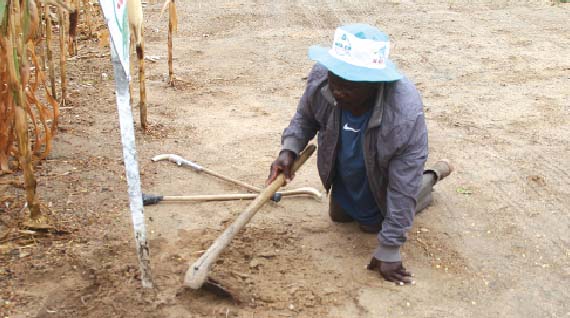
Tanyaradzwa Rusike
THE human spirit is naturally inclined to overcome adversity and persevere in the face of hardship, two distinctive traits that no physical disability can take away.
Pascal Dzoro’s life story is a wholesome demonstration of the dictum disability is not inability.
As a toddler, he was diagnosed with tuberculosis of the spine.
Spinal Tuberculosis is a condition that causes gradual bone destruction, leading to vertebral collapse and hunchback (kyphosis), or an abnormally curved spine.
Progressively, Dzoro legs’ functionality deteriorated to the point of becoming immobile.
In spite of his paralysis, the 62-year-old Masvingo man has defied the odds, conquering his disability while making a name for himself as a successful farmer in Mushangashe, a farming community in the province.
He is among the more than one million people living with disability in Zimbabwe, but he has refused to be enslaved by his condition.
While many people of his age who are living with disability have either retired or are living off handouts, Dzoro has chosen the path of honest, hard work to fend for his family.
“I was born like every normal child; every part of my body was functioning properly,” he told The Sunday Mail recently.
“This condition developed when I was a toddler. I was diagnosed with TB of the spine, which affected my lower body.
“In the end, I couldn’t walk again.”
His passion to work the land, however, continued to grow in spite of his unfortunate physical condition.
“My father was a farmer and growing up, I always wanted to be like him.
“Achieving this dream, however, became a tall order because of my condition. But nothing was going to stop me because my hands were not disabled, too.”
He was always overwhelmed by the fervent urge to fulfil the moral duty of fending for his younger siblings and his mother, who is blind.
He is the second-born child in a family of seven.
“Being disabled physically is not being disabled mentally,” he said.
“If God gave you one hand, use that hand to do something and do not just wait for donations.
“As for me, I don’t wait for people to give me food, but because of my work, I am in a position to give others who are in need.”
Today, Dzoro runs an agriculture enterprise on a 117-hectare farm in Masvingo.
In the process, he is debunking age-old stereotypes about disabled people, which have perpetuated their exclusion from the lucrative agriculture sector.
While farming is naturally a labour-intensive undertaking, this has not deterred Dzoro from staking his claim.
Through sheer hard work and desire to succeed, he is chipping away the glass ceiling one harvest at a time, in the process proving that indeed disability does not mean inability.
“My farm is about 117 hectares, but I have not been able to use all of it because of the lack of resources.
“However, I appreciate the help I have been getting from Seed Co since 2017.
“They appreciated my work and told me they were going to support me,” he said.
“They drilled a borehole to make it easy for me to access of water given my condition, and I have also been receiving inputs.”
Dzoro, who is not married and has no children, said his family remains his biggest pillar of support.
“Being a fully-grown man who has no wife or children is not easy, but my siblings have always been there for me.
“They help in the field and sometimes pay the workers who do the farming and house work.”
He said while his crop was affected by last season’s dry spell, he is looking forward to a bumper harvest.
“The major problem we have is that of climate change,” he added.
“We can produce more if we get mechanised irrigation because tank water is not enough.”
Mushagashe Agritex extension officer Ms Irence Mukwende said people with disabilities should be empowered so that they venture into sustainable projects.
“I have a number of farmers who are disabled and the only advice I give them is to work on their own and not to rely on donations.
“They should desist from depending on other people and venture into sustainable projects like farming because at times when you wait for well-wishers, you won’t get enough or exactly what you want,” she said.
Last year in June, President Mnangagwa launched the National Disability Policy, which seeks to ensure that people with disabilities are brought into the national development matrix.
The policy, which was developed with support from various stakeholders including the United Nations, aims to address the marginalisation and discrimination of people with disabilities.


 Online Reporter