admin
admin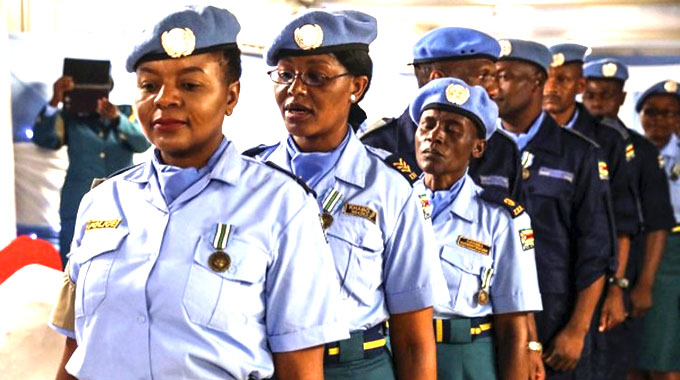
Ruth Butaumocho African Agenda
Zimbabweans will on Saturday join hands in celebrating the country’s 40 years of self-rule, albeit in difficult circumstances because of the deadly coronavirus, which causes Covid-19.
Government and other stakeholders are working on measures to stop the further spread of the disease, while also mitigating its effects.
Suffice to say, the predicament that the country finds itself in because of Covid-19 should not water down this year’s unique and defining four-decade anniversary, whose celebrations are historic, to capture the journey from April 18, 1980 to this day.
Such moments also afford the nation an opportunity to introspect on the heroic deeds of men and women who sacrificed their lives for the independence of Zimbabwe.
It is gratifying to note that the liberation struggle narrative venerates legions of women who took up arms and fought against the colonial regime and lay claim on this land.
Women were not just passive bystanders or victims in war, but active participants in a system of warfare. After the war, women remained vigilant.
While some hung their guns and reclined into family life — away from the smell of gun powder and rigorous exercises — others joined the uniformed forces to ensure that they would continue to jealously guard the hard won independence.
The majority of them still managed to get positions and recognition in uniformed forces, with some being included in peace keeping missions in various war zones throughout the world.
South Sudan, East Timor, Somalia and Kosovo, became home to legions of Zimbabwean women who would traverse the world on peace keeping missions.
As a result, the country had an unparalleled record of affording competent and astute women an opportunity to participate in various peace keeping missions across the world.
To date, Zimbabwe is one of the few countries in the world with the highest number of female peacekeepers from the police force, whose figures are close to the 20 percent female representation.
The first woman served in East Timor in 2000, seven years after the police began participating in peacekeeping missions.
It is that accepted link between gender equality and peace which encouraged the United Nations to establish a number of gender equality principles which have evolved on the role of women in peace and security.
At a global level, peacekeeping has seen the establishment of gender units and the training of soldiers to become gender sensitive, furthering gender mainstreaming and the ultimate goal of gender equality.
The strategy, according to UN agencies and scholars, was to increase the number of women in peace support missions.
The main reason is that women make special contributions to peacekeeping which enhance the operational effectiveness of the mission and improve the human security of the host citizenry.
At a conference on United Nations peacekeeping, held in London in September 2016, more than 60 member States pledged to increase women’s participation at all levels of peace keeping operations
Women, then made up 26 percent of head of mission and deputy head of mission positions, the highest proportion ever achieved.
However, such figures are still far short of gender parity.
Despite numerical deficiencies, Zimbabwe has been working towards achieving provisions availed in the SADC Gender Policy which calls for the participation of women in all peace keeping initiatives.
SADC Gender Protocol 2017 Barometer revealed that of all the countries that deployed female peacekeepers to different missions in 2016, Zimbabwe had the highest ratio of women to male keepers deployed, at 35 percent.
Nine other Sadc countries, Democratic Republic of Congo, Lesotho, Madagascar, Malawi, Namibia, South Africa, Tanzania and Zambia deployed peacekeepers to UN Missions in 2016.
The number of female peacekeepers that Namibia deployed during the same period actually went down to 26 percent in 2016 from 36 percent in 2015.
Madagascar was on third position though with a decline of four percent from its previous 21 percent in 2015.
However, improvements were noted in South Africa, Malawi, Tanzania and DRC.
South Africa had the highest female troops at 289 in 2016, followed by Tanzania at 130 and Malawi at 88.
In 2017, Lesotho Times applauded countries like Zimbabwe of being supportive of women, but noted that “transforming the military to become amenable to women has been a slow development” in many SADC countries, where most still play supporting roles.
Zimbabwe has been consistent in supporting women in uniformed forces, as attested by countless efforts the Government continues to make to ensure gender equality.
The appointment of Cde Oppah Muchinguri-Kashiri to head the powerful Ministry of Defence and War Veterans Affairs clearly affirms the Government’s unclouded vision to elevate competent women and keep the global goal of involving women in military and peacekeeping alive.


 Online Reporter