


 admin
admin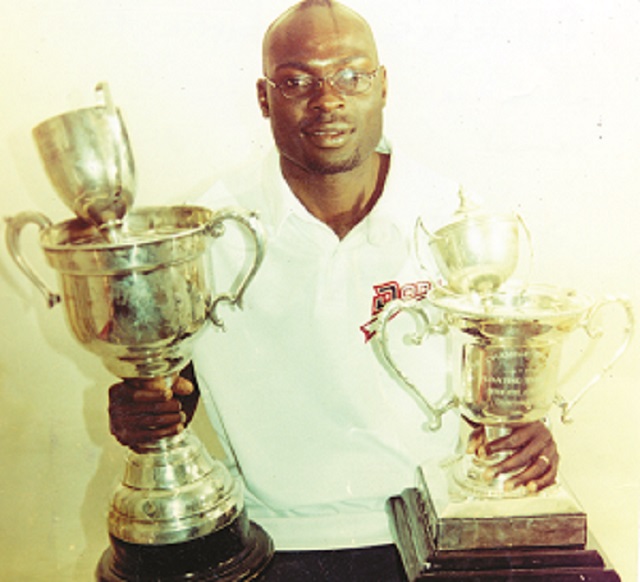

Lovemore Dube
BREAKING the Zimbabwe athletics high jump record twice within a week will remain legendary Juma Phiri’s happiest sporting moment.
But the moments of glory did not come on a silver platter, but due reward to two men who had sweated it out for four months to achieve the milestone. Phiri holds the high jump record of 2,16m set in June of 1999 at the Colliery Stadium.
Sunday News caught up with Phiri on Wednesday at his Zifa Southern Region Division One side Talent Vision offices. Phiri had been poached by the late Hwange Colliery sports officer Prize Ndlovu in 1997. He had previously made his mark in the province then Bulawayo and Matabeleland North making one sports team with jumps of up to 2.08m.
He had longed for a time to beat Ralph Dube’s record of 2,10m which had lasted almost a decade.
“It was a challenge that I had taken that someday I needed to better Dube’s height. By 1999 I had beaten him in a number of events, but breaking his record had remained the biggest challenge of my career. My dream was to soar over 2,10m which was the record then.
“Chapita who was now our coach at Hwange had at the beginning of 1999 put me through a rigorous training programme aimed at me qualifying for the All-Africa Games in South Africa and bettering Dube’s mark,” said Phiri. He was put on an all-white meats diet with no sadza and oily food stuffs. Training started at six in the morning with a 5km jog and then work.
There would be another jog during the two-hour lunch break which would be followed by 120 hours of work up to 4PM then club training at the Hwange Stadium.
“It was hard but my coach told me what we were targeting and I was in agreement with him. He saw the potential in me and decided to invest in a training programme that I had to stick to, to the letter and dot,” said Phiri.
After training he would resign to his room at the Hwange Old Guest House, his residence for two years. But that would not be the end as at 10PM he would have another hour or so at the gym. Days, weeks and months passed by and the hunger for success heightened.
“I remember coach Chapita calling The Chronicle and inviting you in person to come and witness me set the record on a Wednesday, I became apprenhensive but I believed in myself though as I had jumped regularly 2,06, 2,07 and 2,08m so I believed I could do it,” said Phiri.
He was to hurt his coach’s morale on the eve of the 1999 Hwange Championships by refusing to go and stay in the dormitories with the rest of the team ahead of the event.
“I had psyched myself up. My room within the complex where they camped had been my home so I could not understand why I would leave it to sleep in a dormitory environment,” said the lanky former athlete.
On the morning of the championships the Colliery provided buses to take residents to the stadium. By the time the event began the stadium was full to the rafters.
There were 18 athletes who were registered for high jump and after a lengthy debate they all agreed to start at 1,65m. Phiri who had become accustomed to over 2m efforts would not start that low.
“Chapita made it a point that I train and do 2m jumps 20 times daily. If I dropped the bar at the 19th jump I would start all over. So I became accustomed to that standard,” said Phiri. He started at 1,95m, a level that had seen the whole field fall by the wayside. The expectant home crowd got to its feet when he cleared that level, 2m, 2,05m and at that level Phiri asked for 2,15m.
There was deafening silence when the crowd favourite who was following up victories in the sprints by Phillip Mukomana, Themba Ncube, Benjamin Songoya and Gabriel Chikomo, dropped the bar twice at that level.
“On the first one I dropped the bar with a heel touch, the next was one of my calves. Coach Paul Chapita sent Melford Homela to tell me to increase my sprint and leap in my third and final and that worked. I cleared the level and the crowd went into a delirium, I picked myself up, got my bag and headed straight to my home. I was too much of a shy guy then,” said Phiri.
The following week, Phiri improved his record to 2,16m with another remarkable jump in Harare.
“Success is the reward for planning, working hard and executing precise instructions at the right time and then going for the kill at the championship,” said Phiri whose mark of 1999 still stands as the national record.
Trevor Madziya who was earmarked as the heir apparent in 2000 was lost to football after showing a lot of potential.
The former national schools championship would jump 2,05m with ease but lacked the motivation to stick to athletics whose season then was over four months.
Things have changed nowadays, its longer but without a fair number of motivating events. With the national record tugged, Phiri had qualified for the South Africa All-Africa Games of 1999. Bad luck was to strike with Phiri rupturing his patella tendon, something that brought his athletics career to an end. Corrective surgery did not yield positive results, leading to him replacing Chapita as Hwange Colliery Company sports officer and coach.
“It was sad not going to South Africa but I had to accept that I was forced to quit at the top of my career. I went on to achieve some glorious moments as coach at the Chamber of Mines where I coached Chamber of Mine legends Gabriel Chikomo, Themba Ncube, Benjamin Songoya, Phillip Mukomana and Savieri Ngidhi,” said Chapita.
Others he worked with include Teurayi Chinguwa, Gamuchirayi Ndlovu, Chaka Zinhanzu and Pedzisayi Pfakatya who many had tipped to follow great long distance runners the late Thethelani Moyo and Zephaniah Ncube.
He said Chapita had groomed him to take over and hence he had no problems working with older and more illustrious athletes. Phiri later worked at the Sport and Recreation Commission, Shangani Mine, Chicken Inn and now he is the manager of ambitious Talent Vision.
“The director, Khumbulani Nkomo, realises football is a business and has invested in it. He is so professional and working hard to ensure the boys stay motivated and our dream is to play in the Premiership soon,” said Phiri of the club that finished in the top four bracket with a lot of promise this season. Phiri at times doubled up as a sprinter running the first leg of the 4x100m with Garnett Dube, Mukomana, Chikomo and Ncube.
But where did it all begin for Phiri?
Born on 2 February 1973 in Bulawayo, Phiri spent his early days in Matshobana where football enjoyed a cult following with Alfred Ngedla Phiri and a host of players who played for Black Aces and Raylton being most kids’ role models. At Gampu Primary School where he was for his Grades One to Four, Phiri was an athlete specialising in sprints and played as a striker.
He could not regularly take part in sport as in some competitions he would be disqualified as being over-aged because of his height. “This thing of a bar being used to gauge one’s eligibility meant I could not take part in inter-schools sports as I was said to be over-aged,” said Phiri.
A switch to Greenhill by the family was probably the anecdote needed as he moved to guarding goal and continued with his running.
One day a day before an inter-schools competition, the Henry Low champion Xolani Moyo fell sick and there was no one to represent them in the event and the lanky Phiri was asked to fill in. Yes, he did to a school hero’s rouse.
He jumped 1,67m bettering the record of 1,65m which had been the record. With that feat a champion was born and when he moved to Hamilton High School, he could not jump with his agemates and was made to represent Cameroon House seniors.
“In the first term I concentrated in high jump and at one stage I was school team goalkeeper with former AmaZulu, Zimbabwe Saints and Zimbabwe goalkeeper Muzondiwa Mugadza as my deputy,” said Phiri.
He was invited to basketball by his friend Jermainne James and became a club member of ZRP Bulawayo Athletics Club who were coached by Barney and legendary sprints coach Kenny Nyape was still sprinter at the club in the early 1990s.
By the time he left Hamilton, Phiri had soared over 1.85m bettering some school record set by a Finch guy earlier.
Phiri said the Inter-School Relays pitting Arnold Payne of Milton High School, Brian Kagoro and Sherperd Jones of Gifford High School, Plumtree High School’s Ndabezinhle Mdlongwa in the jumps was very competitive and had prepared him for club sport.
“It was quite competitive, the competition was hot and there was a lot of talent in the schools,” said the Talent Vision manager. Phiri’s first mark at club was 2,02m in Zisco where he beat record holder Ralph Dube to second and his confidence was boosted for the future.
“He was the national record holder and had a great profile in inter-club sport. That day Ralph jumped 2m.”
Phiri’s stock continued to rise and was identified for the 1995 All-Africa Games which Zimbabwe played host to.
Just like what would happen four years later, Phiri nearly did not take part in the Harare event. He lost his dad on August 5 and had to be recalled from camp.
At one stage he felt like not taking part in the event but was given an all-clear by the family. He finished fifth in the event and believes if he had not taken the bereavement break, he would have done better than his fifth place finish.
“I am sure I could have done better. I seem to have had an All-Africa Games curse as I missed the 1999 event due to injury which forced to retire when in the two-month camp I had been jumping 2,20-2,25m. I was posed for a great event and Lady Luck did not smile on me,” said Phiri.
Phiri paid tribute to Movern Pakarimwa and Isaac Dick fellow high jumpers for pushing him beyond the limit.
Phiri who also had a glittering career as a club basketballer for Mephis after being identified by Richard Bismark and played with the likes of Donovan Pillay, Witness Martin, Clinton Garnie moved to Hellenics owned and sponsored by Paul Vakos.
“Trevor Hassan was the best three-pointer, we had Zoron Miloslavik from Yugoslavia, a great player, Raymond Buys, Basil West and Vakos in an era where basketball commanded a big following and the organisation was great.
Phiri bemoaned the collapse of the Chamber of Mines Games.
“Those were our own annual athletics, the highest stage for local athletics, with great organisers, management and talent on show. Most records save for the sprints were broken during the times when the Chamber of Mines Athletics Championships were still on the calendar.
“Consideration should be made for the competition to be revived. The best there was in the country took part in those games and mines’ managers would also be in attendance and enjoying every moment of it,” said Phiri.
Phiri said he still loves athletics but was like Bhekuzulu Khumalo and James Rugwevera now with Bulawayo Chiefs and Nyape with Hwange FC elbowed out of a system that favoured a few. He said athletics was no longer the vibrant sporting discipline they had grown to love following great feats by Adorn Trevor, Boniface Magodo, Dera Magodo, Artwell Mandaza, Charles Mafika, Brian Sheep, Vuyani Fulunga, Chris Mutikani, Partson Muderedzi and Ken Pullen.



 Bongani Ndlovu