Online Reporter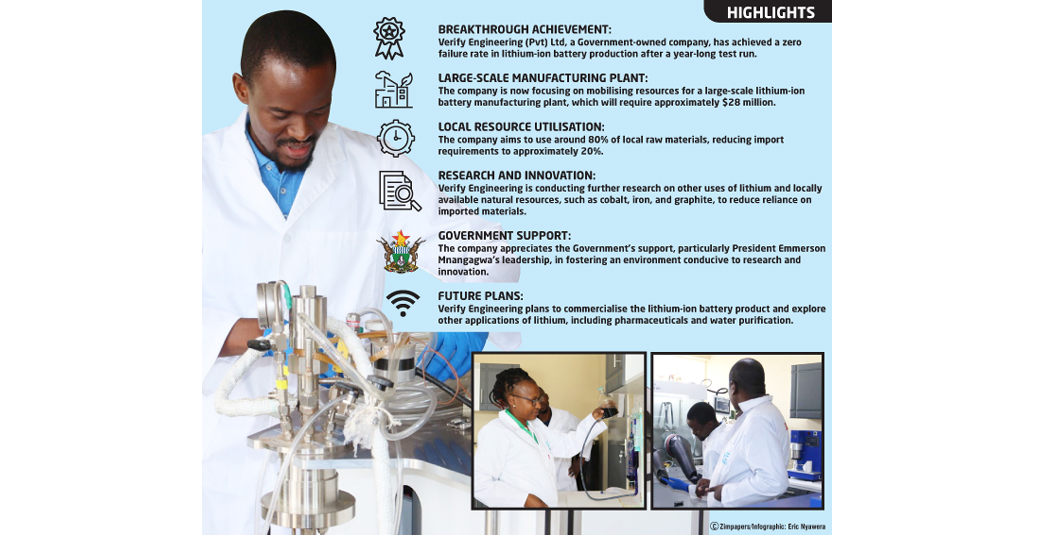
Ray Bande
Senior Reporter
ZIMBABWE has achieved a significant breakthrough in the production of lithium-ion batteries, with Verify Engineering (Pvt) Ltd, a Government-owned company, recording a zero failure rate on the product after a year-long test run.
The lithium-ion battery is what we find in cellphones and other small electronic appliances.
Verify Engineering (Pvt) Ltd was established in April 2005 under the auspices of the Ministry of Higher and Tertiary Education, Innovation, Science and Technology Development.
The company is one of the major suppliers of medical and industrial gases in the country.
Besides manufacturing and distribution of medical and industrial gases, VE Gases also offers a wide range of related industrial tools and equipment, accessories, and consumables, such as safety wear, medical equipment and technical.
This augments the company’s product profile and ensures one-stop-shop convenience to its customers.
Verify Engineering is also driving innovation research aimed at reducing the country’s reliance on imported raw materials for lithium-ion battery production, among other products, made from lithium.
Zimbabwe holds the largest reserves of lithium in Africa and ranks fifth globally in terms of lithium deposits.
The vast lithium deposits, if properly mined, beneficiated and exported, could earn the country the much-needed foreign currency to meet its developmental objectives.
Furthermore, the lithium deposits could be a basis for a green economy, potentially making Zimbabwe a key player in the region for the production of lithium batteries and other green products critical for a transition to cleaner energy.
As a technology innovator and provider in the petrochemical sector, Verify Engineering (Pvt) Ltd is contributing to Zimbabwe’s broader industrialisation agenda through the commercialisation of various technologies.
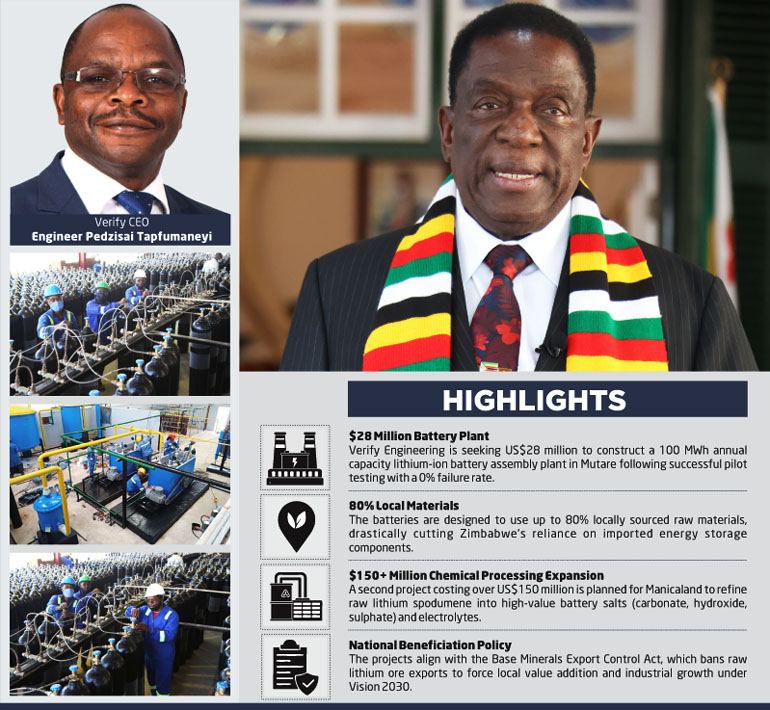
The company is now focusing on resource mobilisation for a large-scale lithium-ion battery manufacturing plant.
This initiative aligns with the ministry’s vision to leverage Heritage-based Science and Technology innovations to revitalise Zimbabwe’s economy.
Verify Engineering (Pvt) Ltd is forging ahead with research on other uses of lithium and locally available natural resources.
In a wide-ranging interview, Verify Engineering chief executive, Engineer Pedzisai Tapfumaneyi confirmed that the lithium-ion battery test run was successful, and focus has now shifted to mobilising resources for a large-scale manufacturing plant.
“I am sure you recall that we won an award for producing the lithium-ion battery, and we are pleased that the product underwent a year-long test, which we can confirm resulted in a zero failure rate last month. What this means is that the product is functioning well, with a normal lifespan of 10 years. We are now focusing on commercialising the product.
“Commercialising the lithium-ion battery will require approximately US$28 million to establish a large-scale manufacturing plant. The initial research phase for the product cost nearly US$500 000,” said Engineer Tapfumaneyi.
The success story of Verify Engineering (Pvt) Ltd’s research and innovation does not start and end there – having commenced operations in 2015 in the eastern border city of Mutare, Verify Engineering (Pvt) Ltd has expanded to include depots in Hwange, Chitungwiza, Harare, Masvingo, Kwekwe, Bulawayo, Chiredzi, and Gweru – a testament to the company’s growth in size and operational research.
To date, the company has expanded its research and innovation efforts to unlock value from the numerous resources available in the country.
The primary objective is to explore ways to reduce the import bill for the production of lithium-ion batteries and other types.
“There are several ongoing research projects that will be unveiled at the right time. We are also working on perfecting the raw material base to reduce the import bill in the production of these gadgets.
“For instance, we are conducting further research in areas such as cobalt, iron, lithium carbonate, lithium sulphate, lithium hydroxide, graphite, and others. Our goal is to utilise around 80 percent of raw materials from local resources, thereby drastically reducing our import requirements to approximately 20 percent.
“We should also be aware that lithium’s uses extend beyond batteries, as it is also vital in pharmaceuticals and water purification, among other important applications of the mineral resource,” said Engineer Tapfumaneyi as he expressed gratitude to President Mnangagwa’s leadership for fostering an environment conducive to extensive research and allowing people to learn from their mistakes in pursuit of tangible outcomes.
“I believe it is essential to acknowledge the space and resources made available to Zimbabweans to explore the benefits of locally available resources for their benefit.
“President Mnangagwa has done a wonderful job in allowing sons and daughters of Zimbabwe to be able to research, make mistakes and still pour resources until tangible results are finally attained. This deserves recognition and praise. More importantly, as President Mnangagwa’s wish, this work is being done in Zimbabwe by Zimbabweans using resources found in Zimbabwe for the benefit of Zimbabweans,” he said.