

 Online Reporter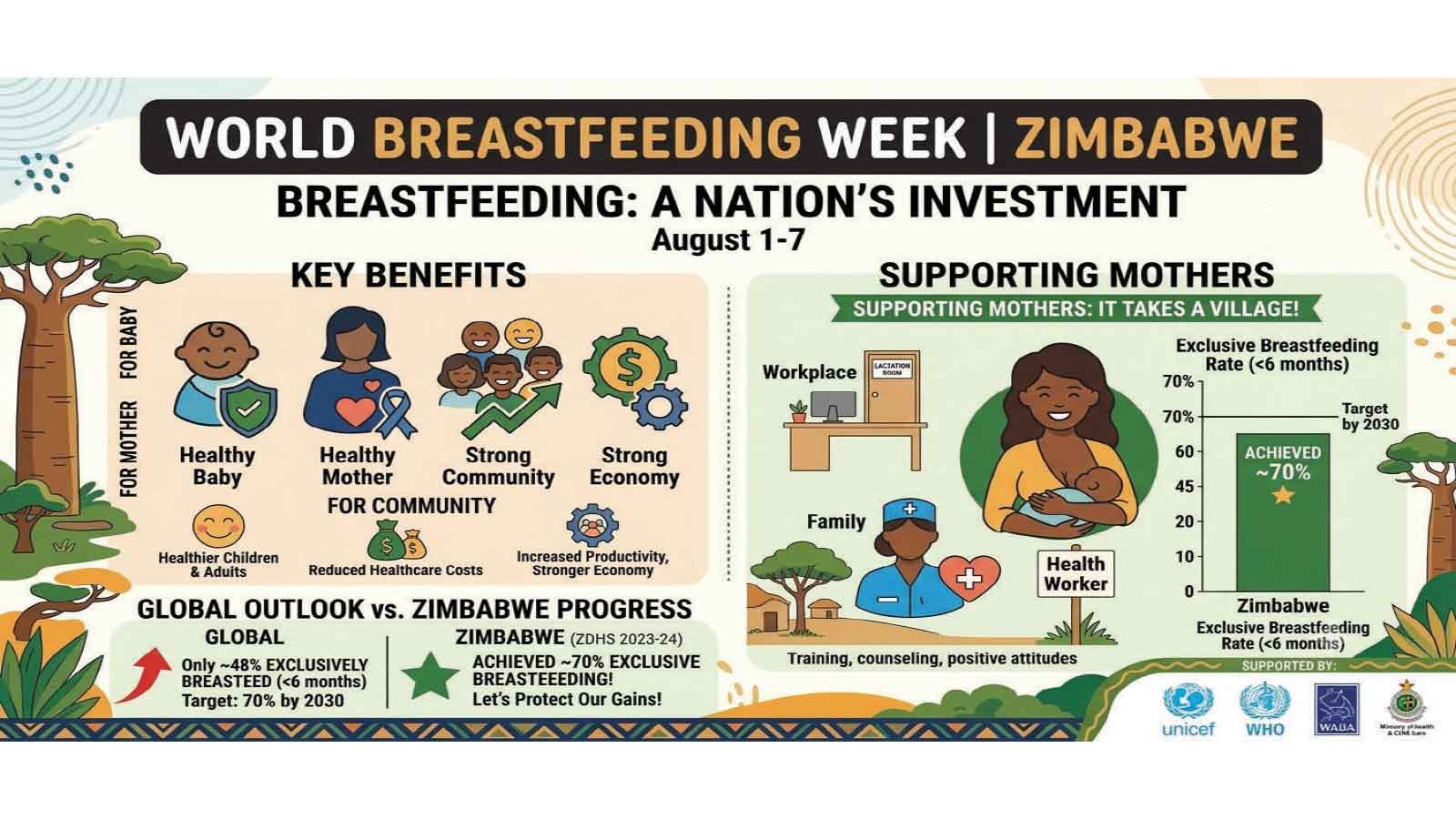
Rumbidzayi Zinyuke
Health Buzz
There is perhaps no sight more familiar than that of a mother gently cradling her nursing newborn.
Moments earlier, the baby may have been crying inconsolably or fussing restlessly, but as soon as it latches onto the breast, calm often replaces distress. The crying subsides, tiny hands relax and both mother and child settle into a moment of comfort and connection.
That simple, everyday scene is far more than an expression of maternal love.
Breastfeeding is a baby’s first source of nourishment, its earliest protection against disease and the foundation for healthy growth and development. It also benefits mothers, strengthens families and contributes to healthier, more productive communities, making it one of the most powerful and cost-effective public health interventions available.
As Zimbabwe joins the rest of the world in commemorating World Breastfeeding Week, observed annually from August 1 to 7, health experts are urging families, communities, employers and policymakers to create environments that enable every mother to breastfeed successfully.
The global campaign, coordinated by the World Alliance for Breastfeeding Action (WABA) with support from the World Health Organization (WHO) and UNICEF, highlights the need to protect, promote and support breastfeeding.
This year’s commemorations continue to focus on strengthening support systems for breastfeeding mothers, recognising that successful breastfeeding is not solely the responsibility of mothers but of society as a whole.
For many mothers, breastfeeding comes naturally.
For others, it requires guidance, encouragement and practical support from health workers, partners, employers and family members.
Without that support, many women stop breastfeeding earlier than recommended despite wanting to continue.
Medical evidence consistently shows that breastfeeding is one of the most effective ways of ensuring child survival. Breast milk contains all the nutrients an infant needs during the first six months of life while also providing antibodies that protect babies from common childhood illnesses such as diarrhoea and pneumonia, two leading causes of child mortality globally.
The WHO recommends that babies be put to the breast within one hour of birth, be exclusively breastfed for the first six months of life without any additional food or water, and continue breastfeeding alongside appropriate complementary foods until at least two years of age.
Globally, however, many infants are still missing out on these benefits.
According to WHO and UNICEF, only about 48 percent of infants under six months are exclusively breastfed worldwide, falling short of the global nutrition target of at least 70 percent by 2030.
Millions of babies are introduced too early to infant formula, water or other foods, increasing their risk of infection and poor nutrition. The consequences extend beyond childhood.
Research has shown that breastfed children perform better in cognitive development, are less likely to become overweight or obese later in life, and have a reduced risk of developing diabetes. Mothers also benefit significantly, with breastfeeding lowering the risk of breast and ovarian cancers, type 2 diabetes and postpartum haemorrhage while helping with birth spacing.
Beyond health, breastfeeding also makes economic sense. Global estimates suggest that inadequate breastfeeding practices contribute to hundreds of billions of dollars in economic losses annually due to increased healthcare costs, reduced productivity and lower cognitive development among children. Investing in breastfeeding support therefore represents one of the highest-return investments countries can make in public health.
Zimbabwe has made encouraging progress in promoting breastfeeding over the years.
According to the 2023-24 Zimbabwe Demographic and Health Survey (ZDHS), exclusive breastfeeding among infants under six months has improved significantly, reaching approximately 70 percent, placing the country among the better-performing nations in the region.
The increase reflects years of investment in maternal and child health programmes, baby-friendly hospital initiatives, community health workers and sustained public awareness campaigns. Nevertheless, challenges remain.
Urbanisation, demanding work schedules, aggressive marketing of breast milk substitutes and misconceptions surrounding breastfeeding continue to affect exclusive breastfeeding rates. Many women return to work only a few months after giving birth and often struggle to find workplaces with facilities that allow them to express and safely store breast milk.
Health experts say breastfeeding should not be viewed as solely a mother’s responsibility.
Employers also have a critical role to play by creating breastfeeding-friendly workplaces through flexible working arrangements, designated lactation rooms and adequate maternity protection.
Families, particularly fathers and grandparents, also have an important role in supporting mothers emotionally and practically during the breastfeeding journey.
Zimbabwe has adopted several policies that promote infant and young child feeding, while health facilities continue to educate expectant mothers during antenatal and postnatal visits.
Programmes supported by the Ministry of Health and Child Care together with development partners such as UNICEF and WHO continue to strengthen counselling services, train health workers and promote early initiation of breastfeeding after delivery.
For mothers living with HIV, significant scientific advances have transformed infant feeding recommendations.
With effective antiretroviral therapy and consistent medical follow-up, WHO recommends that mothers living with HIV should exclusively breastfeed for the first six months while remaining on treatment.
Zimbabwe’s successful HIV programme has enabled thousands of mothers living with HIV to safely breastfeed while dramatically reducing the risk of mother-to-child transmission.
The country’s achievements in eliminating many barriers to HIV treatment have made breastfeeding safer for mothers and babies alike. Nutrition experts also caution against common myths that continue to circulate within communities.
Giving newborns water, herbal remedies or porridge before six months is unnecessary and may expose infants to infections. Breast milk alone provides adequate hydration even during hot weather.
Similarly, concerns that some mothers produce “insufficient milk” are often linked to breastfeeding techniques or inadequate support rather than an actual inability to produce enough milk.
Early counselling by trained healthcare workers can help mothers overcome these challenges before they become reasons for stopping breastfeeding.
As Zimbabwe continues working towards universal health coverage and improved maternal and child health outcomes, breastfeeding remains one of the simplest, affordable and most effective interventions available.
Unlike many healthcare interventions that require expensive medicines or sophisticated technology, breastfeeding is a natural practice that delivers lifelong benefits when mothers receive the support they need.
This World Breastfeeding Week, protecting breastfeeding is an investment in healthier children, healthier mothers and a healthier nation.
Every successful breastfeeding journey begins with a mother’s determination, but it flourishes when families, communities, workplaces and governments stand behind her.
In a world facing rising healthcare costs, increasing childhood illnesses and persistent inequalities, supporting breastfeeding is not merely a maternal health issue, it is a national development priority whose benefits will be felt for generations.
Feedback: [email protected]



