Online Reporter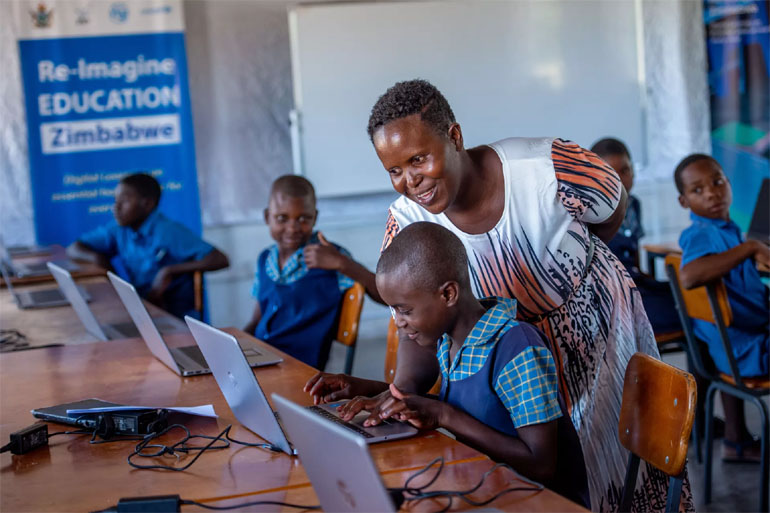
Ronald Takudzwa Sambona
SHOSHANA Zuboff, the Charles Edward Wilson Professor Emerita at Harvard Business School, in her book titled: “The Age of Surveillance Capitalism,” argues that the Fourth Industrial Revolution, for better or worse, creates a new division of learning in our society.
Even though technology is clearly a golden ticket to a better future, it is not guaranteed that everyone will have access to it. Technology is making life better, particularly in education, but history has repeatedly shown that when mankind transforms, new inequalities emerge. That is to say, technology creates a new division in which access to quality education improves. However, the already marginalised will suffer greater inequalities as this new learning division will multiply pre-existing educational inequalities.
I stand with the notion that quality education at its peak must be fuelled by the digital drive. Quality education and technology are inseparably bound. To get the ultimate results out of our education, we must be strategic and forward-thinking. This strategic process involves full utilisation of the great digital tools of our age in our learning.
Where technology meets education, a better learning division is created. Digital education goes a long way by infusing joy, flexibility, and relevancy into our learning, while also extinguishing pre-existing disparities and inequalities. Through a digital education, there is a remarkable increase in the number of young girls and boys, youths, and adults who have better access to affordable and reliable learning. Out-of-school children and dropouts also benefit from a learning division grounded in digital education and technology.
The onus rests upon our Government and relevant policymakers to facilitate and finance the great transition into a new learning division.
Research shows that our rural population is significantly disadvantaged in terms of access to digital tools and internet services. This lack greatly hinders our learners from fully harnessing, or harnessing at all, the grand power of digital education.
From the national level, there have been initiatives such as the Presidential Internet Programme intended to bridge this digital divide among our population. Still, though, one man cannot surround an anthill. We need our people, from corporations to individual citizens, joining in these great efforts to make Zimbabwe the big technology giant it can become.
Our children and youths are our nation’s future; it is a shared responsibility to build their capacity and potential in the digital age.
Studies have shown that the African youth population will account for over 60 percent of the global workforce, thus making Africa the continent of the future. It is vital that our youths in every nation are fully equipped and prepared for this leading global role.
By transitioning into this new division of learning, we actively bequeath our youths with a competitive advantage and make them future-ready. The survival of the African continent strongly relies on the full development of our youth and women, as enshrined through Aspiration 6 of the African Agenda 2063.
“Haba na haba hujaza kibaba,” is a traditional Swahili proverb that translates to “bit by bit, you fill up the jug”.
Transformation in our lifetime needs not be radical, but let us take measured action towards our shared vision of a digitally prosperous Zimbabwe.
Momentum and clarity of vision grow as we take action. Yes, systems are developed in our minds, but they are perfected on the ground. What we are fighting for becomes visible and attainable with each step that we take in unity of purpose and direction.
As youths, we carry a great vision for our nation that is grounded in quality and affordable education for all, modernisation, girls’ and women’s empowerment, and youth development.
What holds our nation together are the sacred values of equality, liberty, and brotherhood.
We must work together with these values hidden in our hearts and implanted in our minds, because our motherland, which we call Zimbabwe, depends on its children to survive.
Thank you! I rest my case.