Online Reporter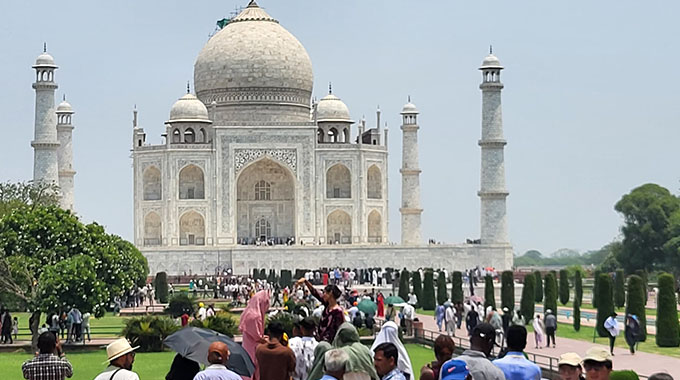
Mashudu Netsianda, [email protected]
WHEN I received an invitation from the Indian Embassy in Harare to participate in a 10-day media study tour of India hosted by the Ministry of External Affairs, I could not have imagined the experience that lay ahead.
Like many, my perception of India had long been shaped by Bollywood cinema, yoga and its growing reputation as a medical tourism hub. But nothing quite prepared me for the dynamic, complex and astonishingly forward-looking country I would encounter.
My maiden trip to India was more than just a journey through one of the world’s oldest civilisations. It was an immersive journey into a country that masterfully blends ancient tradition with cutting-edge modernity. From the bustling streets of Mumbai, India’s financial powerhouse, to the timeless grandeur of the Taj Mahal, India is a living paradox. It’s chaotic yet organised, ancient yet futuristic.
For a Zimbabwean journalist seeking insights into issues around development, governance and economic growth, this was an eye-opener in the truest sense.
My first stop was Mumbai, India’s financial nerve centre. Standing before the Gateway of India, a colonial-era monument that once welcomed British viceroys and now beckons millions of tourists, I was struck by how symbols of the past coexist with the city’s effervescent present. This monumental archway was built to commemorate the arrival of King George V and Queen Mary in 1911. Construction began in 1915 and was completed in 1924, and it served as a symbolic entrance for British dignitaries and later, as a departure point for British troops after India’s independence.
The structure, designed in the Indo-Saracenic style, offers a blend of Indian and Islamic architectural elements and is a popular tourist attraction.
A short walk away is the National Museum of Indian Cinema, a tribute to Bollywood’s journey, from grainy silent films to the global blockbusters of today. Visiting Film City, the heart of India’s cinematic dream factory, was like walking through a world powered not by money alone, but by stories and aspiration. The Indian film industry employs millions, not only boosting the economy but also preserving cultural identity, a model Zimbabwe’s small but growing film sector can emulate.
But perhaps the most thrilling initiation into daily Indian life was my first ride in a “tuk-tuk”, the ubiquitous yellow-and-black three-wheeled motor tricycle. Weaving through the kaleidoscope of Mumbai traffic, our driver navigated with uncanny skill between honking cars, bustling street vendors and even the occasional jaywalking cows roaming the streets. In that short ride, I understood the genius of India’s transportation system, which is simple, scalable and accessible. For just a few rupees, you can get anywhere, fast. Zimbabwe’s cities, which are choked with private cars and an unreliable public system, could adopt a similar model for short-distance, last-mile mobility in urban areas.
The pace and scale of India’s financial systems is amazing. At the Mumbai Stock Exchange (BSE), Asia’s oldest, I watched billions of dollars shift across trading screens in real time. What stood out wasn’t just the wealth traded here but the effort to democratise access to investment.
India’s economy has surged from a US$270 billion economy to US$4 trillion in just three decades, despite being classified as a lower middle income country. It is the world’s fifth largest economy behind the United States, China, Germany and Japan.
With the rise of mobile trading applications and investor education, ordinary Indians are becoming stakeholders in their economy, a critical lesson for Zimbabwe’s own financial inclusion strategies. Our hosts took us to the National Payments Corporation of India (NPCI), the brain behind Unified Payments Interface (UPI)), a real-time payment system that has revolutionised cashless transactions. Street vendors, rickshaw drivers and major retailers alike use QR codes and apps for instant payments. This digital leap, which is built on government-private sector collaboration, holds immense relevance for Zimbabwe’s informal sector, which still struggles with financial exclusion and unreliable mobile money services.
One of the more instructive sessions was with the Confederation of Indian Industry (CII), a 125-year-old body that acts as a bridge between businesses and government. CII’s structured engagement with policy-makers has helped shape reforms that fuel India’s industrialisation. At the Pharmaceutical Export Promotion Council of India, I saw how India became the “pharmacy of the world.” Through strategic investments in research, generic drug manufacturing and strong export policies, India supplies affordable medicine globally. With Zimbabwe’s own rich biodiversity, the country could develop its own herbal and pharmaceutical sector with similar focus, especially given the growing global demand for alternative medicine.
Perhaps the most impressive feat of engineering I saw was the Atal Setu, India’s longest sea bridge, linking Mumbai with Navi Mumbai. Named after former Prime Minister Atal Bihari Vajpayee, it is not just a marvel of architecture but a symbol of how infrastructure can ease congestion, stimulate trade and save billions in lost productivity. The Brihanmumbai Municipal Corporation (BMC), Asia’s richest civic body, showcased what effective city management looks like. From smart waste disposal to digitised public health systems, BMC is proof that local governments can be engines of progress if they are resourced, transparent and responsive. For Zimbabwe’s local authorities, often hamstrung by lack of capacity and resources, this is a compelling model.
A visit to the Coalition for Disaster Resilient Infrastructure (CDRI) added a global dimension to India’s developmental priorities. CDRI works to ensure that infrastructure — from roads to hospitals — can withstand climate shocks. Given that both Zimbabwe and India are vulnerable to climate-related disasters, partnerships with institutions like CDRI could help Zimbabwe build not just back, but better.
At Doordarshan, India’s state-run broadcaster, we learnt how public media can be both a cultural archive and an information powerhouse. Unlike many state broadcasters in Africa, Doordarshan has embraced digital, diversified its content and remained relevant in a competitive media environment.
We visited the National Museum in New Delhi, also known as the National Museum of India, which is one of the largest museums in India. Established in 1949, it holds a variety of articles ranging from the pre-historic era to modern works of art. We also explored India’s deep cultural and historical heritage at the National Museum in New Delhi, home to artefacts spanning 5 000 years.
The final leg of our journey took us to Agra, where the Taj Mahal, an immense mausoleum of white marble commissioned by Mughal emperor Shah Jahan in 1632 to house the tomb of his beloved wife, Mumtaz Mahal. She died giving birth to their 14th child. Shah Jahan, heartbroken, decided to build a monument to immortalise their love. Construction began in 1632 and the mausoleum was completed in 1648, with the surrounding buildings and gardens finished five years later. It’s considered one of the finest examples of Mughal architecture, blending Indian, Persian and Islamic styles.
The Taj Mahal is the jewel of Muslim art in India and one of the universally admired masterpieces of the world’s heritage.
India is not without its challenges as inequality, pollution and population pressures persist. Yet, what sets it apart is its refusal to be constrained by its problems. It dreams boldly, invests in people and adapts quickly.
Zimbabwe, too, is a country of promise. Under the Second Republic, the Government has shown strong commitment to infrastructure development, with projects like the US$300 million Beitbridge Border Post modernisation and the impressive Trabablas Interchange in Harare. The project is part of the road development strategy initiated by the Government which has seen a raft of large-scale road construction and rehabilitation projects underway across the country. These are not mere monuments of concrete, but symbols of connectivity, ambition and economic intent.
To accelerate our development, we must invest in local government capacity, digitise public services, modernise transport systems and create space for private sector-led innovation. More importantly, we must also believe in the power of home-grown solutions — just as India has in our ability to write our own success story.
As I boarded my flight home, the colours, contradictions and confidence of India lingered with me. I returned not just with souvenirs, but with inspiration and a challenge for Zimbabwe to believe, to act and to build.