Veronica Gwaze
WHAT exactly must be done to curb the drug and substance abuse menace that threatens to devastate Zimbabwe’s health and well-being?
This is the pressing question concerned Zimbabweans are probably posing.
Disturbing cases of drug and substance abuse continue to emerge, relentlessly defying the spirited efforts by the authorities to curb this menace.
Even more disheartening are cases involving minors, some as young as eight.
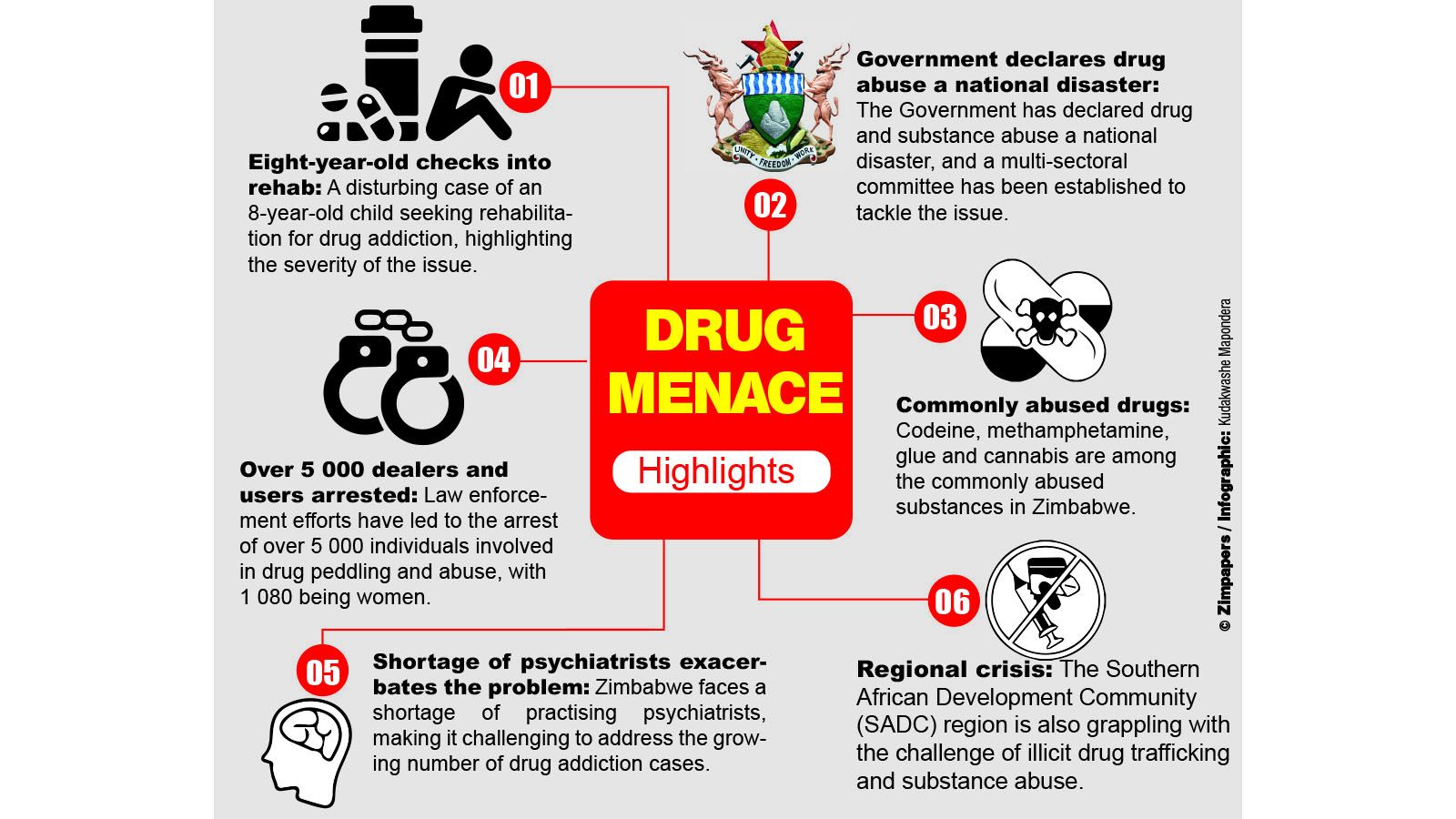
Nearly two years have passed since the Government officially declared drug and substance abuse a national disaster, yet this scourge and its devastating effects are far from over.
The Sunday Mail Society has witnessed first-hand the ravaging impact of drug and substance abuse within society.
One Saturday mid-morning, this writer visited Mufakose.
The Murambaonde neighbourhood initially presents an image of suburban normalcy; from a distance, the houses are neatly packed and uniformly well-maintained.
Yet, drawing nearer to one of the houses (number withheld), popularly known as “KwaGeneral”, an unsettling anomaly emerges.
The seemingly fresh cream paint on the walls is merely a facade, barely concealing stark internal disintegration.
Stepping inside the house, the silence is deafening, literally depicting no sign of life. Most windows are shattered and curtainless.
There is no water reticulation. The two toilets are dry and blocked. They have been converted into a dumpsite. The situation shows years of disuse.
Yet this is the place that 33-year-old Madzikwa (full name withheld), better known as “General”, calls home.
An often-intoxicated Madzikwa, visibly consumed by the ravages of drug and substance addiction, lives alone in this house.
There is no usual clutter that makes a home; in fact, there is no furniture, kitchen utensils, blankets or clothes — save for the set he is wearing.
Even the most basic markers of habitation are absent.
“He used to live with his siblings under the care of their grandmother,” revealed a neighbour who opted not to be named for fear of victimisation.
“When she died two years ago, Madzikwa started taking drugs. He would become violent, so the siblings left. He sold everything that was in the house to feed his addiction.”
He now relies on the sympathy of the community to meet his basic needs.
Sadly, Madzikwa gets violent towards the same people when they try to counsel him for his apparent wayward behaviour.
He has a tenant who rents an outside room, but is reportedly taking advantage of him by not paying rent.
“Instead of paying rent, he just buys him drugs or alcohol. So, when he (Madzikwa) gets high, he conveniently forgets about the rent,” alleged another neighbour.
“It is clear that his relatives have given up on him; the situation is out of hand and he urgently needs rehabilitation.”
This story is not unique.
Over the past few years, Zimbabwe has battled the problem of illicit drugs and substances that is slowly but surely eroding the future of part of the younger generation.
Challenge
At 33, Madzikwa is an adult and has easy access to alcohol and drugs, as do most of his peers.
However, recent developments have left many dumbfounded: Children as young as eight now have easy access to drugs, depicting a bigger challenge that society is facing.
The case of an eight-year-old recently checked into a rehabilitation facility in Victoria Falls owing to drug and substance addiction quickly comes to mind.
Not long after that, a Chitungwiza-based mother was dumbfounded when her 13-year-old daughter dropped out of school due to drug and substance abuse.
Prior to dropping out, the family had lost money and other valuables at home. Months later, they discovered their daughter was behind the theft, selling household goods to satisfy her addiction.
Several such cases are happening across the country.
Officials at Lancos’ Drug Abuse Reintegration Facility (LDARF) say they are receiving between 80 and 100 patients every three months.
The patients’ ages range from 18 to 45 and most claim to have become hooked due to depression.
LDARF founder Roselyn Kuuyandepi notes that, while some victims have been successfully rehabilitated in various institutions, a huge number cannot afford professional therapy.
“Sometimes we also successfully rehabilitate a patient, but end up forced to continue staying with them after they are disowned by their families,” she explained.
Conflict
While the number of drug and substance abuse victims continues to swell, that of practising psychiatrists remains low.
Mandipa Hope Rehabilitation Centre founder Carol Mashingaidze-Tapfumanei notes that the shortage of practising psychiatrists makes it a huge challenge to effectively confront the scourge.
In Zimbabwe, for one to practise, they should hold a master’s degree and be registered under the Allied Health Practitioners Council of Zimbabwe.
“We have degreed psychiatrists, but without a master’s degree, they are not allowed to practise in Zimbabwe,” said Mashingaidze-Tapfumanei.
“So, there is a general shortage of practising psychiatrists. I believe this is because, as Zimbabwe, this scourge caught us unaware, so people are only acting now.”
She said their rehabilitation facility receives close to 200 enquiries for services weekly, but less than a quarter of that figure often comes through for admission.
This, she notes, shows that a huge number of victims are failing to access rehabilitation due to lack of finances, among other reasons.
Ministry of Health and Child Care Permanent Secretary Dr Aspect Maunganidze raised the alarm over the escalating cases of drug abuse among young people.
He said the Government was making frantic efforts to put structures in place to fight the growing challenge.
“We have facilities that are meant to house mentally challenged patients, but due to drug and substance abuse, mental health cases have increased, leading to swelling numbers in our facilities,” he said.
“People with addiction often have one or more associated health issues, which could include lung or heart disease, stroke, cancer, permanent and/or non-permanent mental health conditions.”
Government psychiatric wards that offer help in fighting alcohol and drug addiction include the Sally Mugabe Psychiatric Unit (Harare), Parirenyatwa Annex Psychiatric Unit (Harare), Ingutsheni Psychiatric Hospital (Bulawayo), as well as Ngomahuru Hospital and Halfway House (Masvingo).
Long-term effects on minors
Paediatric consultant Kingsley Chiparaushe notes that drug and substance abuse in minors can have long-term effects.
Substance abuse during the critical years of brain development, he notes, can interfere with brain function and development.
“Physical health problems can also occur. Depending on the substance, issues can range from nausea and weight loss to seizures, liver damage, lung disease, heart problems and even death from overdose,” he said.
“Drug abuse is also linked to higher rates of mental health issues like depression, anxiety, conduct problems, personality disorders and suicidal thoughts.”
Psychologist Dr Nisbert Mangoro added that drug and substance abuse by minors can result in risky behaviours.
“Substance use increases the likelihood of engaging in dangerous activities such as unprotected sex, leading to STIs (sexually transmitted infections) or unplanned pregnancies and criminal activities,” he said.
“Academic decline is also a reality that often manifests within a short to medium period of substance abuse.
“Substance abuse often leads to poor judgement, reduced motivation and difficulty focusing, resulting in declining school performance, absenteeism and dropping out.”
Dr Mangoro said in the long run, drug users often battle damaged relationships due to lying, stealing and unpredictable or violent behaviour.
Law enforcement/policy
The Government recently set up a multi-sectoral national committee on Drug and Substance Abuse, chaired by Defence Minister Oppah Muchinguri-Kashiri.
The committee was established following President Mnangagwa’s declaration of zero tolerance to drug and substance abuse.
Part of the committee’s mandate is to seek interventions and collaborations with other nations.
The Zimbabwe Multi-Sectoral Drug and Substance Abuse Plan (2024-2030), which provides a legal framework for a specialised agency to tackle the crisis, was also launched.
However, some rogue elements within society have been working round the clock to derail strides made by these Government efforts in the fight against drug and substance abuse.
Resultantly, calls have grown loud for stiffer penalties, especially for repeat offenders.
The Zimbabwe Republic Police has made efforts to arrest identified drug peddlers and users.
According to the police, at least 5 738 individuals (1 080 of whom are women) were arrested in Harare for drug and substance abuse and peddling from January to September this year.
Of those arrested, 4 274 are under the age of 35.
At least 52 drug bases were destroyed in Harare province during the nine-month period in question.
Police spokesperson Commissioner Paul Nyathi admits that drug and substance abuse is taking a toll on communities.
“The challenge is that in most communities, the culprits are protected because maybe they are relatives or a neighbour. This will only result in us fighting a stillbirth. This problem is now out of hand, hence the need for collective action if we are to win it (the war on drugs),” he said.
Collaboration
Ministry of Public Service, Labour and Social Welfare provincial officer for Harare Susan Ngani applauded the national response to drug and substance abuse.
“A task force consisting of an element from each ministry is the only way. Police should be there all the way, making the much-needed arrests. The Ministries of Health, Social Welfare, Education, all have a huge role to play,” she said.
“We are also coming up with ways to complement the existing rehabilitation centres. Some parents are battling because they cannot afford private rehabs. Further, drug and substance abuse has led to increased cases of teen and unplanned pregnancies, hence we need to act fast.”
Commonly abused drugs in Zimbabwe include codeine; methamphetamine (crystal meth/mutoriro, ice, guka); glue; BronCleer (Bronco); solvents (fembo); chlorpromazine (maragado); mangemba; cocaine and cannabis (marijuana/mbanje/skunk).
Regional crisis
While it has been declared a national emergency, drug and substance abuse is also a regional challenge.
In South Africa, sights of visibly intoxicated individuals are common.
At public places like Park Station in Johannesburg, vagrants, allegedly high on nyaope and other substances, abound.
Zambia also has its fair share of challenges regarding illicit brew manufacturing and drug abuse cases.
The Southern African Development Community (SADC) region is increasingly used as a transit point for illicit drugs destined for international markets. Those behind the practice are international criminal organisations.
Resultantly, there is a rising trend of substance abuse within the region, with a concerning average age of drug dependence dropping to as low as 12.
To tame these challenges, the region recently responded with a combination of legal frameworks, enhanced law-enforcement cooperation and public health initiatives.
These include the Protocol on Combating Illicit Drug Trafficking and the SADC-UNODC Regional Framework (2024-2030).
Strategies also include demand and supply reduction. With these initiatives, they focus on both supply reduction (disrupting production and trafficking networks; and strengthening border controls) and demand reduction (prevention, treatment and rehabilitation programmes).
The High Commissioner of Zambia to Botswana, Pamela Chisanga, highlighted that the SADC region needs to strengthen efforts to combat illicit drug trafficking to ensure public safety from organised crime, terrorism and violence.
“The SADC region is losing significant money annually through drug and substance-related issues, illicit financial flows and corruption,” she said.
“This has stifled our development labour as a region, hence the need to enhance the ability of criminal justice systems in the region to uphold the rule of law, ensure equal access to justice for all and protect victims of crime.”
Resident coordinator for the United Nations in Botswana Zia Choudhury said: “Working with the SADC will strengthen their response to drug control, transnational organised crimes and illicit financial flows. This will accelerate Africa’s progress towards the Sustainable Development Goals and the realisation of the aspirations of the African Union’s Agenda 2063.”