Online Reporter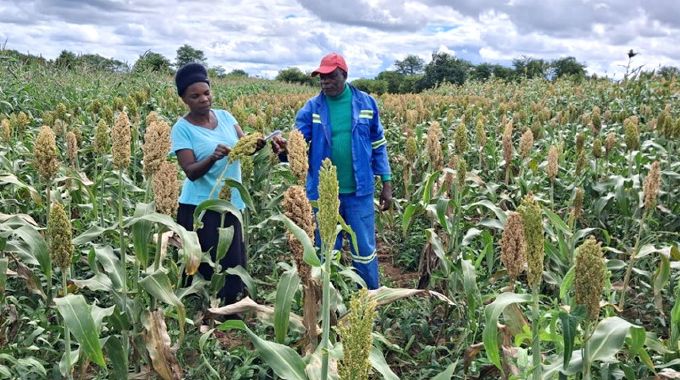
Special Correspondent
IN the heart of agro-ecological Region 4, where erratic rainfall and dry spells often dictate the rhythm of life, one homestead is rewriting the script for smallholder resilience.
The farm of Mr Nhlanganiso Khabo (60) and his wife (56) has become a beacon for the ACIAR-funded Circular Food Systems (CFS) project, which is implemented through a robust partnership led by ICRISAT in Zimbabwe.
They are leveraging their globally recognised work on dry land resilient crop breeding and Climate-Smart Agriculture, in close collaboration with Government departments including Ardas (Agritex) under the Ministry of Lands, Agriculture, Fisheries, Water and Rural Development and the Ministry of Women Affairs, Community, Small and Medium Enterprises Development (MWACSMED).
The project proves that lead farmers, alongside small businesses, are the essential catalysts for community-wide transformation.
From public service to food and nutrition security
After retiring from the police service in 2019, Mr Khabo traded his uniform for a life of full-time farming, working hand-in-hand with his wife as a team. Their motivation is clear — achieving total food and nutrition security for their household, sustaining their livestock and generating income.
Despite the challenges of Region 4, the Khabos’ meticulous approach, characterised by embracing science through the use of improved varieties and fostering circularity through agro-ecological technologies, has set them apart as master practitioners of Climate-Smart Agriculture.
Their commitment to excellent weeding and rigorous record-keeping further ensures that these scientific advancements translate into tangible, high-yielding results on the ground.
Evidence of success: Seeing is believing
The Khabos stand out as local pioneers because they have successfully transitioned from traditional methods to a highly productive, climate-smart farming system.
While many neighbours stuck to traditional varieties, the Khabos adopted the improved Macia Sorghum variety, which has yielded staggering results.
Their crop stands tall with massive heads and zero lodging, putting them on track to harvest over four tonnes per hectare. This success is rooted in their strong advocacy for Conservation Agriculture (CA), where they practice minimum tillage to preserve soil structure and maintain consistent soil cover using a combination of crop residue mulch and live mulch from high-density inter-cropping.
The family has transitioned from traditional “no-input” farming to a robust system of integrated nutrient management and rotation. Their strategic use of organic compost combined with inorganic micro-dosing ensures peak plant nutrition and soil vitality.
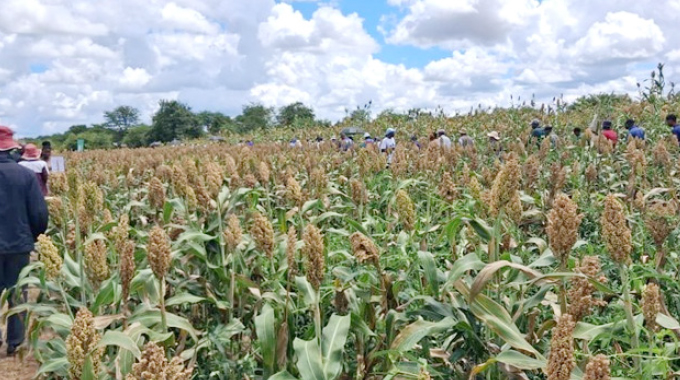
Because adults learn by seeing, the field day provided a platform where seeing is believing, allowing neighbours to witness the results of high-level management first-hand.
A blueprint for rural industrialisation
For the CFS project, the Khabos represent the “Engine Room” of rural industrialisation. By increasing productivity using local resources such as cattle and goat manure and improved local seed varieties and coupling this with the growth of local small businesses, the community is aligning directly with Zimbabwe’s National Development Strategy 2 (NDS2).
District Agricultural Extension Officers (DAEO) Mr Kujinga noted that lead farmers provide the proof-of-concept necessary to turn a village into a business hub.
“Rural industrialisation starts when a farm transitions from a survival plot to a factory for value,” said Mr Kujinga.
“The Khabos’ farm is that factory. By producing high-quality surplus, they create the demand for local MSMEs like
Trust and Reuben’s mechanical threshing, which in turn reduces post-harvest losses and keeps wealth in the ward. This is the essence of NDS2 moving up the value chain, starting at the village level.”
Strategic insight: Building circular food systems
Dr Martin Moyo, ICRISAT Country Representative for Zimbabwe, emphasised that the Khabos are helping identify the conditions for inclusive food systems.
Supporting this vision, Dr Angeline Mujeyi, the Business Development Lead for the CFS project, provides the technical framework for this transformation.
“Our work in Ward 16 is grounded in the hypothesis that the strategic development of Agri-MSMEs is the engine of a truly circular food system. By nurturing businesses like Trust and Reuben’s threshing and milling services, we enable local communities to achieve a fundamental step change in sustainable economic development.
“This circular approach captures more value from the same volume of produce right here in the district. By reducing imports and employing more local people, we ensure the economic returns of the Khabos’ hard work stay within the community, driving rural industrialisation while reducing our environmental footprint.”
Looking ahead: A resilient future
The field day concluded with the Khabos receiving prizes for their unwavering dedication, serving as a powerful testament to the potential of the region. Their farm proves that even in the face of climate change, a combination of disciplined management, Conservation Agriculture and circular thinking can transform a retirement project into a vibrant community-level economic engine. This transition represents a critical shift from subsistence to commercialisation.
A prime example of this ecosystem is the multi-crop threshing business run by Trust and Reuben. By providing mechanised services to productive farmers like the Khabos, this MSME has become a powerhouse of rural efficiency; in 2025 alone, they threshed nearly 200 tonnes of grain, including 152 tonnes of sorghum, 11 tonnes of pearl millet, two tonnes of sunflower and 30 tonnes of maize.
By increasing productivity through improved seeds and management, the Khabos are creating the surplus necessary to fuel these localised value chains. When this grain is milled, processed and packaged locally rather than being exported as raw material, the community retains the maximum economic benefit.
As the sun set over the excellently weeded fields of Dabula West, the message was clear: through the determination of the Khabo family and the technical partnership between ICRISAT’s resilient crop breeding and the expert extension support of government agencies, Ward 16 is moving beyond the cycle of subsistence.
By embracing Climate-Smart Agriculture and circularity, they are no longer just farming to survive — they are pioneering the industrialisation of rural communities, proving that local businesses and local resources can drive NDS2 goals one small, successful step at a time.