Sikhulekelani Moyo
[email protected]
THE 2027 National Budget has moved to cut the cost of connectivity and clean transport, with the Government announcing a reduction in duty on cellphones, electric vehicles (EVs) and knocked-down motor vehicle kits and spares.
Presented by Finance Minister Professor Mthuli Ncube on 19 November 2026 under the theme “Accelerating Economic Transformation and Building Resilience to Climate and Global Shocks”, the ZiG358,3 billion Budget positions cheaper phones, cheaper EVs and local vehicle assembly as part of its drive for inclusive growth, digital transformation and industrialisation.
In a major boost for digital inclusion, the Minister proposed to scrap customs duty on cellular phones entirely.
“To promote adoption and use of mobile ICT capabilities by the general populace, I propose to review customs duty on cellular phones from 25 percent to zero percent,” said the Minister.
The measure falls under Customs Duty on Information Communication Technology Gadgets.
Cellphones are now a basic tool for work, school, banking and farming, not a luxury.
For years, imported handsets have attracted 25 percent customs duty, on top of VAT and other charges.
Scrapping the duty is expected to lower the landed cost of smartphones, especially entry-level models used by students, informal traders and rural consumers; support digital inclusion, mobile money, e-learning and e-government under Smart Zimbabwe 2030; reduce the incentive to smuggle handsets and under-declare values; and help close Zimbabwe’s smartphone penetration gap.
For consumers, the test will be whether retailers pass the duty saving on, rather than absorbing it as margin.
For the Government, the trade-off is lower duty per phone against higher volumes and a bigger formal market.
Under promotion of green energy and environmentally sustainable transport, the Minister proposed a sharp cut in duty on electric vehicles to accelerate the transition to a green economy.
An economist, Mr George Nhepera, said: “Cellphone prices are likely to fall significantly.”
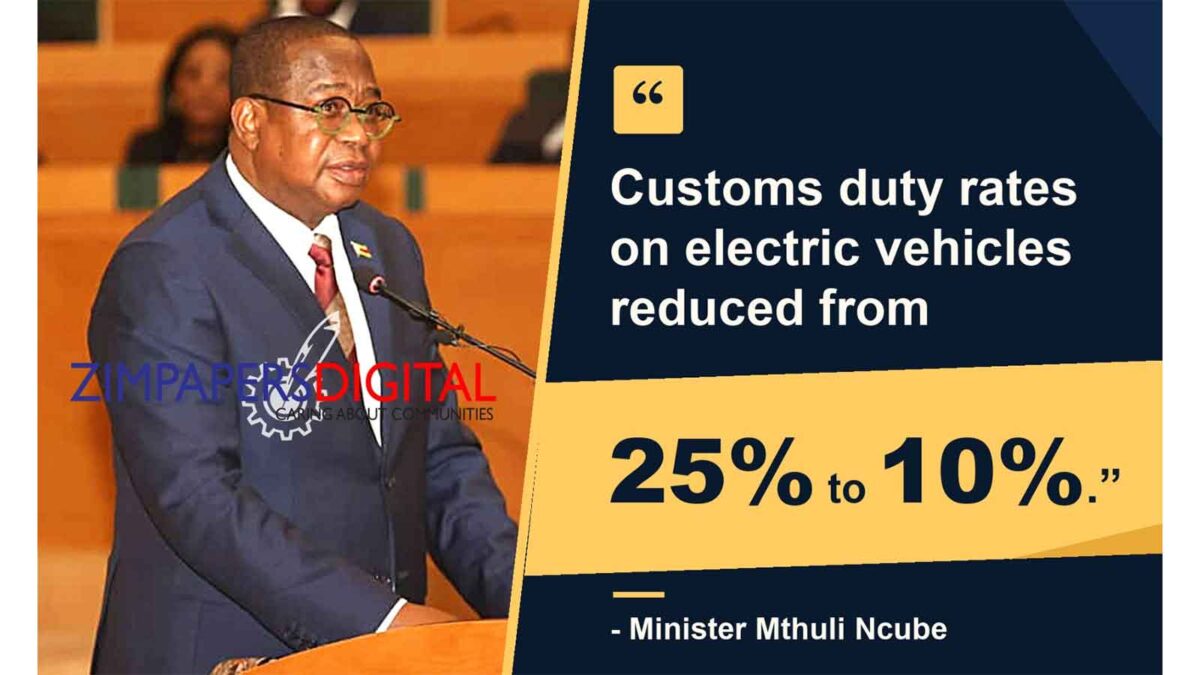
“To accelerate the transition towards a green economy, I propose to review customs duty rates on electric vehicles from 25 percent to 10 percent,” said the Minister.
Zimbabwe has already been moving steadily to cheaper EVs. The Government previously reduced import duty on fully electric vehicles from 40 percent to 25 percent, and in October 2026 removed duty entirely on heavy electric goods vehicles over five tonnes, from 25 percent to zero percent under SI 159 of 2026.
The 2027 proposal builds on that trajectory.
The policy logic is three-fold: a) Climate and fuel costs: EVs cut dependence on petrol and diesel, whose prices have risen by about 35 percent and 39 percent respectively since the onset of the Middle East conflict, according to the Budget. b) Industrial opportunity: Cheaper EVs create demand for local charging infrastructure, solar-powered charging stations — already eligible for a duty rebate — battery servicing, and technician training. c) Affordability: A further cut from 25 percent to 10 percent will significantly reduce the landed cost of an EV, making it more competitive against petrol and diesel models.
An analyst and businessman, Mr Louis Herbst, said: “The Budget’s emphasis on digitalisation, financial inclusion, technology and innovation is particularly significant.
“We should now move beyond policy recognition and accelerate the deployment of digital systems that improve revenue collection, formalise economic activity, reduce administrative inefficiencies, widen access to services and create a more transparent relationship between citizens, businesses and the Government.”