Online Reporter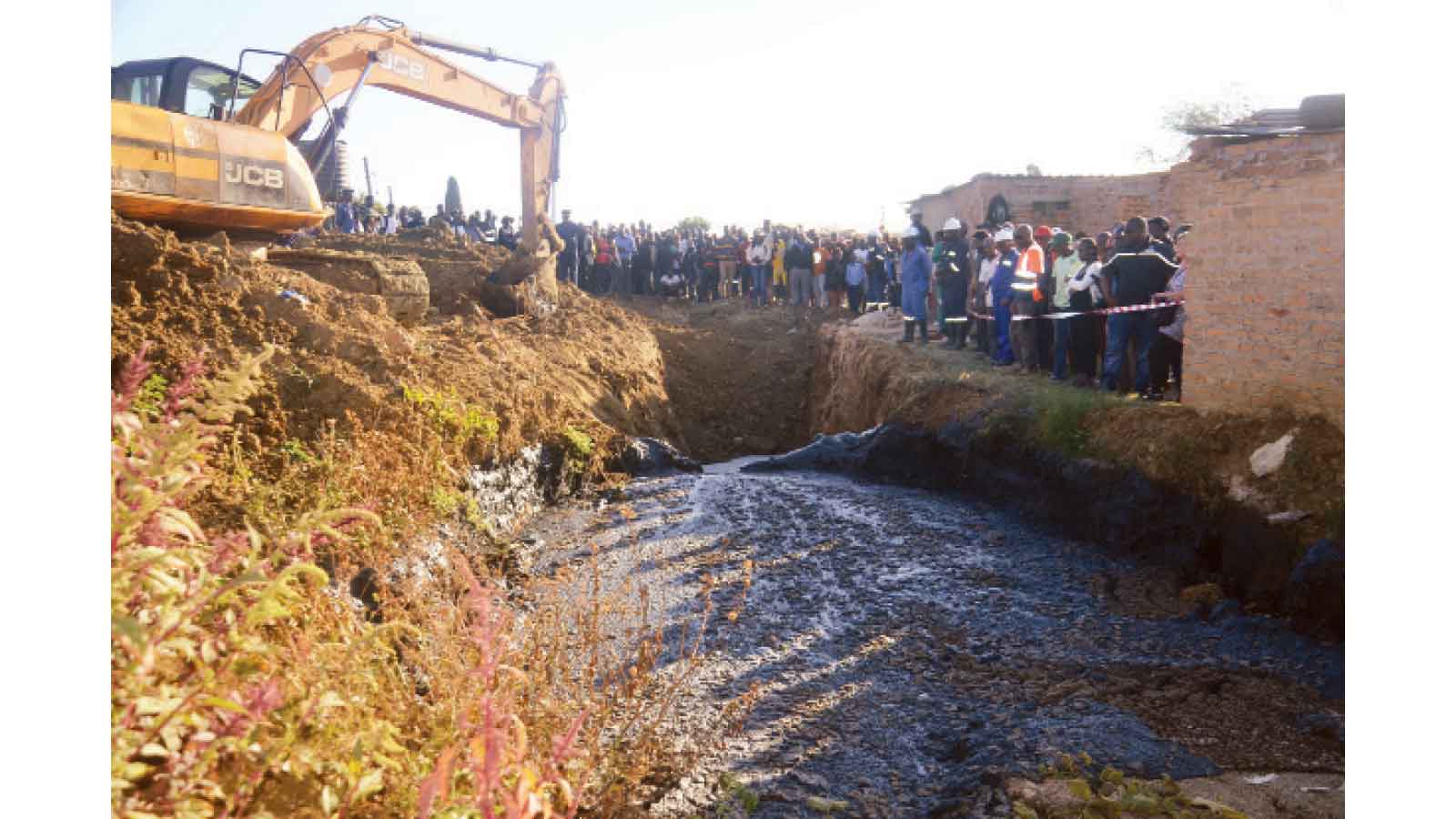
Anashe Mpamombe
THE recovery of three bodies from a sewer pit in Budiriro 3, Harare, has brought renewed scrutiny to safety management systems governing urban infrastructure projects carried out in densely-populated residential areas, where construction activity and everyday community movement frequently overlap.
The incident, which claimed the life of 19-year-old Saul Karakadzai after he reportedly fell into an open sewer excavation while using a footpath, took a more tragic turn when two additional bodies were later recovered from the same site during retrieval operations.
The total number of fatalities now stands at three.
What began as a single fatal accident has since evolved into a broader public concern, raising questions not only about the immediate circumstances of the tragedy, but also about the adequacy and enforcement of safety controls at active public works sites.
The incident has left families devastated and the Budiriro community in shock, while prompting wider reflection on how infrastructure projects are managed in high-density urban environments.
Urban infrastructure development, particularly sewer rehabilitation, water reticulation, and road maintenance remains a critical component of service delivery in cities and towns across Zimbabwe. These projects are essential for improving public health, enhancing water systems, and upgrading transport networks.
However, by their nature, they often involve excavation and trenching activities that temporarily disrupt the built environment and introduce significant safety risks if not properly managed.
In residential suburbs such as Budiriro, these risks are amplified by population density, limited space, and the constant movement of pedestrians who rely heavily on footpaths for daily commuting. In many cases, construction sites are not isolated from residential life; instead, they exist within it, often sharing space with schools, homes, markets, and informal pathways.
It is in this context that the Budiriro incident has highlighted the importance of robust and continuously enforced safety management systems. Excavation sites, particularly those involving deep trenches or open pits, are widely recognised in civil engineering and occupational safety practice as high-risk zones.
Standard protocols typically require that such sites be clearly demarcated, physically secured, and continuously monitored to prevent unauthorised access.
These measures generally include fencing or barricading, warning signage in visible locations, and, where appropriate, lighting or reflective indicators to ensure visibility at night. In some cases, temporary walkways or diversion routes are provided to safely redirect pedestrian traffic around active works. These interventions are considered basic safeguards in environments where public interaction with construction zones is unavoidable.
However, the effectiveness of such measures depends not only on their installation, but also on their maintenance and enforcement throughout the duration of a project. Where works extend over long periods or experience interruptions, safety controls can deteriorate if not consistently monitored. Temporary gaps in supervision, delayed repairs to barriers, or inadequate signage can all increase the risk of accidental entry into hazardous areas.
In Budiriro 3, residents reportedly indicated that the affected excavation formed part of a commonly used pedestrian route. This detail points to a recurring challenge in high-density urban settlements, where informal pathways often emerge over time and become embedded in daily movement patterns. When infrastructure projects are introduced into such spaces, they can unintentionally intersect with established community routes, creating points of vulnerability if alternative pathways are not clearly provided or enforced.
From a planning perspective, urban infrastructure projects are expected to incorporate comprehensive risk assessments prior to implementation. These assessments typically identify potential hazards, evaluate pedestrian movement patterns, and outline mitigation strategies, including traffic and pedestrian diversion plans. In densely populated areas, the provision of safe alternative routes is not merely an administrative requirement but a practical necessity.
The incident, therefore, raises important questions about whether such measures were sufficiently implemented and maintained at the site in question. While investigations would be required to establish the precise sequence of events, the outcome has already underscored the consequences of gaps in safety governance within urban construction environments.
Responsibility for safety in such projects is generally shared between local authorities and contracted service providers. Municipal councils are typically tasked with oversight, ensuring compliance with safety regulations and approved project plans, while contractors are responsible for day-to-day site management and implementation of safety controls. Effective coordination between these parties is essential to ensure that standards are not only defined but consistently upheld on the ground.
In practice, however, urban infrastructure delivery often takes place under conditions that can strain this coordination. Project delays, funding constraints, procurement challenges, and limited supervisory capacity can all affect the consistency of safety enforcement. In some cases, multiple contractors may operate across different sites simultaneously, further stretching oversight mechanisms.
Urban development specialists emphasise that excavation sites require continuous monitoring, particularly in environments where public access cannot be fully restricted. Unlike isolated construction zones, urban residential projects exist within living communities, where movement is constant and often unpredictable. This reality makes the physical separation between people and hazardous zones a critical safety requirement rather than an optional precaution.
Beyond physical controls, communication with affected communities is increasingly recognised as a key pillar of construction safety management. Residents need to be informed in advance about ongoing works, expected timelines, and any changes to pedestrian or vehicle routes.
Clear communication helps reduce uncertainty and allows communities to adapt their daily routines accordingly. Where such communication is weak or absent, the likelihood of unintended exposure to hazards increases.
Regular inspections and compliance audits are also integral to maintaining safety standards. These mechanisms are intended to ensure that contractors adhere to approved safety plans throughout the project life cycle, rather than only at the outset. When deficiencies are identified, corrective action is expected to be taken promptly to prevent escalation of risk.
The tragedy has therefore intensified discussions around strengthening safety governance frameworks for urban infrastructure delivery. It has highlighted the need for not only stronger initial planning but also sustained enforcement of safety measures, particularly in high-density suburbs where the interface between construction activity and community life is immediate and unavoidable.
At a broader level, the incident also raises questions about how success in infrastructure development is measured. While output indicators such as kilometres of sewer lines laid or number of projects completed remain important, there is growing recognition that public safety outcomes must be given equal weight. Infrastructure delivery that compromises safety risks undermining the very communities it is intended to serve.
Ultimately, the events in Budiriro 3 serve as a stark reminder that infrastructure development is not solely a technical or engineering exercise. It is also a social responsibility that requires careful attention to human movement, behaviour, and risk in shared spaces.
As cities continue to expand and service delivery demands increase, the challenge for urban authorities and contractors alike will be to ensure that safety systems evolve in step with infrastructure ambitions.
The goal must be to ensure that development not only improves living standards, but does so without exposing communities to avoidable harm.



 Peter Tanyanyiwa