

 admin
admin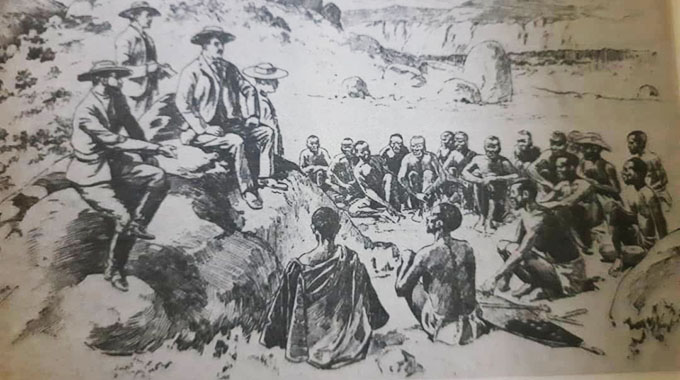
Elliot Ziwira Senior Writer
It is befitting that Zimbabweans celebrate 42 years of Independence from colonial rule for the first time outside Harare, precisely, in Bulawayo, under the theme “Zim@42: Leaving No One and No People Behind”, as the Second Republic takes every citizen on board.
Bulawayo, Zimbabwe’s second largest city, is both the site of the great robbery by colonists through the deceitful Rudd Concession; and the place for the birth of the struggle for independence.
The Rudd Concession between King Lobengula and a team representing Cecil John Rhodes headed by Charles Rudd, was signed at Bulawayo on October 30, 1888.
Bulawayo attained municipality status in 1897, and became a city in 1943.
For close to a century of colonial subjugation, the City of Kings defied Rhodes, the supremacist god of plunder, and the nomenclature enshrined in the hegemonic logic on which colonialism was hinged.
Bulawayo held on to its name, and even had suburbs named after its heroes—African heroes situated in their history. Suburbs that easily come to mind, and whose history has been explored by the historian Pathisa Nyathi, are Mzilikazi, Lobengula, Magwegwe, Makokoba, Nguboyenja, Matshobana, Njube, Sidojiwe, Pumula and Pelandaba,
Among other ills, colonialism was about replacing everything African; history, people, mindset, religion, culture, and above all, names, for it is in nomenclature that identity is located.
Through naming, a people derive meaning from the broader world surrounding and beyond it using language, itself a courier of culture and aspirations.
It follows, therefore, that the colonial project personified in Rhodes was to blot everything African as an ulcer worth of derision. Thus, making the African not only prey to colonialism, but also a victim of himself—a normless self-hater—who sees his culture as a “quintessence of evil”, as Franz Fanon puts it in his book, “The Wretched of the Earth.”
It is for his good that the African begins by loving himself and putting it clearly that he knows how much he is worth, for he did not learn of history or culture for the first time from Europeans.
Rhodes, “the Colossus”, had instilled in settlers, a foreboding sense of might in Rhodesia, a country considered to be “a land of hope, a romance with ‘boundless promise’ by the white people who did not seem to recognise the existence of the indigenous” peoples, to cite Rosemary Moyana in “Reading our past: an historical study of the white authored novel in Zimbabwe CA 1890-1994” published in 2017.
He was ruthless, selfish and had a callousness that could be “explained in the Althusserian concept of ideology as something that has its own existence” (ibid).
Rhodes’ word was law and anyone or anything, whether Black or White, that happened to cross his path to wealth and the Empire’s fortune was immobilised. To him the African was a child in need of guidance; and had neither history nor culture.
His arrival on the scene saw the death of all that was African. Shrines disappeared, names were bastardised and societies were displaced from their ancestral land. Everything had to be changed, beginning with names of places as the supremacist ideology held sway.
New names began to appear; Salisbury (Harare), Marandellas (Marondera), Belingwe (Mberengwa), Enkeldoorn (Chivhu), Essexvale (Esigodini), Fort Victoria (Masvingo), Gatooma (Kadoma), Inyanga (Nyanga), Matopos (Matobo), Que Que (Kwekwe), Hartley (Chegutu), Jombe (Zhombe) and Melsetter (Chimanimani), among others.
Setting the tone for struggle
The European’s image of Africa as an “accursed inheritance” inhabited by “prehistoric” men (Chinua Achebe, 1973), or with “no people” at all (“The Autobiography of Kingsley Fairbridge”, 1927), is telling of the way the African is perceived, and how the issue of his heritage as enshrined in the land, both tangible and intangible, should be viewed.
The tangible aspects of heritage relate to the physical and material gains or lack thereof, whereas the intangible relates to the spiritual, psychological and moral phenomena. The imperatives for colonialism cannot be fully understood in the absence of the human worth theory where the view is that some beings are superior to others because of race.
Records by colonists have pointed to the resilience of the Ndebele people as they were seen as the main aggressors against colonial occupation north of the Limpopo River.
They refused to be pushed around; they would rather die defending their dignity than cowardly cower to the caprices of colonial invaders.
Colonists would scornfully call them, like other black people across Africa, “aggressors”, “savages”, or “uncivilised barbarians”, but the Ndebele remained unperturbed.
Frederick Courtney Selous, a member of the British South Africa Police (BSAP) occupation forces, cited in an article by Nelson Chenga published in The Herald on 20 July 1999, wrote: “The year 1893, most fateful in the history of British enterprise in South Africa (South Africa), has passed and gone, but the events of that year, culminating as they did in the conquest of Lobengula, will never be forgotten by the colonists of Mashonaland, who will ever look back upon the Matabeli (Matabele ) War with feelings of pride mingled with sorrow.
“Sorrow for the comrades who have fallen in the struggle between civilisation and savagery; pride and, not alone in the valour of those dead comrades, but also in the steady courage and strength of purpose which marked the conduct of the whole campaign.”
Of interest here is how colonists, notwithstanding their contempt for black people, admit to their loss at the hands of the defiant warriors in defence of their land.
Collective memory recalls how General Mtshana Khumalo, who was King Lobengula’s Imbizo Regiment commander, routed the colonial bastion embodied in the colonial begot Allan Wilson’s (Allan Wilson Patrol) at the Battle of Pupu (along the Shangani River) on December 4, 1893, in spite of the superior weaponry at its disposal. The battle set in motion the wheels of resistance that halted Ian Douglas Smith’s colonial train on April 18, 1980.
NB: Details of General Khumalo’s military prowess and what happened after the Battle of Pupu will be covered in another instalment.
In Julie Frederikse’s “None But Ourselves” (1990), De Vere Stent, a journalist present at an indaba between Rhodes and Ndebele chiefs, towards the end of the Chimurenga of 1896, captures an interesting exchange involving the imperialist and a young son of the soil; a chief.
The young chief asks Rhodes a pertinent question: “Where are we to live when it is over? The white man claims all the land”.
The colonialist responds: “We will give you settlements. We will set apart locations for you; we will give you land”.
The irony of it is not lost on the young chief, who is aware that Africans should be the ones giving out the land and not the other way round. All the good soils were now in the hands of settlers on the basis of the legality of claims, and the desire to steal and pass on a heritage to their descendants.
Realising that mwana wevhu (son of the soil) is armed, Rhodes tries to persuade him to put down his rifle, but he refuses.
The young chief boldly tells the supremacist godfather: “I find if I talk with my rifle in my hand the white man pays more attention to what I say. Once I put my rifle down, I am nothing. I am just a dog to be kicked.”
There is no other way to fight colonialism except violence. The young chief, like the freedom fighters in the Second Chimurenga, is aware that decolonisation is as violent as colonisation (Fanon, 1967). There is no other language to use except Chimurenga.
KoBulawayo: Remaining true to origin
Old Bulawayo (KoBulawayo) was established by King Lobengula as his capital in 1870 following the death of his father, King Mzilikazi, on September 28, 1868. Named after the original Bulawayo built by the Zulu King, Tshaka, in South Africa, it is located about 20km south of present day Bulawayo.
Before then it was known as Gibxhegu.
Historians say the area had been known as a trading zone long before 1870. According to archaeological evidence, Old Bulawayo’s layout reflects the intricate heritage of the Ndebele people.
After 11 years of occupation, in 1881, Lobengula moved his capital to the present site of the Government’s State House in modern Bulawayo’s Sauertown suburb.
He is said to have ordered the destruction of the old settlement by fire, through his chief induna, Magwegwe, following the Pupu Battle of December 4, 1893.
According to Pathisa Nyathi (then education officer in the Ministry of Education and Culture), cited in Chenga (1999), the Ndebele did not keep “a permanent capital but a series of settlements”. Owing to environmental concerns, economic considerations and traditional religious beliefs, after some time settlements would be destroyed, particularly when they were no longer self-sustainable.
Traditionally, no evidence of the king was to be left behind in case it fell in the hands of sorcerers.
Said Nyathi: “The disposal of excreta and bones after every Inxwala (annual celebrations attracting thousands of people), was also a closely guarded secret, for example.
“After every major event like the Inxwala, all bones were gathered in one pile and closely guarded until the king personally supervised their destruction. The belief was that if an enemy got hold of any bone with the king’s saliva they could magically work it to harm him.”
In 1990, KoBulawayo was identified by the National Museums and Monuments of Zimbabwe as an educational and tourist centre.
To unlock the puzzle surrounding the powerful king and preserve Ndebele history, in 1998 the then Department of National Archives and Monuments, in liaison with the Khumalo family, began the reconstruction of Old Bulawayo as a theme park.
For the next five years, archaeologists, who often travelled to South Africa’s KwaZulu-Natal Province to learn how to build beehive-shaped huts making up Old Bulawayo, stitched together King Lobengula’s capital.
By 1999, in hemming together the story of Bulawayo, archaeologists had identified 19 original sites with huts located inside the palisade, covering an area of the size of two football fields within a two-metre high security fence made of mopani tree poles forming the boundaries of the royal residence.
Writes Chenga: “Inside the palisade the archaeologists are busy working on the reconstruction of the huts, Lobengula’s stone wagon shed, the cleansing hut used by Lobengula’s sangomas (n’angas) to cleanse warriors on arrival from patrols, and his five-roomed brick under thatch main house.
“A settler who befriended Lobengula, but only to spy on him, is said to have built the house” (The Herald, 20 July 1999).
Structures such as a wagon shed, the outer picket, King Lobengula’s palace, eight beehive-shaped huts and cattle kraal, as well as a nearby interpretive centre were reconstructed.
Unfortunately, in August 2010, a fierce bush fire consumed the site, destroying much of what had been rebuilt. Only the Interpretive Centre survived unscathed.
Efforts are currently underway to reconstruct the site.
Indeed Old Bulawayo should be reconstructed as it offers a window through which the Ndebele history could be viewed, as Nyathi aptly pointed out way back in 1999.
“The reconstructed city will provide a window into better understanding of Ndebele history. The scientific investigations currently being done will help us understand the Ndebele state, its economic and political nature,” he told The Herald then. “This should effectively remove the prejudices that have existed in the past. For example, that the Ndebele thrived on raiding other nations.”
Nyathi said investigations by the Department of National archives revealed that the Ndebele’s main economic activity was agriculture and not cattle ranching.



 Online Reporter