


 Vusumuzi Dube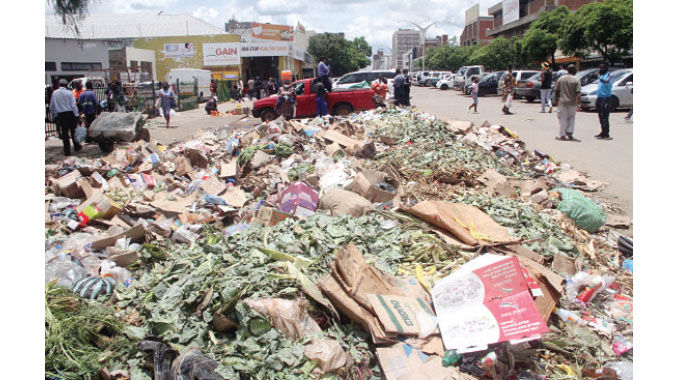
Vusumuzi Dube, Online News Editor
A growing population, a vending headache, compartmentalisation of chain stores and a lack of resources both human and material are part of the coterie of challenges that the Bulawayo City Council is fighting to regain the city’s status as one of the cleanliest in the region.
The local authority recently endorsed an anti-littering policy, which comes into effect immediately and which will see a strict enforcement of anti-littering by laws among other interventions. The policy comes at a time the Bulawayo City Council (BCC) has been struggling to contain litter in the Central Business District (CBD), a situation that resulted in the suspension of the director of health services, Dr Edwin Sibanda. In coming up with the policy, the local authority noted that a clean city is an embodiment of good management, it attracts investors, promotes ecotourism, and enables an aura of public safety.
“Immediate action has to be taken to restore the city to its former glory as everyone has a nostalgia for the yester clean city. It is indeed easy to talk of a clean city that we had back then however, it is more important now to interrogate the past to establish the then enablers for a clean city so as to fully understand the causes of rampant littering. Until the early 1990s, the City of Bulawayo was regarded as the cleanest city in the region. The city was characterised by litter-free streets, few illegal dumping spots and people who prided themselves in a clean city. At present, littering and dumping of refuse continue unabated in almost all areas of the city. The need to have a clean city can never be over-emphasised,” reads the report.

The local authority noted that the city was in a precarious position as, with a population of more than 700 000, and newer suburbs such as Cowdray Park, Emganwini, Pumula South and Mahatshula, among others, the environment section has only 170 employees, which was hindering its efforts to effectively collect litter in the CBD.
“The situation is set to be compounded further when areas that are part of Umguza such as Emthunzini, Mbundane, Hopeville and Lovendale, are incorporated into the city. Additionally, in the Central Business District, there has been an increase in activities. Premises that previously housed one business are now subdivided into a number of lettable units and this has seen a corresponding increase in waste generation. The Central Business District was not an area where vending was not pronounced but now the whole Central Business District is littered with vendors,” reads part of the policy.
As part of the intervention measures spelled out in the policy, the local authority will increase the number of refuse compactors, replace the ageing supervisory vehicles fleet to improve supervision of refuse collection, street sweeping, and monitoring of illegal dumping hotspots, increase staffing levels, intensify waste education and stakeholder engagement, improve enforcement and increase the number of litter bins.

“Previously, the section had 68 refuse vehicles. Among those vehicles, was a fleet dedicated to the removal of street sweepings in the city. Presently, there are only 26 (17 refuse compactors but three compactors have been recommended for disposal, eight supervisory vehicles but most are frequently breaking down as they are more than 20 years old and one three-tonner) refuse vehicles and no fleet dedicated to the removal of sweepings in the Central Business District.
“Sweepings are collected once a day together with bins from premises and this is contributing to the ever-present waste in sanitary lanes. Due to a scarcity of resources, there are 382 bins in the Central Business District instead of the ideal 600 bins. The cleansing workshop has the technical capacity to make the bins in-house however, a shortage of inputs is hampering their efforts,” reads the policy.
The local authority further noted that the increased population of both legal and illegal vendors in the Central Business District has exacerbated the littering problem.
“The increased population of both legal and illegal vendors in the Central Business District has exacerbated the littering problem. Places that are frequented by illegal vendors have been noticed to be the most littered and there is need to attend to this issue if the city is to be clean. Furthermore, some policies, for example, maize roasting in the CBD are not aiding our cause.
“Furthermore, it is worth noting that in the past people were generally fearful of prosecution. Just a mere sighting of a post written ‘Littering is prohibited, offenders would be prosecuted’ was enough to solicit co-operation from residents, yet these days people have made light of enforcement processes,” reads the policy.



 Bongani Ndlovu
 Online Reporter