Online Reporter
Raymond Jaravaza, [email protected]
JAIROS Maropa, a long-time resident of Burombo Flats in Nguboyenja suburb, Bulawayo, has lived in the multi-storey housing complex for the past 30 years. He says his heart bleeds each time he walks around the three blocks of flats and sees sewage flowing in every direction.
Burombo Flats, an iconic housing structure accommodating hundreds of families in three towering buildings visible along the busy Luveve Road, remains a prominent feature on Bulawayo’s urban landscape.
The housing units are named after one of Zimbabwe’s founding nationalists and trade unionists, the late Benjamin Burombo, who led workers’ strikes against racial discrimination during the Rhodesian era. Born in 1909 in Buhera, Manicaland Province, Burombo died in 1959.
The Bulawayo City Council (BCC)-owned property has deteriorated over the years due to a lack of maintenance. While it still tells a unique story of a pioneering freedom fighter, residents feel abandoned by those responsible for their welfare.

On Friday afternoon, the Saturday Chronicle spent time speaking with residents of Burombo Flats, who had much to say about their living conditions.
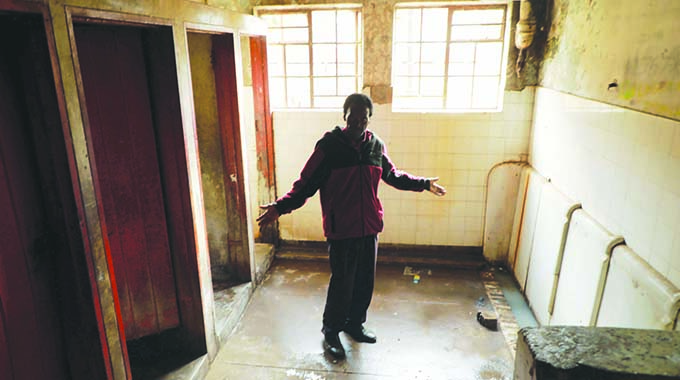
Maropa took the news crew on a brief tour of the flats, detailing the appalling conditions he and fellow residents endure daily. The first stop was a toilet he said is shared by more than seven families, each with at least six members.
“Just look at this toilet and how filthy it is. Seven families, each with six to eight members, are expected to share this one toilet. It’s not right. What choice do we have? Our children and wives are forced to use these toilets because we have no alternatives,” said Maropa.
Next, he led the team to the communal laundry area, where 71-year-old Dene Dube said that she shares the space with more than 50 families, mostly women washing clothes and school uniforms for their children.
Despite her age, Dube said she must wake up early each morning to fetch water before supplies are cut off, so she can wash her grandchildren’s clothes and prepare them for school in nearby Mzilikazi suburb.
“I’m too old to be waking up at 4am, pushing and shoving with younger mothers to fetch water for my grandchildren. Sometimes they feel sorry for me and let me go first so the children can get to school on time,” she said.
Burombo Flats comprises three blocks, each housing hundreds of families. According to Block Three chairperson Anne Makhalima, rent is US$12 per unit per month.
“I’ve lived here for 50 years, and this is the worst it’s ever been. Sewage flows everywhere daily — we’ve become used to it,” said Makhalima.
Outside Block Three, Maropa pointed to the daily struggles residents face — sewage spewing from leaking pipes into the streets, where children were seen playing football or running around, unaware of the health risks they were exposed to.
Across town in Sizinda, another health hazard looms at Sidojiwe Flats, where hundreds of families live in similarly dilapidated conditions. Working plumbing systems are a luxury at Sidojiwe. Former residents’ chairperson Cornelius Nyathi described the daily hardships of life in the rundown housing complex.

“I live in Block 3 at Sidojiwe Flats and have been here for 60 years, but I can’t remember the last time we had running water or working toilets,” he said.
Many windowpanes at Sidojiwe are broken, with residents using cardboard and plastic to cover them. In some entryways, visitors are greeted by the stench of bat droppings, human urine, and faeces left by residents too lazy — or unable — to use the nearby bush.
“We don’t have functioning toilets, and some residents, especially children, just relieve themselves on the floor. Who can blame them?” asked Nyathi.
A resident who requested anonymity said she lives in a block housing more than 60 families, all without access to running water.
“We have an NGO that supplies us with water weekly, but it’s not enough. Sidojiwe Flats has three blocks with over 60 families—we need constant running water for household use,” she said.
Several years ago, the Government declared both Burombo and Sidojiwe Flats unfit for human habitation, describing them as a health time bomb.
Authorities noted that both housing complexes were overcrowded and failed to meet acceptable standards for human occupancy.