

 Chronicle Editor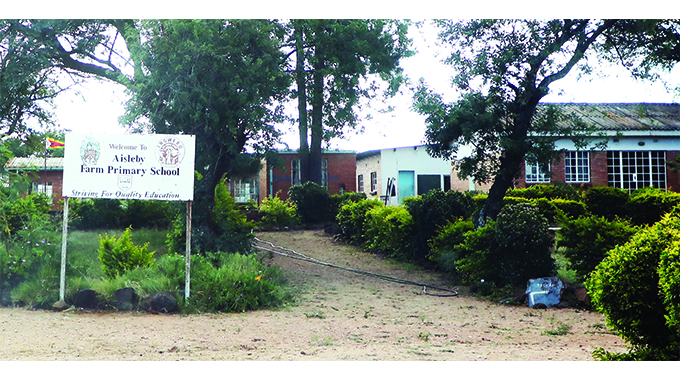
Thandeka Moyo-Ndlovu, Senior Reporter
ABOUT 7km from Trenance suburb lies Aisleby Primary School — one of Bulawayo City Council run schools, which has become the worst performer in the city in terms of examination passes.
It is surrounded by a number of illegal settlements whose occupants make up a majority of parents whose children learn at the school.
Most of these are unemployed widows and single mothers with no source of income.
They do not only have means of survival, but the same community sees no value in education, let alone afford its associated costs.

Running water is a scarce commodity in the area, which relies on the polluted Mazai River, which feeds off the Aisleby Waste Treatment Plants. With no access to public transport, learners have to walk at least 12 kilometres to and from school daily.
School teachers who do not live within the dilapidated farm compound also face the same predicament as the pick-up and drop-off point is 6km away from the school.
One can easily mistake the school for a typical neglected facility with just a few buildings, overgrown grass and no sign of consistent maintenance. A majority of learners whose enrolment stands at 285, do not pay fees and their parents encourage absenteeism from school for no apparent reasons. In 2021 the enrolment at Aisleby was 285 and there were 34 Grade 7 learners, in 2020 it was 279 and 23 Grade 7 learners, while in 2019 it was 219 with 17 Grade 7 learners.

For the past two consecutive years, Aisleby recorded zero percent pass rate according to council standards and remains one of the most consistent worst performing schools.
According to BCC, the school’s pass rate has remained lower than 20 percent for the past 10 years except in 2018 where it stood at 60,78 percent.
In 2011 the rate was eight percent and it went down to 4,55 percent in 2012 and slightly up to 7,69 percent in 2013 before rising to 10,71 percent in 2014.
The following year it went up to 11,54 percent and rose to 19,23 percent in 2016 before the rate dropped to 15 percent in 2017. In 2018 the rate improved to 60,87 percent and went down to 16,96 percent in 2019 before it stood at zero for both 2020 and 2021. The school has a total of eight teachers and five share three houses in the compound, which has no access to electricity.
Aisleby also does not have any ECD block, which is mandatory according to Government policy and the few classroom blocks are not adequate for the current enrolment.
Chronicle caught up with the chairperson of the School Development Committee, Ms Siphiwe Dube, yesterday who said neglect was the major challenge affecting Aisleby. She said the school was treated like an ordinary rural institution hence no action towards its development.
“The standard of everything here is low and could be the reason why no one takes the school seriously. For starters only a handful of squatters are able to pay $4 000 school fees,” she said.
“Children just go to school, some without uniforms and a majority are ever absent from class with blessing from their parents.
“These same parents are not worried about the academic performance, which makes it difficult for teachers to enforce strict attendance.”
Ms Dube said near the squatter camp was Trenance Primary School, but many of the residents could not afford fees.
“Teachers work hard to teach our children but their efforts always come to waste as parents are not pro-education.
They are comfortable with making their children miss school. In fact they would rather have them stay at home than go to school, which is a sad development,” she said.
One of the committee members who spoke on condition of anonymity said authorities did not take the school seriously as they despise the parents and guardians “who are nothing but mere squatters”.
“Some of us are in the committee but we do not qualify to sign for school accounts as bank officials disqualify us for not having proper residential addresses,” said the member.
“Our children suffer neglect because we are poor and no one cares about their future, which should not be affected by our own socio-economic status.
“Teachers are also discouraged to work here because they have no decent houses and those who commute daily have to walk 12km daily to and from the public transport drop off point. Surely our children cannot perform miracles, they do not even have textbooks and other essential academic material to motivate them to study.”
Council corporate communications manager, Mrs Nesisa Mpofu, said: “Aisleby is a peri-urban school located in the City of Bulawayo Aisleby Farm. Most learners come from disadvantaged families from squatter camps around the Cabatsha area.
“Some live in a compound kind of setup, which may be a challenge on its own. While the school has not performed well in the past two years the pass rate was better in previous years.”
She said council and parents would like to have all learners doing very well and passing their national examinations.
Mrs Mpofu said the council was working with the school administration and the Ministry of Primary and Secondary Education to find ways of harnessing the issue of high staff turnover.
“Efforts are being made to procure additional teaching and learning materials for the competency-based curriculum. Council remits funds to the school for sports and textbooks. Plans to build individual teachers houses are in place and await capital funding,” she added.

Mrs Mpofu said the schools feeding programme being spearheaded by the Government will help assist the school to retain learners, thus, aiding the improvement of the pass rate due to improved school attendance.
The councillor of the area, Joyce Ndlovu, said there are many challenges to be addressed before the school can record a better pass rate.
“The truth is learners walk very long distances to the school and it’s mainly those who cannot afford nearby schools,” she said.
“They walk all the way from Richmond and they do not have books or study material in addition to the fact that there are no cottages for teachers,” said Clr Ndlovu.
“The Covid-19 worsened the situation hence the zero percent pass rate and council is doing everything to improve the situation.”
-@thamamoe
Ends CKD PN



 Online Reporter