Online Reporter
Nqobile Bhebhe, Zimpapers Business Hub
THE Reserve Bank of Zimbabwe (RBZ)’s push to expand availability of the Zimbabwe Gold (ZiG) currency across both cash and digital platforms, is drawing widespread commendation from economic analysts and business leaders amid rising adoption and improved transactional efficiency across sectors. Introduced on 5 April 2024, as part of a broader monetary stabilisation and dedollarisation strategy, ZiG is steadily maturing from a transitional currency into a foundational pillar of Zimbabwe’s evolving financial architecture.
Analysts now regard the RBZ’s phased rollout, underpinned by calibrated liquidity provision and a robust digital payments ecosystem, as critical to fostering long-term macroeconomic resilience.
RBZ Governor, Dr John Mushayavanhu, recently reaffirmed the central bank’s commitment to ensuring adequate liquidity to meet public and business demand, noting that as of June 12, 2025, total ZiG deposits in the economy stood at approximately ZiG16 billion with more than ZiG207 million held in physical cash by banks.

“The Reserve Bank has been disbursing adequate cash to banks in line with demand… the cash held by banks meets optimal requirements and is sufficient to support daily deposits and withdrawals by the public,” said Dr Mushayavanhu.
The central bank’s approach is not only addressing past liquidity shortages, especially in rural and informal trade settings, but is also strengthening trust in the local currency through reliable formal financial channels.
One of the most notable developments has been the exponential rise in electronic payments.
Data from the National Payment System shows that ZiG-denominated settlements rose from ZiG786 billion in April 2024 representing 26 percent of total transactions to ZiG56.8 billion by 30 May 2025 or 43 percent. This shift reflects increased public confidence in digital currency usage, driven by wider mobile banking adoption, growing ATM reconfiguration to dispense ZiG and broader integration of point-of-sale platforms.
Retailers and service providers are reaping the benefits through improved cashflow, lower transaction costs and reduced exposure to counterfeit risks.
“If banks make ZiG notes available, we will use it more,” said Mrs Sarah Mbendera, a clothing trader in Bulawayo Business District.
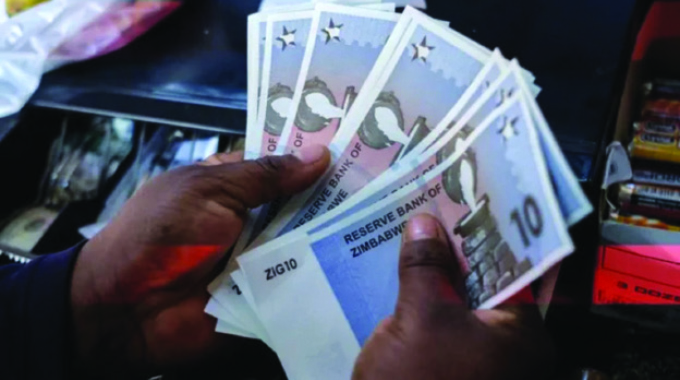
“The key is that it must work all the time not just in town, but in the locations too. For us Bulawayo’s informal sector, consistent availability of ZiG notes means smoother cash flow cycles, better pricing clarity and reduced dependency on electronic platforms that many still struggle to fully adopt.”
He added that widespread cash circulation, especially in smaller denominations, is key to anchoring public trust in the new currency.
Going forward, sustained efforts to meet trader demand, especially during peak business hours, will be critical to cementing the ZiG as a reliable medium of exchange in Zimbabwe’s second-largest city, she added. RBZ’s partnership with commercial banks to decentralise access is thus proving critical for both formalisation and broader financial inclusion.
Economist, Ms Alice Chikonzi, praised the RBZ’s dual focus on liquidity and digital payments, describing it as vital to building a more transparent and efficient economy.
“Reducing dependence on physical cash encourages formalisation of the economy, enhances traceability of transactions and ultimately builds a more robust and transparent financial system,” she said.
“As long as the infrastructure to support digital payments is in place across all regions, this direction aligns well with global best practices and positions Zimbabwe favourably in the long term.”

Business strategist, Mr Busani Malaba, also lauded the central bank’s methodical currency rollout, crediting it for rebuilding public confidence.
“What we are seeing is a deliberate calibration by the RBZ to support both transactional needs and macroeconomic stability. Confidence is not built overnight but when currency is reliably accessible and functions smoothly in digital and cash formats people begin to trust and use it,” he noted.
“If maintained, this dual approach could help Zimbabwe establish a durable monetary framework that gradually reduces the economy’s over-reliance on the US dollar.”
The International Monetary Fund (IMF) has also taken note of the narrowing spread between the official and parallel exchange rates — a development widely seen as indicative of growing faith in Zimbabwe’s monetary policy.
“We see good stability in the official market, and we also see a convergence between the parallel market rate and the official rate . . . ideally and ultimately we would like to see an elimination of this gap,” IMF mission chief Mr Wojciech Maliszewski said recently. In its latest update, the Monetary Policy Committee also noted improvements in the wider usage of ZiG in the economy as a result of the prevailing stability in macroeconomic conditions.

“The proportion of local currency transactions on the National Payments System increased from ZiG7.9 billion (26 percent) in April 2024 to ZiG56.8 billion (43 percent) as at 31 May 2025.
“The MPC also noted the continued full coverage of ZiG reserve money (ZiG4.7 billion) and the entire local currency deposits (ZiG15.5 billion) by foreign currency reserves (US$701 million equivalent to ZiG18.9 billion) as at 13 June 2025. This was observed as important to support the stability of ZiG,” it said.
The tight monetary and fiscal stance jointly pursued by the RBZ and Treasury is further underpinning confidence.
By restricting excess liquidity and avoiding quasi-fiscal activities through the central bank, the authorities have managed to curb speculative pressures and stabilise inflation dynamics.
As of May 2025, Zimbabwe’s month-on-month inflation measured in ZiG stood at 0.9 percent, up from 0.6 percent in April, while US dollar inflation fell to -0.3 percent from 0.2 percent in April. The overall inflation picture remains within target bands set by monetary authorities, with ZiG’s stability anchoring price trends.
According to the Zimbabwe National Statistics Agency (ZimStat), the weighted average monthly inflation rate fell to zero percent in May from 0.3 percent in April, reflecting sustained disinflationary pressures.
With ongoing assurances from the RBZ on the adequacy of ZiG supply and strengthened digital infrastructure the currency is gradually assuming its role not only as a medium of exchange but also as a vehicle for broader economic transformation.
What began as a stabilisation tool is now evolving into a trusted component of Zimbabwe’s economic ecosystem supported by sound policy, institutional credibility and public buy-in.
As stakeholders increasingly transact in ZiG whether via mobile wallets in high-density suburbs or through digital bank platforms in commercial zones the currency’s legitimacy continues to deepen, laying the groundwork for a more stable and inclusive financial future.