Online Reporter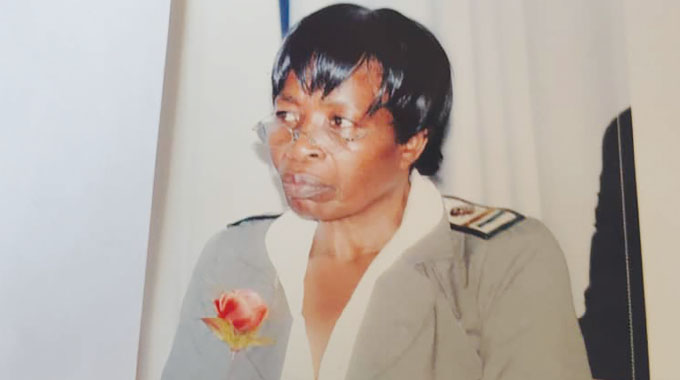
Robin Muchetu, Health and Gender Editor
WHILE some people join certain professions out of desperation or simply out of lucrativeness in perks, others are called and once they are in, they perform their duties not only with detailed discipline but with natural dedication and undiluted passion that takes little cognisance of the rewards.
The difference is that those who are called to execute their duties with a sense of purpose, loyalty perseverance sometimes go out of their way to make sure services are provided.
That has been the case for Matron Vongai Chimbindi who for four decades has walked the length and breadth of Ingutsheni Central Hospital in Bulawayo offering care and support to the vulnerable members of the community — the mentally ill.
Hers is a testament of true passion and dedication to duty and to her calling — to her conscience.
Now a Senior Nursing Officer (III) and the Public Relations Officer for Ingutsheni Central Hospital and St Francis Children’s Home, Matron Chimbindi said she came from a family of nurses which motivated her career choice.

“I did my general nurse training at Sally Mugabe, formerly Harare Central Hospital in Harare in January 1975 to 1978. I worked there for two years and then advanced to do midwifery at the same place and later moved to Chipinge District Hospital for a year as a newly qualified midwife. I then moved to Ingutsheni for psychiatric nurse training,” said Matron Chimbindi.
She trained from July 1982 and worked there for a while before moving to another psychiatric hospital — Ngomahuru in Masvingo for a bonding period.
In 1985, she moved to Ingutsheni in Bulawayo where she rose through the ranks and established her name in the field.
While many shy away from being associated with a psychiatric institution, Matron Chimbindi said she found a home within the walls of Ingutsheni Central Hospital.
“When I did midwifery, I really enjoyed my training and work, there is a lot of responsibility dealing with two lives, of the mother and the baby. Everybody would be on their toes to make sure that nothing goes wrong, we wanted safe delivery of a baby who is well. However, post-psychiatric training I realised I hardly saw any deaths in a psychiatric unit, hardly, versus the maternity wards. All the deaths we witnessed on the general wards too also affected me while in psychiatry we never experienced that. We talk a lot to the patients, finding out their history as part of therapy so it was much more workable than other hospital units,” she said.
Matron Chimbindi said the 40 years she has spent at Ingutsheni have made her appreciate what society calls “madness”.
“Before we came here, we called it madness, then we realised it is an illness. My own father did not understand when I chose this career path, he said the patients would beat me up. A colleague even said psychiatric nurses and staff that worked at Ingutsheni eventually broke down mentally and became patients themselves. They said I would not be the same (mentally) after working at Ingutsheni,” she said.
However, she said she began to understand even her own relatives who had mental health problems after working at the psychiatric hospital. She said mental illness is like any other chronic disease such as hypertension and diabetes where one takes medication all their lives.
She said various theories are tabled when one is admitted to a psychiatric institution such as ngozi/uzimu, witchcraft and financial enrichment by a family using the “brains” of one member saying some theories are to be dismissed as mental illness can affect anyone at any time.
“People look at mentally ill people and accuse them of various things and they are usually judged but when we do our studies, we realised they are innocent victims of a condition just like any other. When people see us creating friendships with our patients, they then think we are also mentally ill that is why we befriend them. But some stay here for years on end and a bond grows inevitably,” she added.
St Francis Home is an annex of Ingutsheni Central Hospital, it caters for children who have varying degrees of disability who need special round the clock care and Matron Chimbindi acts as the PR officer for the institution.
She said her first visit almost made her change her mind about psychiatry.
“During training, I visited the home and the conditions of the children, before I got used to them, really upset me. Again, if you are young and pregnant and you see the children, you wonder how it happened, and if you will have a child like that. I realised that in a way, us as medical professionals might actually have caused some of those conditions when we were doing midwifery,” said Matron Chimbindi.
She remembers vividly, a Ministry of Health official who visited the institution for graduation and requested to visit the home.
“After he saw the children, he said all junior doctors and trainee nurses must pass through St Francis so that they know and account for their responsibilities in the maternity units. He said the time that is taken to attend to the pregnant woman and the use of instruments during delivery can cause some of the conditions. He said the health workers were to get an appreciation of the responsibility in their hands when dealing with pregnant women and newborns if they did not do it right. This made me appreciate our role,” she said.
Matron Chimbindi said nursing was a prestigious career back in the day and it was not easy to secure a place to train. However, she said she feels that things have changed over the years.
“Our training was tough but people were really committed to the profession. Our senior trainers were strict disciplinarians and it was hard but, in the end, it produced nurses who did things right, who were dedicated and accountable. While our young ones today are too relaxed from what I see, there is a lot of change in how they take their profession,” she said.
Matron Chimbindi said the laxity and carefree attitude that is being experienced in health institutions has affected the profession.
“The public is taken for granted and we get a lot of complaints, in some cases they lose confidence in us as nurses and do not respect us. This complicates things because we end up spending a lot of time trying to solve problems rather than seeing patients,” she lamented.
Back in the day she said qualified nurses were forced to resign if they fell pregnant and would re-apply to join the profession and promotions would not come easy if one kept back tracking.
“The current maternity leave that nurses are enjoying only became effective around 1983, they then said one can go on maternity leave and return to work with their rank. Breastfeeding time only came into effect later on, that is why people had to resign as you were not given time for that, it was your own problem. It then became easier much later,” she recalls.
In the year 2000 she furthered her studies and attained a Bachelor of Nursing Science Degree. — @NyembeziMu