Business Reporters
BUSINESS lobby groups and economic analysts have commended the 2027 National Budget, saying the fiscal plan will safeguard macroeconomic stability, contain the fiscal deficit and cushion citizens against climate shocks.
Presented to Parliament on Thursday under the theme, “Accelerating Economic Transformation and Building Resilience to Climate and Global Shocks” Finance Minister Professor Mthuli Ncube’s 2027 National Budget balances cautious macroeconomic projections against targeted tax relief, industrial incentives and climate-readiness measures.
“This is a Budget to accelerate transformation, protect our gains and build resilience for every Zimbabwean,” Minister Ncube said.
With projected 2027 expenditures of ZiG358,3 million (about US$12,8 billion) against revenues of ZiG349,5 million (roughly US$12,5 billion), the budget maps out a modest overall deficit of ZiG8,76 billion (-0,5 percent of GDP), while steering resources towards key infrastructure, social protection, drought resilience and domestic value addition.
The Budget anchors year-on-year ZiG inflation at around 4 percent and projects a contained budget deficit of 0,5 percent of gross domestic product, based on total revenue of ZiG349 billion against expenditure of ZiG358,3 billion.
Economic growth is projected to moderate from an estimated 5 percent in 2026 to 3,5 percent in 2027 due to the anticipated El Niño weather effects before rebounding to around 5 percent in 2028/29.
The Treasury has set aside US$400 million for drought mitigation, ZiG21 billion for social protection, alongside 365 000 tonnes of imported maize in the Strategic Grain Reserve as of October 2026.
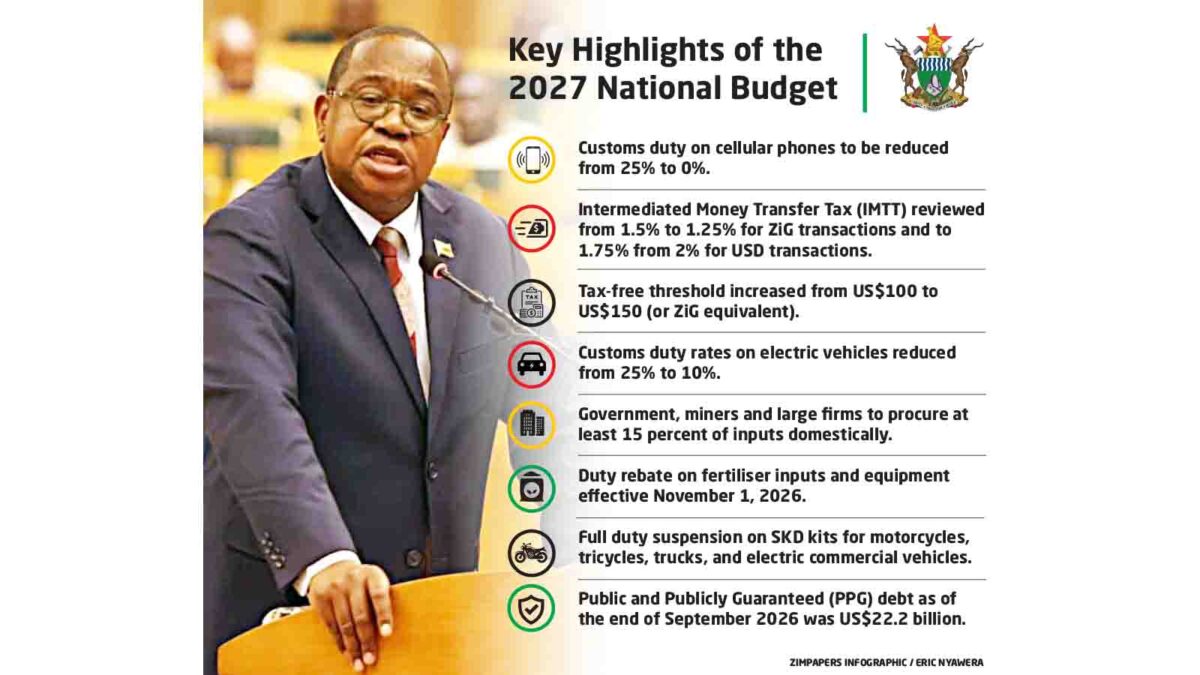
The Budget proposed no new taxes, nor did it increase the existing ones. It has raised the monthly tax-free income threshold from US$100 to US$150 and cut the Intermediated Money Transfer Tax (IMTT) by 0,25 percentage points from 1,5 percent to 1,25 percent on ZiG transactions and from 2 percent to 1,75 percent on US dollar transactions.
This will set back Treasury by an estimated revenue cost of US$120 million, but Prof Ncube is confident that more efficient tax administration and collections will make up for this lost revenue.
The Budget cut customs duty on mobile phones to zero and on electric vehicles from 25 percent to 10 percent, while mandating at least 15 percent local procurement.
It introduced a fertiliser manufacturing rebate and suspended duty on completely knocked-down motor vehicle kits.
Maji-Marefu Institute executive director Dr Tapiwa Mashakada said the fiscal plan balances stabilisation with drought readiness while holding the line on taxes.
“The 2027 National Budget demonstrates the Government’s determination to sustain macroeconomic stability while building resilience against climate change and external economic shocks,” Dr Mashakada said.
He said industrial incentives and gross domestic product numbers must be backed by reliable electricity, better public healthcare, water and sanitation, urban road maintenance and irrigation infrastructure to prevent newly built dams from becoming underutilised assets.
“The ultimate test of economic transformation is not simply the growth of GDP or the expansion of national revenues,” said Dr Mashakada.
“It is the extent to which ordinary citizens experience improvements in their livelihoods and opportunities.”
The Zimbabwe National Chamber of Commerce (ZNCC) noted that discipline stopped short of deeper structural reform.
“The Minister (of Finance Prof Mthuli Ncube) chose a fiscally cautious Budget rather than a pro-business shock therapy budget,” chief executive officer Dr Chris Mugaga said, adding that businesses would likely view the plan as stable and prudent, yet insufficiently bold to materially lift competitiveness.
Dr Mugaga said the IMTT cut falls short of business calls for abolition or a 1 percent rate and “does not materially alter investment or operating decisions”.
On foreign direct investment, which stood at US$992,7 million in 2025 and US$565,4 million in the first half of 2026, Dr Mugaga said new Special Economic Zones and tax incentives are secondary to operating trust.
He added that scrapping capital gains taxes on the Zimbabwe Stock Exchange only partially addresses migration to the US dollar-denominated Victoria Falls Stock Exchange (valued at US$8,3 billion).
Economic analyst Mr Reginald Shoko hailed the 2027 National Budget for ring-fencing procurement for capable local industries to boost domestic production and for cutting IMTT rates.
Bulawayo-based businessman and former Zimbabwe National Chamber of Commerce vice president (Matabeleland region), Mr Louis Herbst, described the IMTT rate cuts as a positive step and demonstrated a willingness to progressively review the cost of transacting within the economy.
“I believe this process should continue progressively. Lower transaction costs can encourage greater use of formal financial channels, stimulate digital payments, improve liquidity and support SMEs,” he said.
Mr Herbst said ultimately, the objective should be to make it easier and more affordable for money to circulate within the economy, while increased economic activity, formalisation and a broader tax base can, in the long run, be just as valuable as higher rates of taxation.
While applauding Treasury’s US$400 million drought mitigation allocation, commentators argue that Zimbabwe must shift away from reacting through food imports and instead build sustainable agricultural infrastructure.
What it means for
corporates, economy
Businesses face a mixed landscape of targeted input rebates, lower electronic transaction charges and stricter compliance and infrastructure rules.
Fertiliser manufacturers will gain a rebate of duty on raw materials, specialised intermediate inputs and capital equipment, while approved local motor vehicle assemblers receive a suspension of customs duty
on selected semi-knocked-down (SKD)
kits.
Lower IMTT rates trim routine commercial payment costs, which for years businesses have lobbied to have cut or scrapped.
Under the drought readiness framework, the private sector is permitted to import cereal and stock feed to help bridge domestic food and feed gaps while creating opportunities for enterprise profit and growth.
Capital expenditure is budgeted to rise to ZiG73,58 billion (3,8 percent of GDP) in 2027 from ZiG41,10 billion (2,3 percent of GDP) in 2026, supporting transport, water/dam projects (such as Gwayi-Shangani Dam at 82 percent and Kunzvi Dam at 76 percent), key to building resilience and supporting business, economic growth and development.
Banking sector stability remains a supportive anchor, with non-performing loans (NPLs) at 3 percent in September 2026, below the 5 percent benchmark, providing a safe and stable financial system to support economic and business activities.
Analysts said maintaining a 0,5 percent of GDP deficit alongside rising capital spending tests the Treasury’s ability to protect macroeconomic stability while funding resilience.