Taking Stock
Kudzanai Sharara
In Zimbabwe’s highly informalised economy, corporate earnings are often the most reliable macroeconomic indicators we have.
The latest round of financial disclosures from four of the Zimbabwe Stock Exchange’s (ZSE) heavyweights — Delta Corporation, Innscor Africa, Simbisa Brands and Axia Corporation — offers a fascinating, if nuanced, reflection of consumer confidence and the underlying health of the economy for the quarter and half-year ended September 30, 2026.
Collectively, these companies touch almost every facet of the Zimbabwean consumer’s daily life, from a pint of beer and a chicken pie to a mattress and a television set.
By synthesising their results, a clear narrative emerges: the formal economy is experiencing a resilient, volume-led recovery, underpinned by a return to durable currency stability, though a bifurcated market and intense pressure from the informal sector remain significant hurdles.
The macro backdrop: Stability breeds spending
The consensus among the management teams is that the macroeconomic environment in Zimbabwe has been notably more benign compared to recent turbulent years. Both Simbisa and Axia explicitly point to “relative exchange rate stability” while Innscor notes “relative stability” in the first quarter of its 2027 financial year.
Axia highlights “low inflation” and “local currency stability” as key enablers, resulting in a robust operating environment where 97 percent of Delta’s gross sales contribution is now in USD.
This stability has done wonders for consumer confidence.
When consumers do not have to worry about the daily erosion of their purchasing power, they spend.
This is vividly illustrated by Simbisa’s 10 percent increase in customer volumes and a 12 percent improvement in average spend, pushing group revenue up by an impressive 24 percent to US$104,4 million.
Discretionary vs staple
The performance of these blue chips reveals a shift in consumer behaviour. While consumer confidence is improving, it is anchored in value and convenience rather than blatant extravagance. Innscor’s results are a testament to this.
The group recorded solid volume growth across its core business, with its National Foods division seeing aggregate sales volumes up 22 percent.
This suggests that the bread-and-butter of the Zimbabwean pantry —maize meal, flour and cooking oil — remains in high demand.
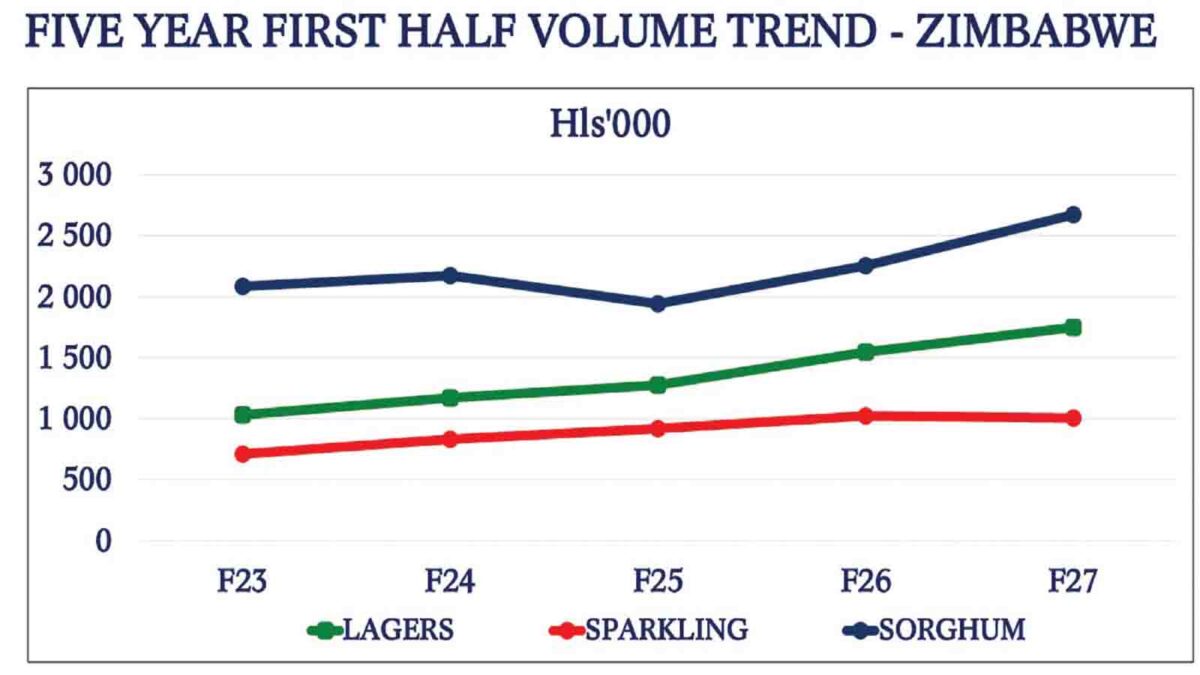
Delta’s results mirror this basic demand, with Sorghum Beer Zimbabwe volumes rising by 19 percent, indicating that the economically sensitive consumer is still willing to part with disposable income for affordable, traditional social lubrication.
On the more discretionary side, Axia’s TV Sales & Home posted a staggering 52 percent revenue increase, driven by a 42 percent jump in volume sales.
To put this into perspective, buying a television or a lounge suite is a significant capital outlay for a Zimbabwean household.
The fact that volumes in Axia’s Restapedic Lounge grew by 26 percent suggests that there is an emerging class of consumers willing to spend on home improvement, buoyed by the stabilisation of the local currency.
The informal sector and regional drags
However, the barometer is not entirely sunny. The results starkly highlight the resilience and, conversely, the threat of the informal market.
Axia’s Malawi operation provides a sobering warning, with revenue down 21 percent and volumes plummeting 45 percent.
Management attributed this directly to “intensifying informal sector competition” and a consumer shift towards cheaper, unregulated basic products in informal markets.
Furthermore, the post-election economic disruptions in Zambia dealt a blow to Axia’s regional operations, with volumes down 16 percent.
This flight to the informal sector is a persistent structural challenge for the Zimbabwean formal economy.
While the formal retailers and manufacturers are battling to keep shelves stocked and prices competitive, they are often undercut by traders operating outside the tax and regulatory net.
Operating pressures: The margin vs volume trade-off
While the top line looks healthy, the bottom line is under severe pressure. Across the board, the trading updates ring with the same warning: operating margins are being squeezed by inflationary input costs, energy expenses and employee bills.
Simbisa explicitly notes that despite higher input costs, they are protecting margins through supply chain optimisation, digitisation and solarisation.
Delta’s operating income grew by 13 percent, slightly lagging revenue growth of 18 percent, highlighting the burden of rising costs.
Innscor’s EBITDA also grew by 13 percent, suggesting that while volumes are up, the cost of doing business — particularly energy and logistics — is eroding profitability.
The heavy investment in solarisation across Simbisa, Innscor and Delta is a direct response to the unreliable power grid and the high cost of alternative energy. It is no longer just a “green” initiative; it is a vital survival strategy to protect margins in a high-cost environment.
The year ahead
The outlook provided by these captains of industry is cautiously optimistic. Simbisa plans to open 87 new stores by June 2027, while Delta has declared a 20 percent increase in its interim dividend, reflecting confidence in its cash generation abilities.
Axia, despite its regional woes, is focused on organic growth and acquisitive opportunities in Zimbabwe and Zambia.