

 admin
admin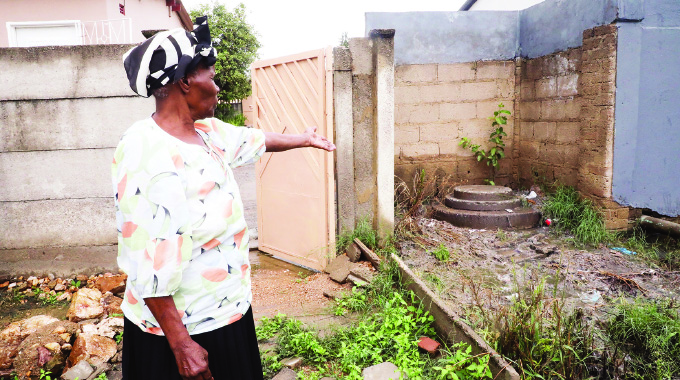
Bulawayo Bureau
FOR almost a year, raw sewage has been spilling at a house in Nkulumane suburb in Bulawayo with the occupants enduring pungent smells and nauseating sights of human waste strewn in their yard.
This is the story of 70-year-old Mrs Christine Mkhwebo who lives in Nkulumane’s Glenkara suburb.
She has to always cover her nose and mouth with a face mask to avoid inhaling the contaminated air which is also attracting pests and rodents.
So bad is the situation that the sewage has even clogged her drainage system, sparking fears of an outbreak of cholera, which has plagued some areas of the country.
Mrs Mkhwebo said she has on several occasions reported the matter to the Bulawayo City Council (BCC) and they only attended to the problem once.
When Chronicle visited Mrs Mkhwebo yesterday, the news crew was greeted by a strong stench emanating from human waste.
“This started more than nine months ago. We woke up to find our drainage clogged with sewage and initially, I thought it was my sewage that had burst,” she said.
“I contacted the city council and they did come and they advised me that the entire pipe connecting all the houses in my street was blocked. Since my house is the last one in the line, all the waste is now clogging my yard.”
Mrs Mkhwebo said a few days after the sewage had been unclogged at her house it filled up again.
“I called the city council again, but they never came. The last time I went there they told me they do not have the necessary tools to unclog the drains for them to remove the sewage,” she said.
Mrs Mkhwebo said during hot days, the odour is unbearable.
“I need help in light of the outbreak of cholera in the county, I fear that we might end up contracting the disease. The city council has disappointed us and cleaning waste that is not even yours is a nightmare,” she said.
BCC had not responded to written questions by the time of going to print.
Similarly, in Entumbane and Makokoba suburbs, sewage has also been haunting residents with raw sewer flowing into Mthombowesizwe Primary School in Entumbane and Lobengula Primary School in Mzilikazi, putting learners at risk of contracting diseases.
The sewage emanates from a nearby burst pipe, which residents say has been flowing for over two months.
Concerned residents said raw effluent has been overflowing for over two months with the problem only briefly easing whenever council workers attend to it, on the numerous times that school authorities have reported the matter.
The residents accuse BCC of neglecting its duties which could result in the outbreak of water-borne diseases such as cholera and typhoid.
A resident, Mr Douglas Dube said “I heard people saying the council was called although l cannot confirm whether it’s true or not. What amazes me is that they have failed to even fix the problem which has now spilled into schools”
At Lobengula Primary School in Makokoba, sewage spews right at the gate of the school.
Residents who live nearby said they are now used to the odour.
They said although BCC tries to fix the burst pipe, the problem resurfaces a few days later.
In efforts to fight the disease, Government has put in place measures that seek to strengthen systems as part of its effort to address the current cholera outbreak in the short and long term.
These include putting water, hygiene and sanitation (WASH) infrastructure to ensure that communities have access to safe drinking water and basic sanitation.
Zimbabwe has been experiencing a cholera outbreak since February last year recording 18 332 suspected cholera cases and 329 suspected deaths. About 2 145 cases and 71 deaths have been confirmed as cholera-related.
Health and Child Care Permanent Secretary Dr Aspect Maunganidze said Government is tasked with addressing the determinants and drivers of cholera including perennial water shortages, breakdown of sanitation infrastructure, improving rural water and sanitation coverages, and enforcement of city by-laws.
“Government is working to ensure that we address all the drivers of cholera. The surge of cases, increase in deaths, the countrywide spread of the outbreak, and the continued persistent existence of underlying drivers of transmission need a whole of Government, whole of society response so that we stop the further spread of cholera in Zimbabwe,” he said.
Dr Maunganidze said there is a need for an increased supply of potable piped water without interruptions at the household level.
“Where there is no council water, alternative sources should be availed for the affected communities through water trucking. In this regard, the private sector should be engaged to assist,” he said.



 Peter Tanyanyiwa
 Online Reporter