Online Reporter
Prosper Ndlovu, [email protected]
GOVERNMENT has ordered a sweeping review of licences, permits, levies and fees in the mining sector, in a decisive move to unlock investment and strengthen the industry’s contribution to the mainstream economy under ongoing ease of doing business reforms championed by President Mnangagwa.
The sector is already undergoing significant transformation under the Second Republic with several milestones across key mineral sub-sectors centred on growth, investment and job creation.
This comes as President Mnangagwa has demanded sustained focus on accelerating mineral beneficiation, increasing investment in exploration, and boosting output in gold, lithium, and steel to achieve Vision 2030.

On value addition, President Mnangagwa has led his Government to stop raw mineral exports by enforcing local processing of key minerals to maximise returns. Recently, lithium and battery minerals have come under focus as expressed in the National Development Strategy 2 (NDS2) where Zimbabwe is shifting attention to producing lithium carbonate and hydroxide, rather than just exporting raw lithium.
In the last few years, Zimbabwe has increased investment into exploration with new mining projects, expansion of existing mines, and the reopening of closed operations, supported by billions of dollars in new investments. The gold sector has played a key role with the formalisation of artisanal miners, paying huge dividends on deliveries to Fidelity Printers, thereby helping anchor the local currency and boosting foreign currency reserves.
The resurgent steel industry following the successful commissioning of the US$1,5 billion Dinson Iron and Steel Company plant in Manhize, Midlands province, has sparked significant growth in the steel sector, with exports increasing significantly and higher production helping Zimbabwe cut on imports while rejuvenating Bulawayo industrialisation.
To accelerate the gains achieved so far, Cabinet yesterday noted and approved the proposed review of licences, permits, levies and fees charged by Ministries, Departments and Agencies in the mining sector, which was presented by the Minister of Finance, Economic Development and Investment Promotion, Professor Mthuli Ncube.
The review of licences, permits, levies and fees in the mining sector is in compliance with the Cabinet decision of July 29 2025, which approved the implementation of a raft of business reforms in 12 sectors of the economy.
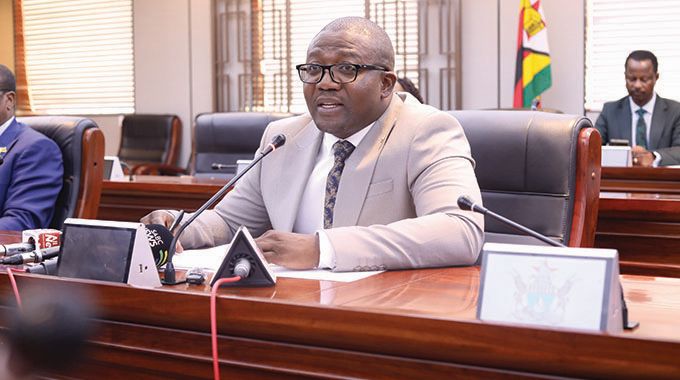
In a post-Cabinet briefing in Harare yesterday, Acting Minister of Information, Publicity and Broadcasting Services, Mangaliso Ndlovu, said the bold move is aimed at reducing the cost of doing business, increasing competitiveness, enhancing the viability of enterprises and enabling the growth of the Zimbabwean economy.
“More specifically, Cabinet approved the streamlining of duplicated and overlapping regulatory licences and permits, removed unnecessary levies and fees and lowered unjustifiably high levies and fees for the mining sector,” said Minister Ndlovu.
“Duplicative and overlapping licences and permits are now streamlined under a single regulatory authority. Over 80 percent of the mining sector fees that are considered reasonable have been maintained. Fee differentials based on operator’s capacity to pay have been introduced, with licence fees for artisanal and small-scale mines being pegged at a fraction of fees payable by large firms.
“New regulatory fees such as gold jewellery permit and application for registration of approved processing plants for lithium, have been introduced. Registration fees to deal with precious stones have been reduced and will be payable every five years.”
Minister Ndlovu said the Ministry of Mines and Mining Development annual fees for the first, second and subsequent inspection fees for block of claims (Base Minerals, Precious Metals and Mining Lease) have also been reduced.
“The Ministry of Mines and Mining Development trading on mining location fee has been scrapped; and the diamond cutting and polishing licence fee has been reduced. Rural District Councils land development levies are now being standardised,” he said.
“Cabinet also considered policy and legislative issues affecting the mining sector, including the ongoing review of the Mines and Minerals Act; the development of the Minerals Development Policy, and the operationalisation of the Mining Cadastre System to ensure that mining licences are granted, tracked and managed in a legally binding and accurate manner.
“Other issues include capacitation of the relevant regulatory bodies to strengthen oversight of the mining sector and the formalisation of small-scale mining operations.”
Meanwhile, Cabinet also noted the impressive report on the 2026 Zimbabwe International Trade Fair (ZITF) as presented by the Minister of Industry and Commerce, Mangaliso Ndlovu. The 66th Edition of the ZITF was officially opened by Botswana President, Advocate Duma Gideon Boko on April 23 under the theme “Connected Economies, Competitive Industries”.
The event saw an increase from 795 exhibitors in 2025 to 812 in 2026, with 98 being first-time exhibitors. The premier expo further witnessed an increase in private sector participation, which accounted for 61 percent of exhibitors, complemented by a 39 percent contingent of Government entities. Among the major highlights of the expo was the Rural Industrialisation and Economic Empowerment Indaba held on 20 April 2026, where strategies to strengthen linkages between large-scale industry and Micro, Small and Medium Enterprises focusing on agro-processing and mineral beneficiation at local level were discussed.
The ZITF 2026 Youth in Business Forum held on 21 April, 2026 focused on the topic “Youth Financial Inclusion: Closing Gaps in Connected Economies” in order to empower young entrepreneurs with financing and innovation opportunities.
A US$1 million Youth Economic Empowerment Fund was also launched to support youth-led business growth and development. The International Business Conference held on April 22 drew more than 600 delegates and was opened by Vice President, Dr Constantino Chiwenga who reaffirmed Government’s commitment to the shift from raw resource exports towards domestic manufacturing and value addition in the mining and agriculture sectors.
The Connect Africa Symposium held on April 24 brought together over 300 delegates to address the future of continental commerce and was led by Vice President Dr Kembo Mohadi, who reiterated the need to optimise trade policies to take full advantage of the African Continental Free Trade Area (AfCFTA) and to also harmonize standards as a key enabler of trade.
The Digital Economy Conference 2026 reaffirmed Zimbabwe’s strategic commitment to accelerating digital transformation as a key enabler of economic growth. The conference successfully positioned Artificial Intelligence as a practical tool for driving innovation, improving public service delivery and enhancing productivity across sectors such as agriculture, mining, health and education.
“The 66th Edition of ZITF was a resounding success, reinforcing Zimbabwe’s status as a premier destination for investment and trade under the Second Republic,” said Minister Ndlovu.