


 admin
admin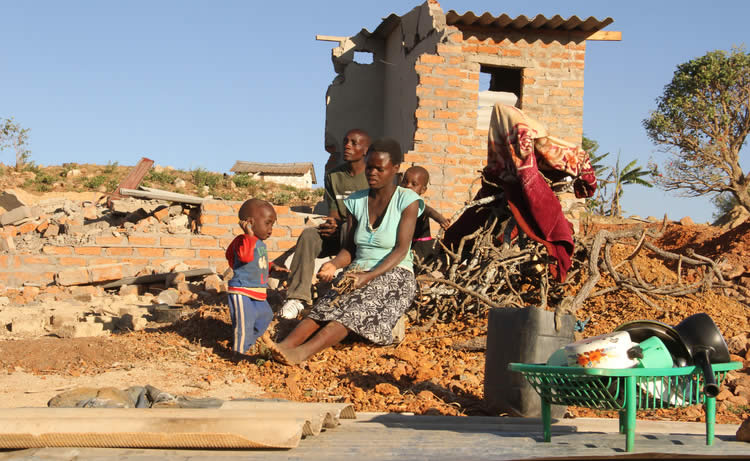
Harmony Agere
A humanitarian crisis is looming at Caledonia Farm where hundreds of people were left homeless and in short supply of food following mass demolitions of houses allegedly built on private land. Caledonia Farm’s decade-old housing conflict between authorities and the alleged illegal settlers was revived last week after the Deputy Sheriff, acting on a High Court ruling, demolished the houses.
Last week the High Court recognised Agriculture, Mechanisation and Irrigation Development Deputy Minister, Cde Paddy Zhanda, and one Rina Loonie DuToit as joint owners of the farm.
As a result people who had been allocated housing stands on the farm were ordered to evacuate and had their houses demolished
Although the demolitions have since been stopped following an urgent High Court application seeking an interdict filed by Nhaka yeMadziteteguru Edu, a consortium of 30 housing co-operatives at Caledonia Eastern Height Farm, those affected are living in gruesome conditions.
A visit to the farm last week revealed the harsh conditions in which the affected people have been living in since the demolitions began. While some victims left the farm, others are still stranded and have been sleeping on the open with children as young as eight months old.
Most of the affected families claim that they have run out of food supplies as their food stocks were destroyed together with the houses. There is also lack of proper sanitation since toilets and water wells were damaged. The damaged water wells and pit latrines pause danger to people, especially children, as the holes are uncovered.
Some children have since stopped attending school after their uniforms and books were destroyed. And despite all these hardships, most of the families have vowed to stay put. Some of them have started rebuilding their houses and re-erecting their cabins as they say they have nowhere else to go.
However, some individuals said they feared for their health since they were shocked by the demolitions.
“This is what is left of my once elegant three-roomed house,” said 33 year old Ropafadzo Masunda, pointing at a pile of concrete rubble. “I do not have an option except to salvage whatever I can from the debris and start building again because leaving is not an option. I and my family have nowhere else to go.”
Ropafadzo and her family are some of the scores of people sleeping in the open and living from hand-to-mouth.
What pains Ropafadzo and many other Caledonia residents the most is the fact that they are “only innocent home-seekers” who paid all the money required for them to be allocated a piece of land.
“When I came here in May I never imagined that I would one day suffer like this because we did everything that we were told by the leaders of Shamuyarira Housing Co-operative,” she said.
“We paid all the required money. At first we paid $10 joining fee, then we paid $150 for allocation and we have been paying $60 for monthly subscriptions until about last month when the figure was reviewed downwards to $25.”
Ropafadzo recounted the confusion and commotion which characterised the day the houses were destroyed
“On the day we heard noises, the moment we tried to see what was happening, there was already commotion and bulldozers was were destroying houses everywhere. They (bulldozer operators) did not care about our property, they were just destroying houses, even with property inside.
“I lost quite a lot of property because it got damaged while trying to recover it before it was damaged by the bulldozers. Since the demolitions we have been sleeping outside and there is hardly anything to eat because all the food was destroyed together with the houses.”
Ropafadzo said she has three children, all of whom have not been attending school because of the demolitions.
Another victim, Mr Zvikomborero Gadaga (37), who is a father of three, said his house was not completely demolished because his wife pleaded with the operators to be given a chance to pull out the roofing sheets.
He said only the windows and some property were damaged in an effort to take them to safety. Nonetheless Gadaga and his family have been sleeping outside since the house was partially destroyed.
He said there wasn’t much pain during demolitions but revealed that it is the aftermath which is really hurt many people.
“During the demolitions it was much more of anxiety and confusion, now the pain is really sinking in because you begin to realise the situation you are in. Without food and without anywhere to sleep you are almost not a human being. And if the situation is like that for us adults, just imagine the children.”
Despite all the troubles and uncertainty over the future, Kuda Chaodza, another victim who has since re-erected his cabin, vowed that he is not going to leave.
He said he would do anything to protect his children, aged three and five: “We do not know what will happen next, but whatever will happen we won’t be leaving because we just don’t have anywhere else to go. As you can see I have already re-erected my cabin, whatever happens we will be here.”
A member of the Nhaka yeMadzitateguru Edu Consortium who declined to be named said the people who got their stands are safe as authorities recognise their credibility.
“There are a lot of lies being spread out there so that is why I won’t comment. The issue is before the courts and I know a positive result will come. Our members should not panic because the authorities know of our existence and they have promised that our issue will be resolved.”
It is not the first time since controversy has reared in the settlement with squabbles dating back to 2005.



 Online Reporter
 Bongani Ndlovu