Online Reporter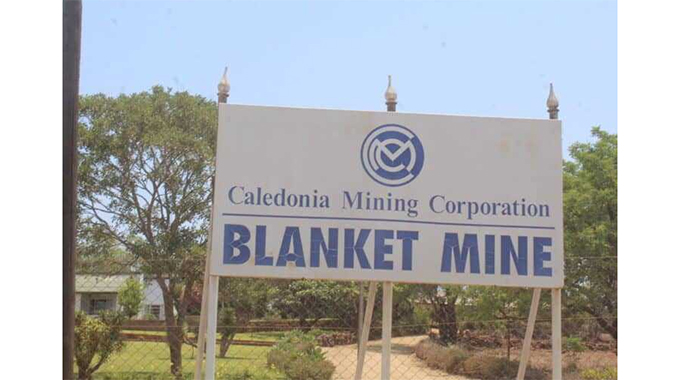
Nqobile Bhebhe [email protected]
Caledonia Mining Corporation says results from its surface exploration programme at Blanket Mine have confirmed the presence of significant near-surface gold mineralisation in a previously unknown mineralised horizon, opening up the prospect of a new low-cost source of production to complement its underground operations.
The exploration results indicate that the mineralised zone has not been exploited by the existing underground mine and could represent a new orebody, with potential for conventional heap leach processing of near-surface oxide material and a sulphide extension beneath any future open pit.
The latest discovery is significant as it indicates the untapped exploration potential within the Blanket mining lease and could extend the mine’s production profile while lowering extraction costs.
Early this week, the mining house saod gold output rose 18 percent to 17,360 ounces in the second quarter ended June 30, 2026, from 14,767 ounces in the first quarter.
The company has maintained its 2026 production guidance of between 72,000 and 76,500 ounces, with output expected to be weighted towards the second half of the year as access to higher-grade mining areas continues to improve.
In an update, Chief executive officer Mr Mark Learmonth said the results reinforced Blanket Mine’s considerable exploration.
“This is an exciting development at Blanket and further demonstrates the significant exploration potential that exists within the mining area.
“We are well advanced in our work to incorporate the results of this surface exploration programme into a revised resource statement expected to be published in August 2026, which will reflect the results of surface and underground exploration at Blanket alongside the exploration programme at Motapa, where we recently announced encouraging initial drilling results,” he said.
Mr Learmonth said preliminary metallurgical test work on the oxide material had also produced encouraging results.
“We have commenced metallurgical test work on the oxide material at Blanket to evaluate its amenability for conventional heap leaching and the preliminary results are encouraging. If the conclusion of the test work shows an acceptable recovery, we intend to commence a trial heap leach operation on an initial sample of 10 000 tonnes of material during the second half of 2026.
“The potential to develop a low-cost processing route for this near-surface mineralisation could provide an attractive opportunity to complement Blanket’s existing underground operations and unlock additional value,” he said.
Caledonia said the K-Pits exploration programme was originally designed to evaluate near-surface targets within the Blanket mining lease that had received little previous exploration attention.
Trenching and reverse circulation drilling have since confirmed significant gold mineralisation associated with major shear structures and lithological contacts.
Geological interpretation suggests the newly identified mineralised system lies about 200 metres east of the nearest projected underground orebody, raising the possibility that it is a separate gold-bearing horizon that has never been exploited by historic underground mining activities.
The firm said the presence of oxide mineralisation near the surface is particularly significant because it may be suitable for conventional heap leach processing, a comparatively lower-cost extraction method than underground mining.
If metallurgical test work confirms acceptable recovery rates, the company intends to commence a trial heap leach operation using an initial 10 000 tonnes of material during the second half of 2026, noted the firm.
The Blanket surface exploration programme commenced in 2024 with geological mapping, geophysical surveys, trenching and the collation of historical exploration data.
During 2025, the company completed 2 304,1 metres of trenching across 13 trenches and 7 063 metres of shallow reverse circulation drilling at the K-Pit target, focusing on identifying oxide gold mineralisation suitable for low-cost surface mining.
Further drilling is planned to determine the continuity, size and depth extent of the newly discovered mineralised system.