malvernmugadzikwa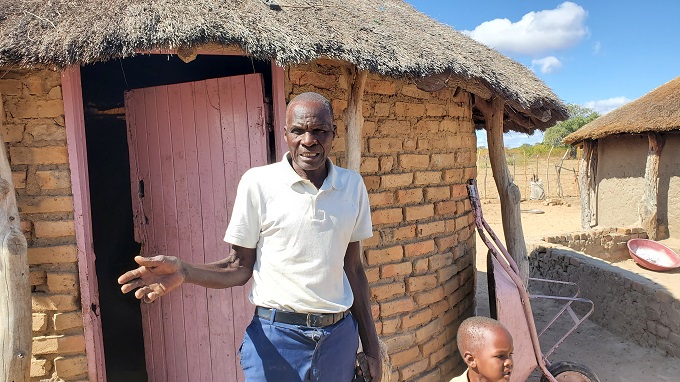
Theseus Shambare in MANGWE
IN swathes of the drought-stricken Matabeleland South Province, one family clings to an ancient tradition as its last hope for survival.
For generations, the Mpofu clan has relied on mopane worms to feed and sustain their remote village — Madabi.
But as the worms vanish from the parched landscape, 67-year-old Mkhumbulo Mpofu watches his family’s livelihood slip away.
“The mopane worms are our life,” Mr Mpofu says, his weathered face etched with worry as he surveys the barren mopane trees surrounding his homestead.
“Without them, how will we survive?”
The mopane worm, known locally as “amacimbi” or “madora”, is intrinsically tied to the hardy mopane tree that dots the harsh terrain of Madabi.
These trees are the worms’ sole source of sustenance — and their loss spells disaster for the villagers.
Situated in the punishing agro-ecological Region 5, Madabi is no stranger to adversity.
The rocky, infertile soil and scarce, erratic rainfall make traditional farming all but impossible, forcing villagers to adopt innovative survival strategies.
While some try in vain to coax crops from the unyielding earth, most had turned to mopane worms as their dietary and economic lifeblood.
Yet, as climate change tightens its grip on this remote corner of Zimbabwe, even that age-old practice has become untenable.
With the mopane worms vanishing, Mr Mpofu and his neighbours now face the stark reality of an uncertain future.
Lifeline
However, as the old adage goes, there is always light at the end of the tunnel.
Despite the fact that the villagers initially despised the Harmonised Social Cash Transfer (HSCT) and the Emergency Social Cash Transfer Programme (ESCT), brought by the Government, in partnership with UNICEF Zimbabwe, they now value the initiatives.
HSCT and ESCT are unconditional cash transfer programmes targeted at underprivileged households who are labour-constrained.
Each family is entitled to a monthly cash transfer. The cash is given to each individual for a family of up to six members.
The objectives are to enable beneficiary households to increase their consumption to a level above the food poverty line, to reduce the number of ultra-poor households and to help beneficiaries avoid risky coping strategies such as child labour and early marriage.
In Mangwe, the programmes are being implemented in collaboration with the Ministry of Public Service, Labour and Social Welfare, as well as the Ministry of Primary and Secondary Education with funding from the German Kreditanstalt für Wiederaufbau.
Development bank.
“Since we could get our money through the sale of mopane worms, the programmes seemed to be of no importance.
“But the Government and their partners continued to teach us that there are natural shocks that may befall us that might put us on the point of need. Definitely, that time has come. You rarely see a mopane worm in these trees,” said Mr Mpofu.
To date, despite the hardships being faced by his community, Mr Mpofu is a stress-free man, with his basic needs being catered for.
“I have been paying for my grandchild’s school fees and for the first time, I managed to buy three donkeys to use in my fields as draught power, indigenous chicken and goats, all from ESCT savings.”
Gogo Sidumisile Mguni (71) from the same village is a happy woman.
“I am now too old to do heavy duties. I used to rely on mopane worms, but things have really changed.
“During our good times, we would fetch at least US$70 per month, but the worms are no longer there. We are grateful for the Government’s programmes that bring in donors who assist us with the money to take care of our needs,” she said.
Gogo Mguni gets US$48 every month, which she uses for food and other basic needs.
Meanwhile, efforts are being made to come up with measures to safeguard the mopane worms from extinction, with some councils like Gwanda seeking to pass by-laws to protect the trees and control their harvesting.
According to the Food and Agriculture Organisation of the United Nations, the caterpillar is one of the best-known and most economically important forestry resource products of the mopane woodlands in southern Zimbabwe, Botswana and northern South Africa.
It has been estimated that annually, 9,5 billion mopane larvae worth US$85 million are harvested in Southern Africa’s 20 000 square kilometres of mopane forest, of which approximately 40 percent of that goes to producers, who are primarily women from poorer rural areas.
Research has found that mopane worms are not only good for eating from a nutritional standpoint, but they also may be key to maintaining the ecological balance of the dry bush they inhabit.
However, environmentalists are now concerned that the trade in mopane worms is becoming a threat to biodiversity.
This not only leaves the land barren but also threatens the livelihoods of locals.
Climate change has also affected the availability of the worms. Experts believe the caterpillars are declining in the region due to rising temperatures.
As the villagers in Madabi struggle to adapt to the changing climate and the loss of their mopane worm resource, the Government’s cash transfer programmes have provided a lifeline, ensuring their basic needs are met and their families can weather the storm.
However, the long-term fate of the mopane worm and the communities that depend on it remains uncertain.
Will the villagers be able to find a sustainable solution to preserve this ancient tradition, or will the mopane worm vanish forever from this harsh, yet vital, landscape?



 Online Reporter