Chronicle Editor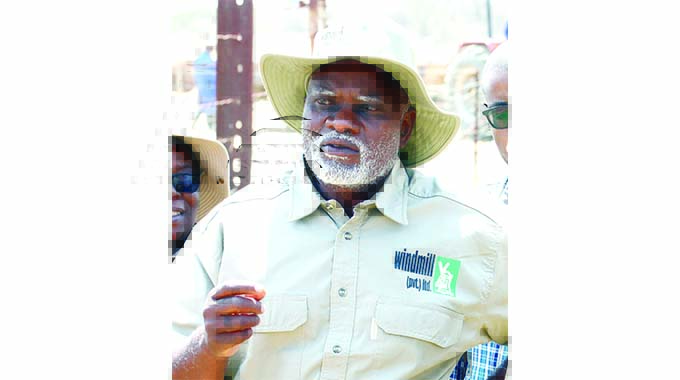
Peter Matika, [email protected]
IT was back in the early 90s when Mr Obert Chinhamo of Esigodini in Umzingwane District decided to take a leap of faith and venture into a realm known to many, but understood by a few.
His dream was to own a farm flourishing with a herd of cattle, one that would instantly turn him into a multi-millionaire.
After careful consideration and consultations with his wife and close family members, Mr Chinhamo, who then was in the transport business, decided to sell his trucks and used the money to buy cattle, a bold decision which nearly rendered him bankrupt.
“I ventured into cattle ranching in the early 90s after weighing options. When I pulled out of my trucking business to venture into cattle farming, it was not an easy decision, especially given that I lacked experience and knowledge in that field,” he said.
Generally, cattle are considered as a measure of wealth in African society.
“Cattle contribute to a number of things in our society as Africans, and it is a measure of wealth. They can be used in place of currency and of course paying bride price,” said Mr Chinhamo.
“There are many uses of cattle, for instance, for communal farmers they can use them for draught power, they also provide food for the family.”
Mr Chinhamo said it was only after some years, and engagements with other farmers and breeders that he took another leap of faith and ventured into a stud breeding.
“This was a bold move, and I knew this was the point in time that I would either break even or not and that sometime around 2006 I decided to try out pedigree breeding and started with Simmentals,” he said.
The Simmental or Swiss Fleckvieh is a Swiss breed of dual-purpose cattle. It is named after the Simmental — the valley of the Simme River — in the Bernese Oberland, in the canton of Bern in Switzerland.
It is reddish in colour with white markings and is raised for both milk and meat. They are well-muscled animals, being long and deep-bodied with strong bone, and give a higher yield of meat.
Unlike the usual breed of cattle, Mr Chinhamo said Simmentals are quite friendly and are adaptive to climatic conditions.
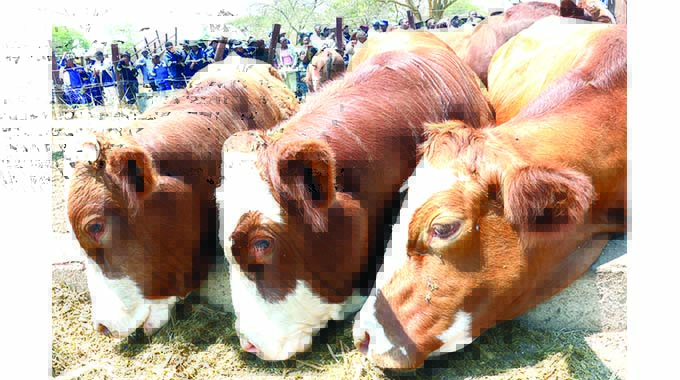
Today, with his farm nestled just 30 kilometres away from Bulawayo in Esigodini in Matabeleland South, Mr Chinhamo is an esteemed pedigree cattle breeder who specialises in Simmentals.
With a herd of 300 Simmental breeds of cattle bustling on his 80-hectare farm, which is called Biano Farm, Mr Chinhamo is now regarded as a fountain of knowledge when it comes to cattle breeding.
“Over the years I have learnt a lot and I always host field days at my farm to impart knowledge to upcoming farmers and cattle breeders,” said Mr Chinhamo.
His Simmental breed weighs an average of 500 to 1 000kg, with the cost of the beasts being as high as US$6 000.
“I live a humble life and as you can see I am fond of farm life. I need nothing much, but my cattle and the love of my family. All I can say to other farmers, especially communal farmers is that they should destock,” said Mr Chinhamo.
“Keeping hundreds of cattle will not spell fortune, but misfortune. The fewer cattle you keep the better as that will give you enough time to focus more on quality than quantity.”
Mr Chinhamo believes that the livestock sector can record huge successes if farmers focus on improving their animals through cross-breeding.
Under the Livestock Recovery Plan, Government seeks to improve cattle genetics by harvesting of semen from bulls and distributing it across provinces. Growth of the livestock sector is key to the attainment of Vision 2030
Mr Chinhamo has a fully mechanised farm that boasts state-of-the-art farming equipment.
“My farm is self-sustainable, and we utilise all that is grown here. I produce my own feed through mechanisms that other farmers should adopt,” he said.
Mr Chinhamo said making his own feed helps him mitigate against drought-related disasters.
Silage is one of the technologies used to preserve fodder, especially during the dry season. It helps to preserve nutrients in stock feed.
“I have employed complex strategies that I believe can assist in the event of drought when pastures are depleted. Silage production is the way to go and I urge farmers to adopt this. I produce silage using grass, sorghum and maize, and only buy feed on rare occasions,” he said.



 Online Reporter