admin
admin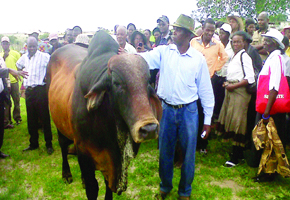
Mr Zvenyika is a self-driven man who is guided by a simple philosophy, “Do it yourself”, in his operations.
When he moved into the farm in the year 2002, there was basically no infrastructure for either livestock or human beings. The farm was virgin land.
“I first built a six roomed block of flat-roof structure for my employees and a cattle kraal. I had no cattle then, not even any type of livestock.
“As a man who believes in planning, spurred by the saying ‘One who fails to plan, plans to fail’ I went back to my hometown, Bulawayo, to re-strategise. I was away for two years planning on how best I could turn around my farm project. When I came back, I first bought 20 cows before adding another 50 after applying for a loan from a bank. I now had 70 cattle,” said Mr Zvenyika.
His early days as a cattle rancher were quite productive, as he was fortunate and his beasts gave him 50 calves at once.
Sadly, since he was an inexperienced farmer, Mr Zvenyika watched helplessly as some of his cattle died due to a variety of diseases that he did not know then.
“I had to seek advice from a relative who is a veterinary officer and has vast knowledge in cattle diseases.
“He told me the importance of appropriate infrastructure for animals. Again he advised me to dip my cattle frequently,” said the Somabula farmer.
The advice that Mr Zvenyika received from his relative led to the construction of well-ventilated state-of-the-art animal infrastructure on the 350-hectare farm.
His hard work, commitment and zeal in livestock farming could not go unnoticed. Some two weeks ago, stakeholders in livestock farming, including senior Government officials from relevant departments in the Midlands, gathered at Mr Zvenyika’s farm to celebrate his achievements in livestock management.
Midlands Provincial Governor, Jason Machaya, who was the guest of honour, commended Mr Zvenyika for coming up with a vibrant cattle ranching project.
He said his work was confirmation that armed with a high level degree of commitment and dedication; indigenous people were competent farmers capable of achieving any goals they may set for themselves.
“There are three types of farmers. Firstly, we have the non-farmer. These are farmers who fail totally to utilise their land. Then we have the potential farmers, these are farmers who apply a little bit of effort and show signs of improving. Then lastly, we have farmers through and through. I must say a good example of the last lot is Mr Zvenyika. His work has shown dedication and commitment. I urge all farmers across the nation to emulate him,” said Governor Machaya.
Somabula was historically noted as an area that produced high quality beef suitable for the European Union market.
The beef from the area was in high demand then. It is also said the area was also known for producing high quality cow hides, which helped lure giant shoe company, Bata Shoe Company, to Gweru.
Governor Machaya said Somabula still has what it takes to revive the national economy, through producing high quality beef for the export market and cow hides for the shoe manufacturing industry. He said all resettled farmers should be like Mr Zvenyika and strive to shake off the dependency syndrome.
“However, as farmers you need also to embrace new technology and seek to boost your management skills always. There is also need to constantly consult professionals in managing these agricultural projects. You (farmers) should also learn to plan your projects and operations to enable you to sail through any challenges that you might face in your operations. Don’t allow natural disasters to derail your projects. In this area for example, pastures have been invaded by armyworms. As farmers, you should have plans to ride over such kind of disasters and give your animals supplementary feeds,” said Cde Machaya.
Successful animal husbandry as practised by Mr Zvenyika is no easy stroll in the park. Mr Zvenyika acknowledged that he lost a number of beasts when his project was still in its infancy, primarily because of limited knowledge on his part.
Provincial Veterinary Officer for Midlands, Dr Thomas Sibanda, puts the challenges of livestock farming into perspective. He stressed the importance of having appropriate infrastructure on farms, especially during the rainy season.
“During this season, there is a common disease known as foot rot.
“This usually affects hoven cloven animals and is caused by standing in the mud or wet places for a long time. Their feet get soft and bacteria affect them, causing some wounds.
“Foot rot is not a fatal disease but it has to be controlled. We urge farmers to guard against such diseases.
“We also have internal parasites which are very common and can kill many cattle during the rainy season. These again can be controlled through de-worming cattle generally about three times a year and making sure that they are always in dry places,” said Dr Sibanda.
He said for cattle farmers to be successful; there was a need for them to dip their cattle often to prevent tick borne and other diseases. Four major tick-borne diseases are red water, gall sickness, heartwater and theileriosis.
“These diseases usually cause problems in areas where dipping is poor. We have reports that five to six cattle are reported dead due to one of these diseases.
“This is not an outbreak since it’s quite normal to have such cases during the rainy season. Farmers should dip their cattle every week to reduce the risk of their animals contacting such diseases.
“We also urge farmers to report any signs of sickness among their livestock to the nearest animal health centre,” he said
Dr Sibanda said there were various diseases such as lumpy skin and boumer ephemeral fever (also known as three days stiff sickness). These are caused by insects (insect borne diseases). They usually thrive in low lying areas which contain a lot of water or vegetation.
“A lumpy skin affected animal develops small round lumps which at times will grow big and rapture and they become like bleeding wounds.
“Three days sickness is caused by biting insects like mosquitoes. The symptoms are that the animal becomes reluctant to walk, develops stiff legs especially the front legs. Normally, the animal will lie down for three days.
“Farmers with high quality cattle like dairy cattle are advised to vaccinate against these diseases. They can also use the pyrethroid dips that have a residual effect of 14 days,” he said.
Dr Sibanda said insect-borne diseases could again be prevented by vaccinating the animals around September or October before the onset of the rains.
“In areas like Gokwe and some parts of Kwekwe there are diseases such as dermatophilosis/senkobo which only appear during the rainy season and disappear in winter. The causes of these diseases are yet to be determined but ticks and thorns are implicated. The control is using antibiotic quickly, which, however, do not cure the animal completely,” he said.
The veterinary expert said those who live in areas with stagnant water bodies should also de-worm for liver fluke as well. He said farmers needed to embrace the expertise of his department, if the country’s restocking exercise was to bear fruit.



 Online Reporter