admin
admin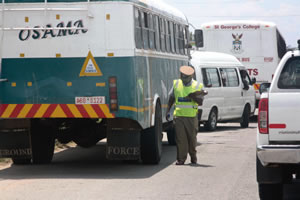
kombi crews claimed police roadblocks — which are mounted freely on the routes — were now money-spinning ventures for traffic police. The demonstration comes barely a week after a similar one by kombi operators and crews plying the Harare-Norton route.
On both occasions they vented their frustration by boycotting, at least during the peak hours in the morning and evening, carrying passengers and barring non-conforming operators from carrying passengers.
Thousands of people felt the pinch as they were stranded and had to walk into town, or simply go back home.
Police said it was for people’s good that they mount roadblocks.
Spokesperson Inspector James Sabau dismissed the protests by commuter bus operators saying the roadblocks were necessary to compel operators to regularise their operations.
He told The Herald that of the 4 500 commuter omnibuses operating in Harare, only
1 000 were on the road legally.
“We do not accept people who operate illegally. Our duty as police officers is to ensure that commuters are being ferried by roadworthy vehicles,” he said.
He said the police were having problems with those operators refusing to regularise their operations. “This exercise in our view is going to compel all operators to regularise their papers so that our commuting public moves safely. The problem we are having is with those who do not have any papers,” he said.
Insp Sabau said the police would maintain their presence on the roads. He said police would start impounding kombis of those operators who refused to comply with the law.
However, the kombi crews – not just those from Marondera, Chitungwiza and Epworth — say they feel the pinch everyday and two or more times on each way.
“You find there are these roadblocks where they all ask for the same things and want to inspect the vehicle for the same things,” said one driver who only identified himself as Itso.
“When they fine you these so-called spot fines, you are given tickets at all the roadblocks despite producing papers that you have been fined already for the offence.
“They tell you, ‘We don’t care.’ It is simply absurd. Imagine having to be punished for the same offence everyday and they are in the habit of finding faults so that they punish you.
“These roadblocks look like a fund-raising mechanism,” said Itso.
His conductor, Tawanda, added: “You have to prepare for these encounters. I think this is the root of corruption because you end up negotiating for lower penalties than the gazetted fines.
“These other monies are not receipted and you can guess where they end up — in the pockets of individuals.”
He said kombi owners had grown to accept the fact that their crews run into roadblocks and have to part with some money.
“But they want their US$90 per day and you have to work hard to offset any losses at the roadblocks. When we speed, the blame is on us but this is part of the problem because you will have to work to impress your master and keep the job. We have to look after our families.”
Others point out that the increased presence of police on the roads actually fuels disrespect for the force.
“You get used to them and no longer respect them,” said one Kuwadzana Extension conductor.
“Because they (roadblocks) are so many, you look for ways to duck and dive or negotiate or resist,” he said.
Kombis have resorted to using alternative routes just to avoid roadblocks — at least one each time because the other route might have another one.
Some drivers also trail heavy vehicles and buses so as to avoid detection.
Amai Nyasha, a commuter from Epworth, says the ducking business of kombis almost injured her.
“There was a roadblock near a place called ‘PaChan’s” and the driver took a path that leads to Hatfield.
“The path is bumpy and waterlogged and narrow. Kombis give each other way as they negotiate.
“When the kombi was manoeuvring this path suddenly it plunged into a ditch with its rear tyres and we were jerked in our seats.
“I don’t know what happened that moment but I hit my head against the roof and I experienced pain in the neck,” narrated Amai Nyasha.
Another commuter, Mr Jeffrey Mutoko of Ruwa, says police roadblocks, though noble in their cause, can be a little unsettling and inconvenient.
“You see them mounted in the morning and there is a lot of traffic. It can take several minutes before you proceed. Sometimes this happens when you are late,” he decried.
The case is by far not a preserve of Harare only as roadblocks are mounted along the country’s major roads. A survey by The Herald established that there is sometimes ridiculously massive police presence on the roads over a short distance on most highways.
Interestingly, they have become permanent features which motorists know of.
On the Harare-Bindura highway, for example, a distance of 88 kilometres, there are five roadblocks.
These are at Marlborough, Concession turn-off, Christon Bank, Speed and Pote business centres.
When one is going to Hwedza — a distance of about 100 kilometres —motorists encounter no less than seven police roadblocks.
These are: Just after Hatfield suburb, St Mary’s Police Station, Makoni Shopping Centre, Dema Growth Point, Mabhawuwa Business Centre, Waddilove Institute and Chemhanza Secondary School.
Going to Murehwa — some 70km from Harare — one encounters police roadblocks at Chisipite, Juru Growth Point and just before Murehwa Centre.
But all this is trumped when one embarks on the long journey to Bulawayo — 439 kilometres from Harare.
There are a total of 12 roadblocks, at Kuwadzana, Snake World, Norton, Chegutu (times 2 when entering and leaving the town), Kadoma, Kwekwe (Battlefields and Redcliff), Gweru (2), Shangani and as one enters Bulawayo.
This makes it a roadblock for every 37 kilometres.
One motorist said: “This is too much. You lose so much time that you may begin to lose patience.”
A long distance bus operator who declined to be named concurred that for the Harare-Masvingo route he plies, a considerable time is lost during the numerous roadblocks.
“Ordinarily you would take about three hours but you end up with an hour or so more,” he said.
He added: “We know the police are doing their job but sometimes the frequency defeats the whole purpose and people end up believing it is all for money.”



 Online Reporter