Peter Matika [email protected]
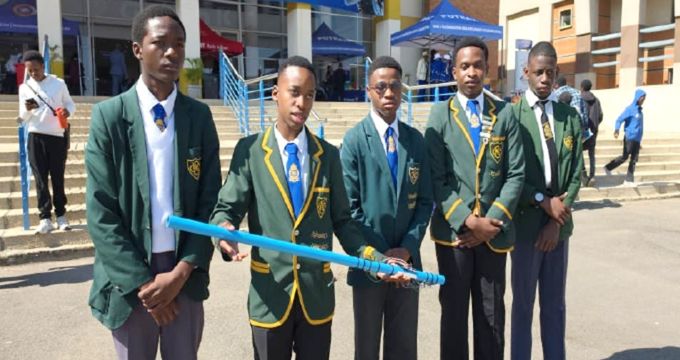
A GROUP of innovative Upper Sixth pupils from Bulawayo’s Christian Brothers College (CBC) has developed an automated smart walking stick designed to improve mobility, safety and independence for visually impaired people.
The ground-breaking invention, created by members of the school’s robotics club, uses sensor-based technology to detect obstacles and alert users in real time, marking a significant step in applying science and robotics to solve everyday challenges faced by people living with disabilities.
The project was spearheaded by Busiso Nyoni in partnership with Bukhosi Sibanda, Siyabonga Mnkandla, Tinotenda Gotosa and Zinhle Ndlovu — all Upper Sixth students passionate about robotics, engineering and artificial intelligence.
The automated cane is fitted with ultrasonic sensors capable of detecting nearby obstacles above ground level, an area traditional white canes sometimes struggle to cover effectively.
The students said once an object is detected, the device sends warning signals through vibrations and sound alerts, helping the user navigate more safely.
Busiso, speaking on behalf of the team, said they were inspired by the need to modernise assistive technology while ensuring it remains affordable and practical for communities in Zimbabwe.
“We wanted to create something that goes beyond the ordinary walking stick by using science and technology to improve the lives of visually impaired people.
“Our smart cane uses ultrasonic sensors to scan the environment and alert the user before they come into contact with obstacles,” he said.
Busiso said the invention combines robotics, embedded systems and programming, adding that the pupils spent months researching how assistive technologies are being used globally before designing their prototype.
“We realised that many advanced mobility devices are expensive and inaccessible to ordinary people,” he said.
“So, our goal was to develop a low-cost but efficient solution that can still perform critical safety functions.”
According to the students, the smart cane operates using micro-controller technology connected to distance-measuring sensors.
The ultrasonic sensors emit high-frequency sound waves, which bounce off surrounding objects and return to the device, allowing it to calculate distance and identify obstacles almost instantly.
The device also incorporates rechargeable battery technology and energy-efficient circuitry to ensure longer operational life.
The pupils said they hoped to further improve the device by incorporating GPS tracking, voice guidance systems and machine learning capabilities that can help the cane adapt to different environments.
“Our vision is to see this technology being used by visually impaired people across the country. We believe young people can use innovation to solve real societal problems,” said Busiso.