Online Reporter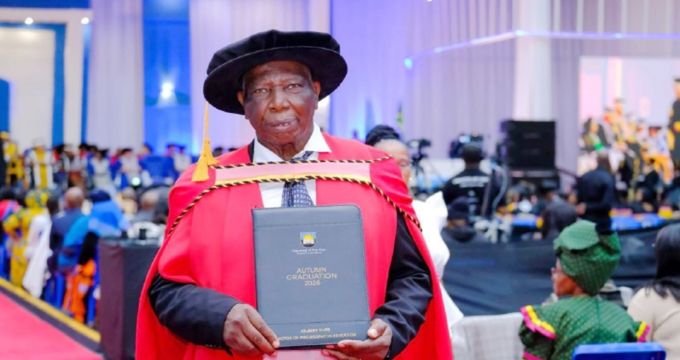
Sukulwenkosi Dube-Matutu [email protected]
AT the age of 72, Dr Gilbert Dube from Gwanda District has proven that age is nothing but just a number after graduating from University of Fort Hare with a Doctor of Philosophy in Education, earning recognition as the university’s most senior graduate this season.
Dr Dube is among scores of students who have graduated from the university’s 2026 autumn graduation. He believes learning should not stop at any stage of life.
For him education is a ‘never-ending journey’, which he will continue to embark on and now wants to focus on writing. Dr Dube said he hoped that his achievement can inspire his age mates and the young.
“What inspired me to study for a PhD is my quest for knowledge and a wish to be a better version of myself towards self-actualisation. This is based on the belief that nothing is static in life,” he said. “Everything around us is changing and we also need to evolve to be adaptive to our environment.
“While I have become of age and can’t do some manual work, my brain is still active and I can develop it further to develop my community and country,” said Dr Dube.
“I can also impart the knowledge I have gained to youngsters so that we can prepare them for leadership today and tomorrow. I believe that education plays a crucial role in the country’s development and there is a need to invest in it through both human capital and resources. That’s how we groom future scientists, inventors, and entrepreneurs, among other critical workforce.”
Dr Dube’s doctoral research examined the implementation of Open and Distance Learning (ODL) in Zimbabwe’s teacher training system, focusing on the “2-5-2” model used in colleges in Matabeleland.
The study found that a lack of specialised training among educators and limited resources have affected the effectiveness and acceptance of ODL.
Dr Dube recommended that institutions strengthen ODL delivery by recruiting specialised personnel, improving learning environments, and investing in ongoing development, particularly in Information and Communication Technology.
His study also proposes a framework to guide policymakers and institutions in implementing ODL more effectively.
Open distance learning is a flexible educational approach that removes barriers to access (such as age, location, or strict entry requirements) by allowing students to learn remotely, often through digital, print, or online resources, without attending daily, in-person classes.
It bridges the gap between teacher and learner through technology and self-paced study.
ODL removes constraints of time, place, and rigid entry requirements, often targeting working professionals or those in remote areas. It is often more affordable than traditional, campus-based education.
The model further enables individuals to continue their education while managing family or work commitments.
“ODL is a specialised area with its specific philosophy, and epistemology quite different from that of conventional learning. The belief that any teacher can handle ODL is the tragedy of ODL programmes in teachers’ colleges resulting in ineffective implementation,” said Dr Dube.
“Evidence is that during Covid-19 period, colleges closed instead of using ODL. Lecturers are not specialised in ODL.”
Dr Dube, who hails from Lower Gweru, did his primary education at Lower Gwelo Mission and Mafakela Primary School in Bulawayo. He did his secondary education at Mpopoma High School.
At that time the school mostly had white teachers and progression from Form 1 to 4 was based on strict criteria of screening. Dr Dube did teacher training and taught briefly before joining the liberation struggle in 1977.
After Independence, Dr Dube worked in the Airforce of Zimbabwe (Manyame Air Base) before doing in-service teacher training at the United College of Education (UCE) in 1982. He also obtained a Bachelor of Education from the University of Zimbabwe and a Masters of Education from the Zimbabwe Open University (Zou) before obtaining a PhD from the University of Fort Hare. During his teaching experience, he taught Grades One to Seven, served as a school head, science teacher. He also worked as a lecturer.
Dr Dube is a husband, father of three and a grandfather of three. He expressed gratitude to his family who have supported him through his academic journey and to institutions and lecturers who have helped to shape his academic journey.
In a post on their Facebook page the University of Fort Hare said Dr Dube’s graduation stands as a reminder that learning can continue at any stage of life.
“Introducing UFH’s most senior graduate this season. At 72, Dr Gilbert Dube graduated today from the University of Fort Hare with a Doctor of Philosophy in Education, marking the culmination of a life shaped by service, teaching and continuous learning.
“His doctoral research examined the implementation of Open and Distance Learning (ODL) in Zimbabwe’s teacher training system, focusing on the 2-5-2 model used in colleges in Matabeleland,” reads the post.
“The study found that a lack of specialised training among educators and limited resources have affected the effectiveness and acceptance of ODL.”