Business Reporter
CBZ HOLDINGS, Zimbabwe’s largest financial institution, is launching a coordinated assault on the country’s most intractable economic barriers, deploying a US$600 million infrastructure bond, a US$170 million trade credit line and a groundbreaking joint venture with a Pan-African trading giant in a single strategic push that signals a decisive shift from policy rhetoric to execution.
The infrastructure bond, to be rolled out in US$100 million tranches, represents the largest domestic infrastructure financing initiative in recent memory.
CBZ has committed US$75 million of its own funds to the first tranche, challenging pension funds, asset managers and retail investors to raise the remaining US$25 million.
“You can’t tell me our pension funds, asset managers and retail investors cannot raise the remaining US$25 million,” CBZ chief executive officer Mr Lawrence Nyazema said in an interview on Capitalk FM.
“In the unlikely event that they fail, I’m sure we’ll either get it from our usual friends outside the country, or I can convince the CBZ Bank board to just put the additional US$25 million.”
The bond will initially target major road rehabilitation, addressing what Mr Nyazema called a sector relying on fiscal cash balances for infrastructure spending for years.
“No one does that in the world,” he said.
CBZ Holdings, which is already three-quarters of the way towards doubling its balance sheet from US$1 billion to US$2 billion by 2028, has positioned itself as the engine of a new economic model — one where balance sheet growth is deliberately linked to infrastructure, housing and service delivery.
Zimbabwe requires an estimated US$2 billion annually to overcome its infrastructure deficit and Treasury has been treading carefully to manage the cost of new debt. The CBZ initiative represents a deliberate attempt to mobilise domestic capital before turning to international markets, a strategy Mr Nyazema believes will attract foreign investment once Zimbabweans demonstrate their own commitment.
The infrastructure push is complemented by a US$170 million line of credit from the African Export-Import Bank (Afreximbank) — the largest single facility of its kind secured by a Zimbabwean institution.
Crucially, US$20 million is ring-fenced for small and medium enterprise lending. This addresses the longstanding complaint that the financial services sector neglects small businesses.
“The usual complaint has been that we don’t support SMEs to the full extent we should,” Mr Nyazema said.
The remaining US$150 million will target productive sectors, including mining. CBZ is already leading the charge in gold mining financing, serving as lead arranger for the US$150 million Bilboes gold project.
The domestic portion of that fundraising, originally targeted at US$75 million, has been oversubscribed and now stands at US$100 million raised locally — a testament to Zimbabwean financial institutions’ growing capacity to mobilise capital.
Afreximbank has indicated it intends to more than double its credit support to CBZ, targeting US$500 million “in the fullness of time”.
The Pan-African lender has committed US$11 billion to Zimbabwe since 1993 across trade finance, infrastructure and industrial development.
Speaking on the sidelines of the World Economic Forum in Davos earlier this year, Mr Nyazema framed the engagement as part of a broader “Team Zimbabwe” strategy to re-engage with global capital after decades of limited engagement.
“As Zimbabwe and as CBZ, I would say we have been out in the cold for the past 30 years,” he told CNBC Africa.
“Some call them sanctions, some call them restrictive measures, but it is always important to engage and re-engage with where capital is found across the globe.”
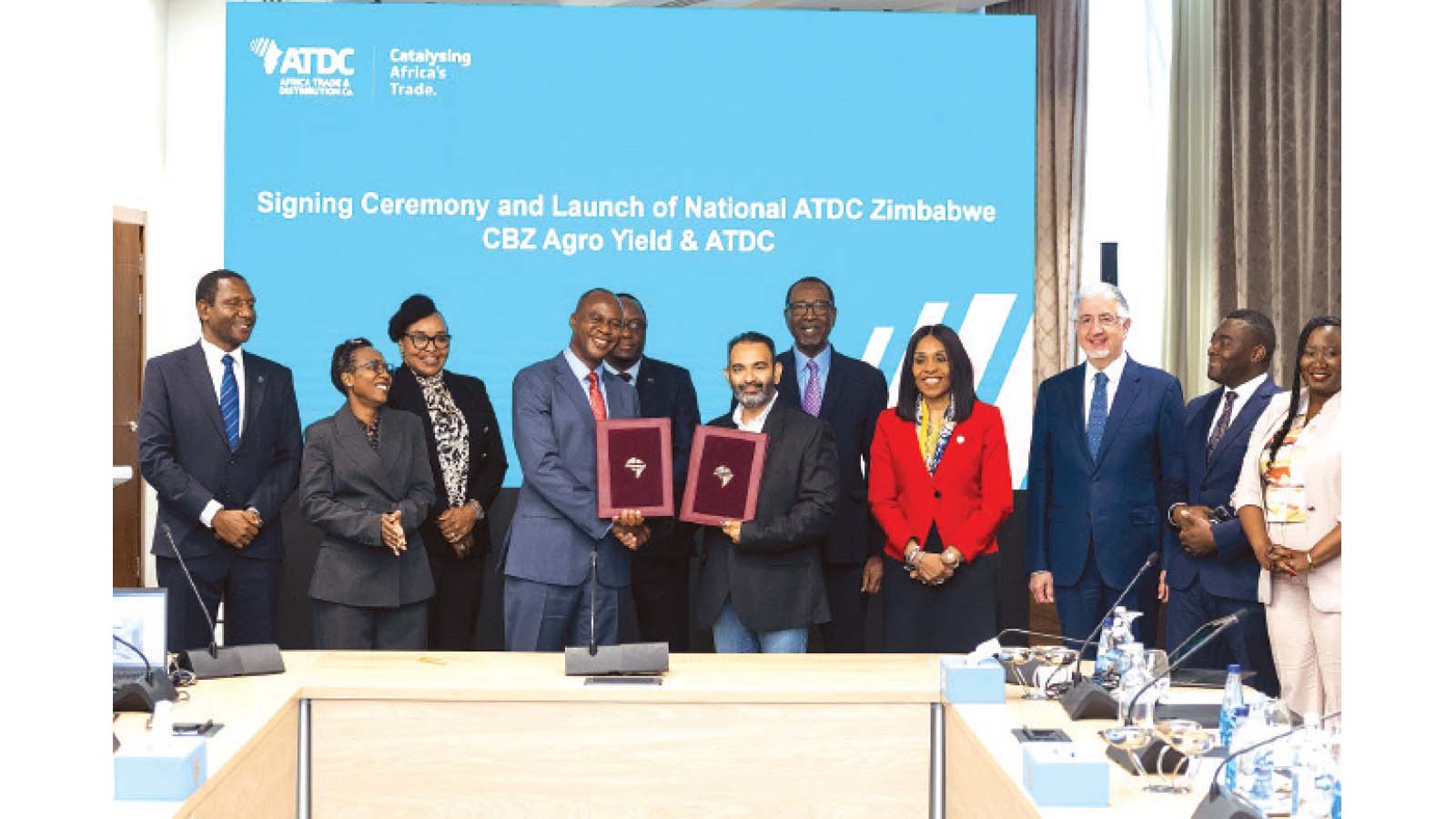
In a parallel development that could prove even more transformative, CBZ has entered into a joint venture with Afreximbank’s African Trade and Distribution Company (ATDC) — a US$1 billion Pan-African trade initiative launched at the Intra-Africa Trade Fair 2025 in Algiers. The joint venture company, ATDC Zimbabwe, will drive agricultural exports while facilitating competitive importation of fertilisers and chemicals. For Zimbabwean farmers, this means access to international markets and better prices for their produce.
“Gone are the days when our farmers would struggle for export markets at the right price,” Mr Nyazema said.
The initiative is designed as a catalyst for the African Continental Free Trade Area, targeting a shift from Africa’s current 15 percent intra-continental trade to a more integrated economic model.
Afreximbank president Professor Benedict Oramah described the initiative as a move to “close the loop and take back control of how our commodities and minerals are produced and traded across value chains”.
Mr Nyazema identified horticulture as a prime beneficiary of the new trade platform.
The sector is targeting expansion from 65 000 hectares (ha) to 100 000ha, potentially boosting exports from US$120 million to US$2,5 billion and creating 600 000 jobs.
Vice President Dr Constantino Chiwenga recently toured major horticulture operations in Burma Valley and declared the US$500 million export target for 2026 “modest” and “easily surpassable”.
Blueberry exports alone surged from approximately US$1 million in 2018 to more than US$50 million in 2025.
“I would want my brothers in Chihota to start having decent lives, to be living in electrified villages,” Mr Nyazema said.
“I would want our people who are struggling currently in places like South Africa to be able to come back home and have a meaningful life.”
The bond announcement sets the stage for the Zimpapers “Moving Zimbabwe Forward” public lecture on July 30, 2026, which will run under the theme “Transport Logistics as the Backbone of an Upper Middle-Income Economy”.
The event, featuring Transport and Infrastructural Development Minister Felix Mhona and industry leaders, will address corridor upgrades, one-stop border posts and rail recapitalisation — the very infrastructure priorities the CBZ bond seeks to fund.
“We cannot continue to talk about our problems and potential solutions,” Mr Nyazema said. “We have to be part of the solutions and we have to be on the execution side.”
The challenge now is whether the broader financial sector, pension funds and international investors will follow.