Chronicle Editor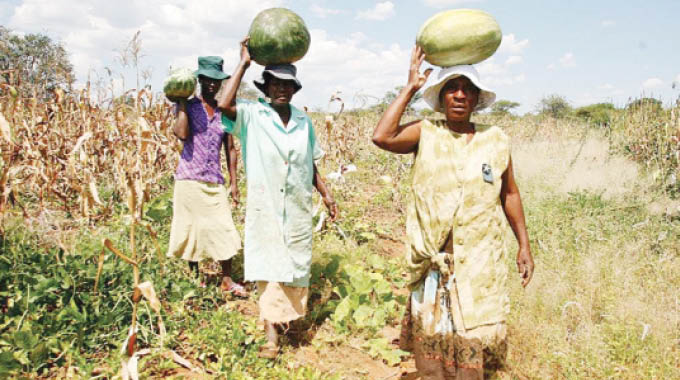
Andile Tshuma
The month of March sees the celebration of women. The media, churches and corporate sector all take time to appreciate the female species during this time of the year and it is a time where one feels special to be a woman.
However, many a times when the woman is celebrated, the rural woman is often forgotten, yet she makes significant contributions to society.
The rural woman is often only remembered in October, on the 15th, which is International Day for the Rural Woman, however many times throughout March, most talk is on celebrating the achievements of corporate women.
Society tends to sideline the housewives, the domestic workers, the self-employed, the vendors, and the women in rural communities.
A lot of talk in March is on women breaking glass ceilings in the corporate sector.
Spare a moment and think of how rural women have broken barriers to education, fought against harmful practices that violate their sexual reproductive health rights, how they have managed to start and sustain businesses and how they have broken the political glass ceilings all the way to parliament and beyond.
Their courage, innovation, determination and love for families and communities amid the exclusion from mainstream information, opportunities, skills, infrastructure, policy and legislation; they still stand out, in their innovation, to raise, educate, feed and nurture families.
Hardly have these women been consulted in their spaces on financial and economic policy reforms or at least receive a copy of such in a language that most of them can relate with.
Their stories of determination and a true fighting spirit have not received enough support.
It is fact that patriarchy still thrives more in traditional societies and society cannot be more traditional than rural, therefore, if there is a woman who deserves mention, it is the rural sister.
Director of the Zimbabwe Gender Commission Mrs Virginia Muwanigwa said although rural women still get less opportunities as compared to their urban counterparts, Zimbabwe had made significant strides in ensuring that they got the same opportunities as their urban sisters.
“We must celebrate rural women. However, the month of March usually sees people emphasising the strides made by women in offices and breaking glass ceilings in the corporate world.
“Rural women have put in a lot of work individually and collectively. The rural woman is assertive, she ensures that people eat, even if there was nothing in the fields, as in the case with climate change wreaking havoc in rural communities.
“The rural woman somehow finds a way to put food on the table. Rural women also carry a bigger burden of being marginalised. The amount of work that the rural woman does often surpasses the work that the average woman performs in an urban set up.
“They contribute a lot with less resources and more complicated circumstances,” she said.
She highlighted that successful partnerships between urban and rural women would help the female species realise greater achievements in the country, as both rural and urban life has advantages and disadvantages.
“There is now substantial representation of rural women in politics, we have our women in rural areas leading in various aspects.
“These rural women are mentors to rural girls and are raising trailblazers. They are the mothers that birth the powerful people that we have in society.
“Rural women are fighting child marriages and are doing all they can in communities with limited resources to ensure that communities are safe spaces for children and themselves,” said Mrs Muwanigwa.
The crucial role that women and girls play in ensuring the sustainability of rural households and communities, improving rural livelihoods and overall wellbeing, has often gone unnoticed.
Women account for a substantial proportion of the agricultural labour force, including informal work, and perform the bulk of unpaid care and domestic work within families and households. They make significant contributions to agricultural production, food security and nutrition, land and natural resource management, and building climate resilience.
Even so, women and girls in rural areas suffer excessively from multi-dimensional poverty. While extreme poverty has declined globally, the world’s one billion people who continue to live in unacceptable conditions of poverty are heavily concentrated in rural areas, according to UNICEF.
Poverty rates in rural areas across most regions are higher than those in urban areas. Yet smallholder agriculture produces nearly 80 percent of sub-Saharan Africa and Asia and supports the livelihoods of some 2,5 billion people globally.
Women farmers may be as productive and enterprising as their male counterparts, but are less able to access land, credit, agricultural inputs, markets and high-value agrifood chains and obtain lower prices for their crops.
Structural barriers and discriminatory social norms continue to constrain women’s decision-making power and political participation in rural households and communities.
Women and girls in rural areas lack equal access to productive resources and assets, public services, such as education and health care, and infrastructure, including water and sanitation, while much of their labour remains invisible and unpaid, even as their workloads become increasingly heavy due to the out-migration of men.
Globally, with few exceptions, every gender and development indicator for which data are available reveals that rural women fare worse than rural men and urban women, and that they disproportionately experience poverty, exclusion and the effects of climate change.
The impacts of climate change, including access to productive and natural resources, amplify existing gender inequalities in rural areas.
Climate change affects women’s and men’s assets and well-being differently in terms of agricultural production, food security, health, water and energy resources, climate-induced migration and conflict, and climate-related natural disasters.
Rural women are also prejudiced by gender relations in their conditions of existence. Gender relations in Zimbabwe have always been biased against women.
Male dominance is not only a sexual and social problem but also a political one directed at maintaining existing power relations which subordinate women.
As we continue to celebrate women throughout the month of March, let us celebrate the diversity of our sisterhood.
We all shine in the different conditions of our existence. — @andile_tshuma



 Online Reporter