admin
adminreputation as a publisher — it wasn’t clean.
After what transpired last year over the phone-hacking scandal at The News of the World, the tycoon must have wondered if Evans had cast a curse of sorts on his empire. I was reminded of this after the shock news of Bornwell Chakaodza’s death last month. He and other editors had problems with publishers too.
I would not be as reckless as to suggest that his set-tos with publishers must have had a bearing — even a slight one — on his health, eventually.
I first heard of Bornwell Chakaodza’s death on the radio. I was stunned. I had not seen him for months. There was a brief mention of cancer. I hadn’t been aware of this. It was not as if I would have been routinely informed of this illness. We were colleagues, not relatives.
For months, we had worked together closely on what I thought was, for both of us, a labour of love. A Sort of Life In Journalism, published by the Zimbabwe chapter of the Media Institute of Southern Africa (MISA) in 2011. MISA’s request to me to write the book centred around my more than 50 years in the media trenches of Southern and Northern Rhodesia, before and after independence. They had to curb my desire to tell the whole story — the cost would have been astronomical.
I knew of Chakaodza’s role in the project before he did. MISA’s Nyasha Nyakunu, the sort of major-domo of the project, had confided to me of it before he told Chakaodza. The three of us met, not by any design, to settle the matter — at Warren Hills cemetery.
We were at the burial of Timothy Nyahunzvi. Like most members of this closely-knit fraternity, we were all deeply saddened by Tim’s death. We all knew he had been ill for some time, but the end still came as a shock.
For me, it cut very close to the bone, more deeply than it did with others. Tim and I had first worked together at The African Daily News in Salisbury in 1959. We were both then in our 20s.
This was the year in which he had apparently been let out of jail — having been thrown in during the state of emergency, precipitated by the defeat in the 1958 election of RS Garfield Todd’s pro-African advancement United Rhodesia Party by Edgar Whitehead’s neo-racist United Federal Party.
Tim and I were reunited in 1963 in Northern Rhodesia at The Central African Mail, where we joined a former colleague from the Salisbury paper, the Selukwe-born (now Shurugwi) Kelvin Mlenga, who was deputy editor of that radical tabloid, a fierce critic of the federation and a campaigner for independence for all three territories of the former federation.
Chakaodza was as delighted as I was at the news of his role in the project — proof-reader. We knew each other well. We enjoyed the same quirky, weird, sometimes bizarre jokes. We had a lot of laughs. We had both worked faithfully for the government media, before an incident of “road to Damascus” proportions occurred for us to switch sides and back to the hilt an independent media thrust. We both had physical and mental scars and bruises to prove this.
Like most African journalists, we had reconciled ourselves to surviving in a profession whose pitfalls were quite often unrelated to the integrity of the editor, rather than to the wiles and whims of the publisher..
Not many journalists penning Chakaodza’s obituary have dwelt on the topsy-turvy nature of his career as a journalist. He began as a government operative — to use a word he probably would have despised.
He ended up as an independent media consultant, having worked as editor of the decidedly private Standard Sunday paper and a columnist of The Financial Gazette, also private.
He had been director of Information — the government “propaganda supremo”. It bestowed on him the right to speak on behalf of the government — mostly when there was ambiguity — as there often is — in what the government meant in one statement or another.
I came to know Chakaodza well shortly after my return from Zambia in 1980. He trained at Zimbabwe Newspapers, before its government takeover in 1981. Among his classmates were Geoffrey Nyarota and Tonic Sakaike, then only known to me personally at the time, because we had worked together at The Times of Zambia. He rose to bigger things, as the Reuters correspondent in Zimbabwe. In the 1960s I too had worked as a stringer for the news agency.
Sakaike died young while still working for Reuters.
Both Geoff and Bornwell left Zimpapers shortly before the government takeover. Someone I had found there, ABC Rusike, was the sports editor and left shortly after my arrival too. He was a former speedy striker of my favourite soccer team of the Salisbury and District Football Association, Civil Service, where Freddy “Dusty King” Gotora made his name.
Then we met again in Zambia, where he worked for a mine newspaper, together with another Zimbabwean, Alex Mahlangu. They are both late now. All three of us had worked together at African Newspapers in Salisbury in the 1950-60s.
I joined Zimpapers as Assistant to the Editor, probably the highest editorial post held by an African at the time. I am convinced the “mini” exodus had absolutely nothing to do with my arrival.
We nevertheless still formed a tight fraternity, as we interacted socially and otherwise. Among us was the late Justin Nyoka, who had worked as a correspondent for The Times of Zambia in Salisbury. We arranged for him to come to Lusaka to collect his payment for the contributions. We remained close until his death.
I remember Nyarota introducing himself to me, with his copy of The Press in Africa, by Frank Barton. Nyarota’s interest was a reference to my clash with President Kenneth Kaunda of Zambia in 1975. He fired me as deputy editor-in-chief of Times Newspapers, which Kaunda’s government had taken over from Lonrho.
Chakaodza was chief information officer when there was a high-powered meeting on the media in Harare in the mid-90s. There were fairly heated exchanges between pro-government and independent-media advocates. At that time, Zanu-PF was steeped in Marxism-Leninism. It stood almost four-square behind a government-controlled media. Apart from Chakaodza, other casualties of this policy were Farayi Munyuki, Tommy Sithole and Nyarota.
One memorable comment I will always recall at the seminar was made by Emmerson Mnangagwa, then in charge of security.
He said although he had been a victim of the settler regime’s Law and Order (Maintenance) Act, before independence, he had found it “handy” after independence. Many journalists suffered hell under LOMA.
At the time of the seminar, Willie Musarurwa’s ouster by the government as editor of The Sunday Mail was a few-years-old. I spoke very strongly against Musarurwa’s sacking as an example of the dark side of the government control of the media.
Chakaodza stood up to criticise me for “bringing up the past”.
I reminded him of this when we were working on the MISA book. We laughed it off, particularly my visit to his office, on the same day, with a letter in which I scolded him for taking the matter lightly
At our meeting, he sounded fairly contrite, particularly as I sounded totally inconsolable over Willie’s dismissal. Chakaodza and I worked well on the book — his function was that of a proof reader — and he was good. He understood why I insisted that if he thought there ought to be a change in the content or context, then he had to consult me, which he did.
He wrote a fairly balanced back page introduction of the book, which I found sympathetic.
During this period of our interaction, we discussed such matters as how did you go from being totally pro-government to being thoroughly critical of same, without experiencing a sort of “tsunami” intervention.
Chakaodza was frank in discussing how he went from being editor of The Herald to editor of the thoroughly “non-Herald” or “non-Zimpapers” Standard newspaper.
He also confided that there had developed “bad blood” between himself and the publishers of the Sunday paper, which led to his departure in controversial circumstances. Neither of us would dwell on the details: I’ve travelled that route many times.
Differences between editor and publisher can be as irreconcilable as those between husband and wife. Whenever that time comes, when there is no chance of “kissing and making up”, it is time to call it quits.
Harold Evans, who famously edited The Sunday Times before quitting when Rupert Murdoch took it over, cited, as his reason, Murdoch’s notorious penchant of not letting the editor do his job autonomously.
Harold Evans must have chortled when Murdoch got his comeuppance — mired in the recent “phone hacking” scandal at The News of the World in the UK.
All publishers, including governments, ought to learn to part ways with hard-headed editors amicably.
Firing them in a huff can bring them a load of ill-fortune.


Online Reporter
- Herald
- September 22, 2026
- 12 views
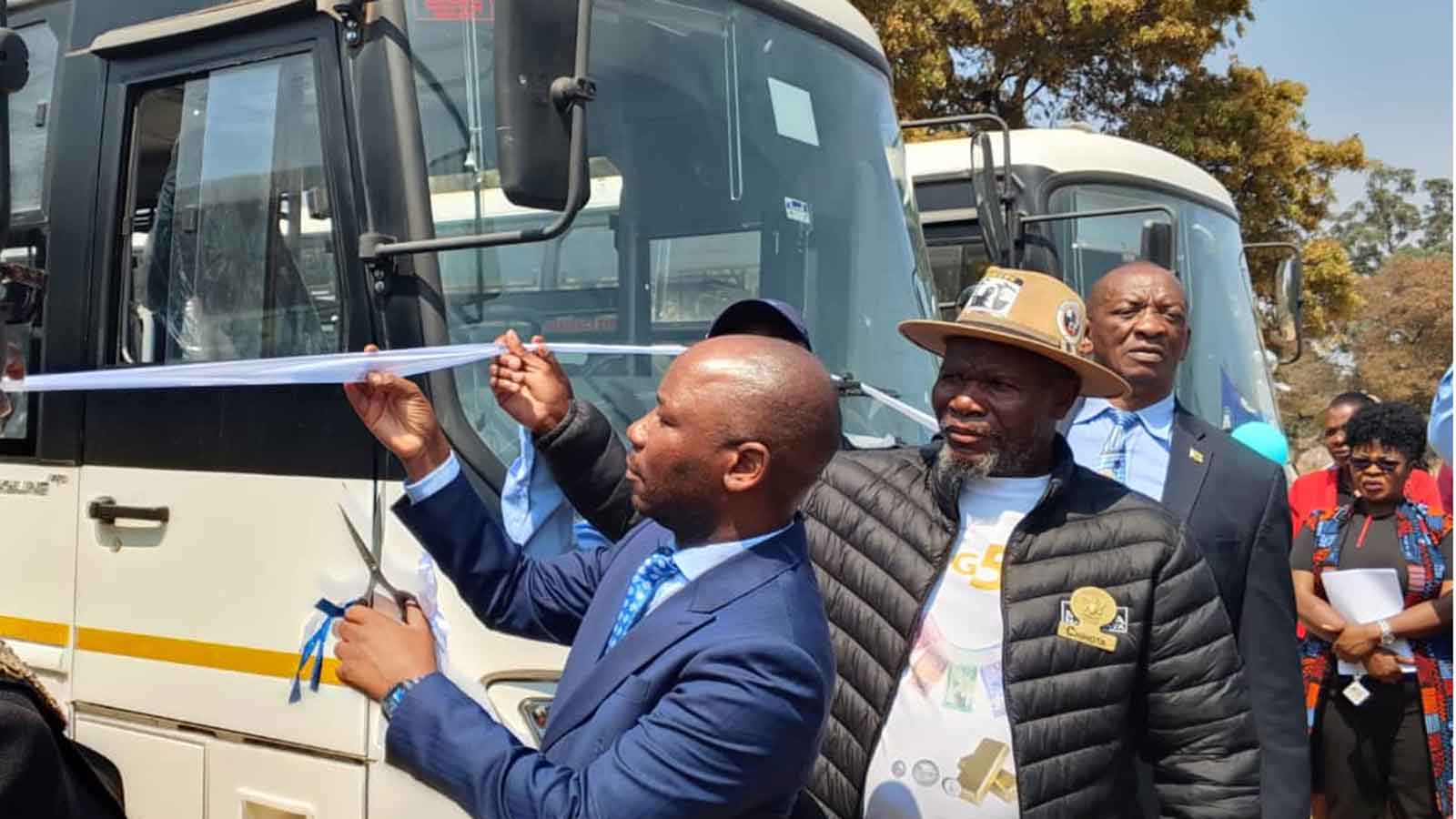
Minister Ndudzo commissions Public Service Commission buses
Victor Maphosa Mashonaland East Bureau Mashonaland East Provincial Affairs and Devolution Minister Advocate Itayi Ndudzo today commissioned four buses that will ferry civil servants in the province, as the Government…