

 admin
admin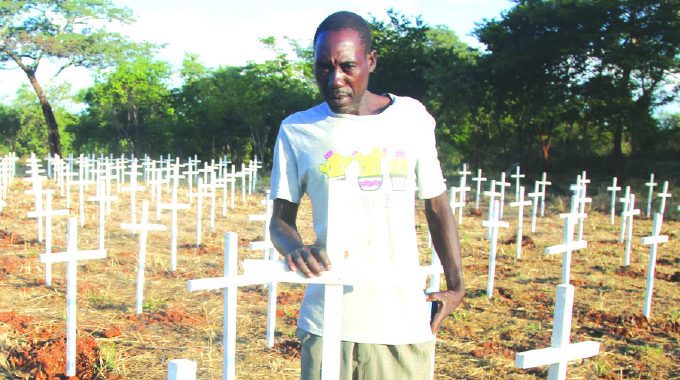
Tadious Manyepo recently in MT DARWIN
He stammers at every turn and there is no doubt of the struggle and speech incoherence.
It is understandable. His eyes are blood red, and, again it is understandable because they have seen the worst.
A network of veins almost runs out of his sun-tanned skin, from the temple to the arms and little everywhere else visible. This body has lived the worst and touched the worst.
Godfrey Kapingidza (42) of Gochera Village, a spitting distance west of Mt Darwin Centre, is ekeing a living out of artisanal gold mining.
The field from which he is extracting the precious mineral is about two kilometres from his new homestead where he resettled after moving from Dotito.
It is an abandoned mining claim which used to be explored by the Rhodesians. He has already gathered a group of helpers as the panning gets more lucrative.
But all of a sudden, everything dries up. The year is 2011.
The group attempts other surrounding patches for salvation, but they cannot hit the jackpot.
Slowly, they are losing hope and then one night, a dream visits Kapingidza. As he shakes off the lethargy of sleep the following morning, he finds the dream frightening and surreal.
“There was someone who instructed me to dig an exact spot behind a huge tree on the same claim. Before I went too deep, I would find gold.
“But there was also a frightening voice in that dream,” said Kapingidza.
“It said after a little bit of digging, we would come across some tunnels down which we would have to follow. Deep down, I remember, in that dream, I came across some human skeletons.
“It was very frightening. I am someone who has always trusted my dreams and when I woke up, I knew something was wrong.
“I thought if we would continue with the artisanal activities, we would die underground. That was my own interpretation of the dream.
“I was so concerned but I didn’t tell anyone, not even my family, about the dream. Instead, I visited a faith healer (a Madzibaba) by the name Dinaida Chigogo and he told me that we were likely to find human remains underground, but we would be safe.”
The artisanal miner continued sifting for gold as usual.
Three weeks later, they came across what looked like gaps underground. There were suffocating gases and seeing it was too risky to continue, they stopped.
Heavy rains pounded our area all night that same day and they decided to check out the mine the following day.
The gases had been absorbed by the rains and the digging continued.
Then the shocker!
“No one could run. As I moved my hands to remove debris along a tunnel, I touched some hard substances.
“I dragged them and they were human bones and skulls. I wanted to run away just like most of my colleagues did, but I then recalled my dream and the subsequent interpretation by Madzibaba Dinaida.
“I was shivering and too weak to climb up back to the surface. My friends had to help me out.”
That’s when the group decided to inform other villagers, including the headman, Mr Christopher Gochera.
“Yes, Mr Kapingidza and his group of artisanal miners came to report to me first. They were all in shock. We gathered villagers and decided to go to the site.
“We got the shock of our lives. Mr Kapingidza had made it clear there could be more human remains in the shaft given the number of hard substances he had touched before pulling the scull,” said Mr Gochera.
“Indeed there were many remains including some which were still intact, with their clothes on.
“The atmosphere was sombre as villagers turned away with tears strolling down their cheeks.
“Then we informed higher authorities and the following day, experts from the Zimbabwe Defence Forces and National Museums and Monuments of Zimbabwe visited.
“The ZDF guys warned that we weren’t supposed to temper around some substances which they said were bombs which were yet to detonate.”
The sight, according to Mr Gochera was gory.
The shaft is close to 120m deep. And there are five others, too. Some remains showed signs of mutilation. Others were of women with babies strapped on their backs.
Liberation war fighters and civilians, butchered, shelled, massacred, slaughtered, burnt and thrown down the shafts.
All along, everything had been hidden under a thick forest.
Without the allure of gold reserves, smelt by Mr Kapingidza and his colleagues, the shafts housing thousands of unaccounted for victims of the Rhodesian brutality wouldn’t have been discovered until now.
“We suppose since this area is a gateway to Mozambique and Zambia where the liberation fighters got their training, people were being waylaid and then thrown into these shafts,” said Mr Gochera.
“The mutilated bodies should have been prisoners of war or those who attempted to resist. The toxic gases obviously suffocated those thrown while still alive.”
Eventually, the exhumation began.
Remains of 850 people were retrieved. All but three of them were reburied at a mass cemetery laid adjacent to the shaft.
Three of them were claimed by their relatives identified through the help of spirit mediums.
National Museums and Monuments of Zimbabwe curator Mr Godfrey Nyaruwanga said more bodies are still in the shafts.
“Look, the process to remove the bodies got complicated and authorities ordered that it be stopped.
“There are thousands of bodies still in the shafts. So we are in the process of building a monument here,” he said.
“Some bodies from those retrieved were positively identified since some were still intact with their clothes on and identification documents as well as currency in their pockets.”
When The Herald visited the mass grave in Chibondo, officials from the National Museums and Monuments of Zimbabwe as well as villagers were busy marking the graves of 850 reburied bodies.
As the country commemorates the 43rd Independence whose main celebrations are set for Mt Darwin on Tuesday, Chibondo is one of the places where the Independence Flame will pass through.
It is a befitting gesture for the slain sons and daughters of this country who were brutally slaughtered for trying to liberate Zimbabwe from white minority rule in the late 1970s.
The Chibondo genocide is thought to have taken place between 1973 and 1979.



 Online Reporter