Sundaymail Editor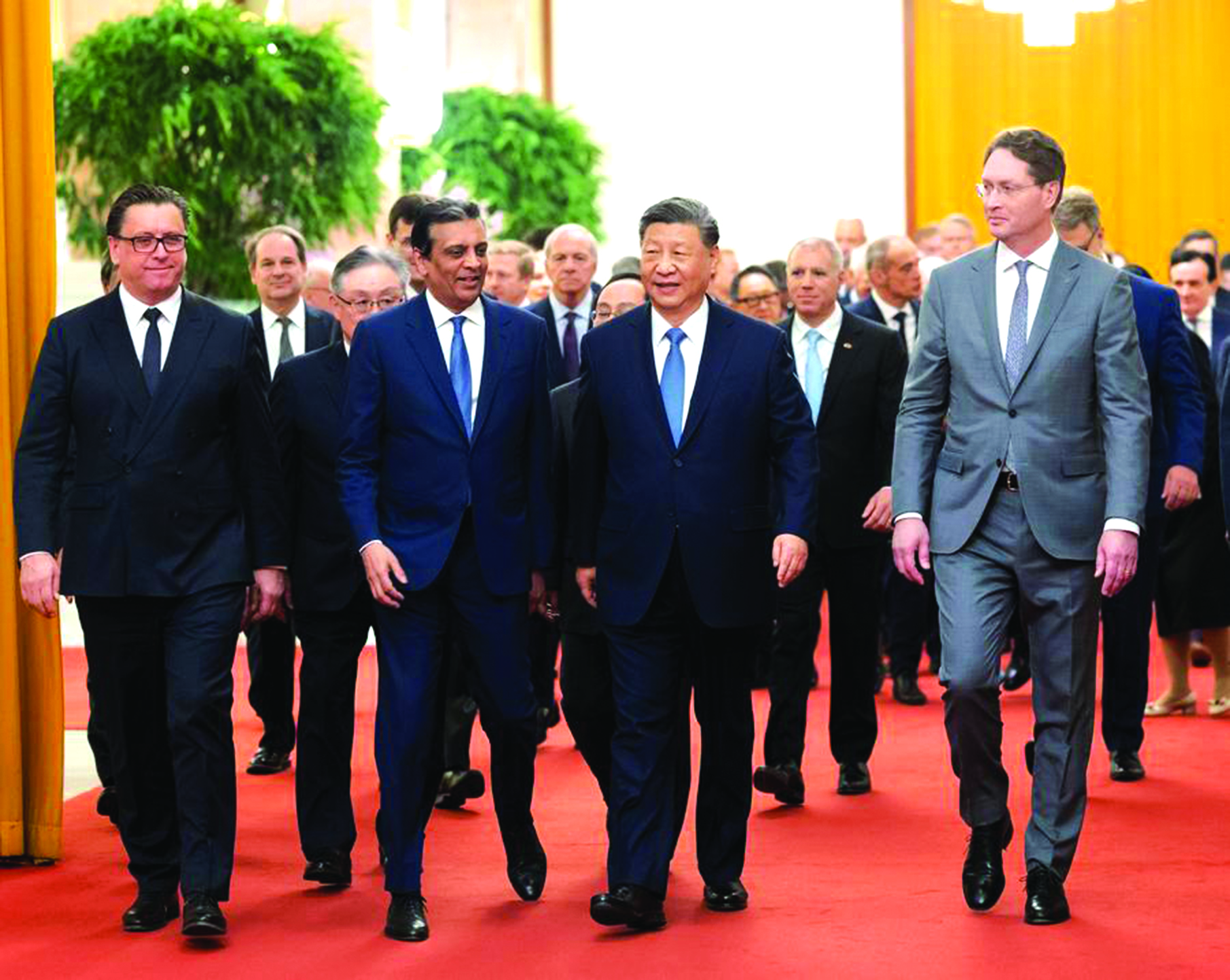
Farai Ziruvi
LAST MONTH, China’s President Xi Jinping met with more than 40 representatives of the international business community.
He said China was, and would remain, an ideal, secure and promising destination for foreign investors, and that investing in his country “is investing in the future”.
The line-up of the business titans that attended the meeting, representing various industries, was pretty impressive: FedEx Corporation president Raj Subramaniam; chairperson of the board of management of Mercedes-Benz Group AG Ola Källenius; Sanofi SA CEO Paul Hudson; group chief executive of HSBC Holdings Plc Georges Elhedery; executive chairperson of Hitachi Ltd Toshiaki Higashihara; SK Hynix Inc president Kwak Noh-jung; and president of Saudi Aramco Amin Nasser.
To an observer, African moguls were conspicuous by their absence.
However, this is instructive in a number of ways. Realistically, Africa, being the world’s least developed continent, has not yet mustered big industries to compete at the world stage.
At the same time, it is a continent with relatively few wealthy individuals, with Forbes magazine this year naming 22 billionaires with a net worth of just US$105 billion.
South Africa had the biggest number of billionaires this year (seven), followed by four from Nigeria and an equal number from Egypt. The list also includes three billionaires from Morocco, one from Algeria, one from Tanzania and one from Zimbabwe.
Aliko Dangote of Nigeria, Johann Rupert, Nicky Oppenheimer (both of South Africa), Abdulsamad Rabiu, Nassef Sawiris and Mike Adenuga are some of the top names.
Zimbabwe boasts its only billionaire, Strive Masiyiwa, who owns telecommunications giant Econet. The number of African billionaires represents less than 1 percent of the total number of billionaires worldwide.
Specifically, out of 3 028 billionaires globally, only 23 are black, according to Forbes.
While the total wealth of Africa’s 22 billionaires has risen to US$105 billion, the overall percentage of African billionaires remains small. There are currently 3 028 billionaires in the world, representing the highest number ever recorded by Forbes since it started the ranking in 1987.
The combined wealth of these billionaires is estimated at US$16,1 trillion.
China’s 450 billionaires are worth a combined US$1,7 trillion. In this context, given close cooperation and friendship between China and Africa, the relationship must mint new billionaires that serve the interests of the two sides and reflect mutual benefit and win-win outcomes. China’s opening up to high-quality foreign investments must benefit African entrepreneurs and forge closer economic cooperation.
However, this is still a long way off and there should be deliberate efforts to harness the opportunities and goodwill to create a new generation of Sino-African billionaires.
Opportunities
Africa — arguably the world’s richest continent in terms of natural resources and a future human resource base and market — is emerging as a prime landscape for future billionaires, driven by rapid economic growth, demographic advantages and expanding industries. With an investable wealth of US$2,5 trillion and a projected 65 percent rise in millionaires over the next decade, countries like Mauritius, Rwanda and Namibia are leading wealth creation through investor-friendly policies.
Over half of Africa’s population is under 31, fuelling urbanisation and demand across sectors. Key sectors poised for billionaire-making include renewable energy, agribusiness, fintech, heavy industry, real estate, healthcare, education and the creative economy.
While challenges like currency volatility and infrastructure gaps remain, Africa’s untapped potential and entrepreneurial momentum offer vast opportunities.
Influential figures such as Dangote, Patrice Motsepe and Tony Elumelu illustrate how solving local issues can generate immense wealth on a global scale.
Critically, the Forum on China-Africa Cooperation (Focac) provides a clear framework for economic and industrial cooperation that must be re-evaluated towards laying the foundation for creating wealth for the two peoples in the long term.
Last year’s Focac summit, held in Beijing, outlined a number of areas for partnership.
These include the partnership initiative for industrial chain cooperation.
China pledged to support Africa in developing local value chains, manufacturing and deep processing of critical minerals, build growth circles for China-Africa industrial cooperation in five regions, undertake 10 supporting projects of industrial parks for African countries and hold 100 training sessions on industrialisation.
According to the summit, China will advance the development of the pioneering zone for in-depth China-Africa trade and economic cooperation, as well as establish a corresponding fund to promote the integration of industry and trade, and interconnected development of industrial parks.
China will implement an African small and medium enterprises (SMEs) empowerment initiative. This includes financing support for African SMEs, 50 matchmaking activities and 1 000 training opportunities for African business managers.
A China-Africa digital technology cooperation centre will be jointly built, while Chinese businesses will be facilitated to undertake 20 digital infrastructure projects and digital transformation demonstration projects in Africa.Another key area is the partnership initiative for connectivity.
China will help implement 30 infrastructure projects in Africa and continue to provide support for the development of the African Union (AU) and the African Continental Free Trade Area (AfCFTA).
It will also promote interconnected development between transport infrastructure and industrial parks built and operated by Chinese companies in Africa.
Further, it will build a multimodal sea-rail transport network that connects China’s central and western regions to Africa.
To enhance financial market connectivity, the Asian giant will deepen cooperation with Africa in local currency settlement and financial technology, including issuance of panda bonds by African countries.
The partnership initiative for rural revitalisation and people’s well-being outlines China’s support in eradicating hunger and achieving food security and sustainable agricultural development.
It will also foster a network of China-Africa cooperation on agricultural modernisation, help to build or upgrade 10 agricultural technology demonstration centres, build no less than 6 667 hectares of overseas demonstration areas of Chinese agricultural standardisation and provide African countries with RMB1 billion of emergency food aid.
Among the commitments, the Asian nation will establish a China-Africa agricultural science and technology innovation alliance, build 100 demonstration villages for poverty reduction through agricultural development, send 500 agricultural experts to African countries, provide training for 1 000 leaders in pursuing a better life through agricultural development and advance the development of a China-Africa Juncao cooperation centre and a China-Africa bamboo centre.
On the partnership initiative for people-to-people exchanges, Beijing will continue to implement Future of Africa, a project for China-Africa cooperation on vocational education, build with African countries schools of engineering technology and set up or upgrade 10 Luban workshops and 20 schools.
In addition, it will offer Africa 60 000 training opportunities, with priorities given to programmes for women empowerment and youth development.
China will refine the mechanisms and platforms for China-Africa science and education cooperation. It will establish China-Africa regional cooperation centres for digital education. Under the partnership initiative for trade prosperity, China pledged to grant duty-free treatment to 100 percent of the tariff lines of products from least developed countries (LDCs) with diplomatic ties with China; sign framework agreements on economic partnership for shared development with interested African countries; and strengthen cooperation on inspection and quarantine and standards, as well as expand access for agricultural exports from Africa.
China will deepen China-Africa e-commerce cooperation, support African countries in setting up country pavilions in China’s Silk Road e-commerce cooperation pilot zone and host cloud lectures to train African e-commerce talent.
It also undertook to implement the China-Africa quality enhancement programme; establish the China-Africa centre for standardisation cooperation and research, and the China-Africa trade digitalisation trust verification platform; and implement the China-Africa conformity assessment capacity-building initiative.
Lastly, within the framework of the partnership initiative for green development, China proposed to support Africa in enhancing climate adaptation capacity, provide new energy technologies and products, implement 30 clean energy and green development projects, and set up a special fund for the China-Africa green industrial chain.
Systems thinking
It is also crucial to note that during discussions at Focac, the flow of investment was largely predicated to come from China towards Africa.
This asymmetry could change in due course.
All the above-stated areas have the capacity to create a sustainable, long-term engagement that China and Africa are likely to continue engaging in for several decades to come.
What is then required is a systems thinking approach to ensure there are clear outcomes that will create wealth and mint new billionaires, both African and Chinese.
Crucially, we must see the Sino-Africa cooperation bear fruitful results.
A systems thinking approach enables African leaders to holistically leverage China-Africa cooperation by aligning infrastructure (for example, Belt and Road Initiative projects) with local value chains (linking ports to agribusiness zones), prioritising value-addition partnerships (refining minerals domestically) and integrating Chinese tech investments with skills development to fuel industries like renewables and fintech.
Analysing feedback loops — balancing debt sustainability, environmental costs and cultural integration — and scaling up synergies (for example, combining Chinese solar tech with African off-grid solutions) transform political goodwill into structural wealth diversified industries, skilled workforces and innovation ecosystems that ensure long-term, inclusive growth beyond transactional deals.
This is also a challenge for ordinary Africans, particularly businesses and entrepreneurs, to recognise that Sino-Africa relations are not elite pacts but they offer vast opportunities that must cascade to ordinary people.
The African bourgeoisie must leverage good cooperative relations between China and Africa to venture into brave, new frontiers.
Recent developments in the global economy necessitate a rethink of how people do business.
A pursuit of multilateralism and harnessing China’s rising influence as the next economic superpower is crucial.
Economic globalisation is not dead.
It is actually gaining new momentum, given recent developments that should necessitate restrategising and re-evaluating in a multilateral context.
China has pledged to uphold “true multilateralism”, promote universally beneficial and inclusive economic globalisation, actively participate in global economic governance and “is committed to building an open world economy”.
During the meeting with business chiefs, President Xi pointed out that multilateralism is “the only choice for addressing global challenges, and economic globalisation is an unstoppable trend of history”.
This should give rise to new money and new billionaires; hopefully, more African and Chinese businesspeople working together towards common prosperity and building a community with a shared future.
Farai Ziruvi is a business strategist and consultant based in Harare. He writes in his personal capacity.


 Online Reporter