


 Sundaymail Editor
During the pageantry that was the campaign period leading up to the United States elections in November last year, many people across the world, not least here in our teapot-shaped Republic, would have enjoyed the spectacle as a riveting contest for arguably the most powerful job in the world.
The plot — pitting a doddering incumbent, Joe Biden, desperately trying to extend his term against a disgraced maverick suitor, Donald Trump, a convicted felon who had previously only saved one term and was therefore angling for a historic comeback — made this epic duel all the more entertaining.
Unbeknown to most, especially here, the outcome of the election would profoundly and materially change their lives in more ways than one.
You see, globalisation essentially knitted the world into one big village that is inextricably linked to such an extent that a sneeze in one part of the community inevitably results in everyone catching a cold.
Some local workers, who have for long been sustained by non-governmental organisations linked to the US Agency for International Development (USAID), had to painfully reconcile themselves to this fact when their contracts were abruptly terminated when Trump decided to dismantle the 64-year-old organisation soon after assuming office.
This development will likely see a lot of realignment in countries that disproportionately relied on USAID funding, particularly in the health sector.
They now find themselves weaned off at a time they least expected.
Trump’s curse for cashvists
The new Trumpian era also heralds the beginning of trying times for many of our cashvists, most of whom were nuisance mischief-makers, after the US president turned off spigots on more than 5 000 projects in Zimbabwe.
The curious funding that was budgeted for these supposed programmes included US$19 million for “promoting greater and more effective citizen participation in governance processes”, US$5 million for “constitutional reform advocacy”, US$12 million for “youth campaigns for good governance”, as well US$5 million “for torture victims”.
A further US$8 million was reserved for “new narratives for accountability”.
In addition to the US$5 million ostensibly meant to “promote the independence of institutions in Zimbabwe’s justice sector”, there was also a US$7 million largesse for the usual noisy members of the Fourth Estate to enhance “the capacity of the media to hold powerful State and non-State actors accountable for their acts and omissions”.
However supposedly decent or noble this funding was couched, the reality is that it was nothing more than a slash fund for cashvists, whose major preoccupation was to soil the Government’s image.
But the CIA will always find alternatives to fund mischief-makers who help to advance their goals and interests — perhaps not as efficient and as effective as under the guise of the humanitarian organisation.
Bishop Lazi is simply trying to show the extent to which the world is interconnected. We also saw this during the Covid-19 era, when the virus reached every corner of the world. It was similarly evident after the outbreak of the Russia-Ukraine conflict in February 2022, when global supply chains for commodities such as maize, wheat, fertiliser and vegetable oils were severely affected, as the two countries are largely considered the “world’s breadbasket”.
Together, they used to ship around 60 percent of the world’s sunflower oil, 20 percent of the world’s maize and an estimated 30 percent of wheat.
Tariffs: Another pebble in the shoe
Bishop Lazi recently found it amusing that there were Zimbabweans who were actually cheering American comedian Stephen Colbert — host of CBS’ The Late Show — after his April 8 monologue pejoratively referred to their motherland as a nonentity in world politics, especially after Harare decided to suspend duties on all American goods.
In addition to the baseline 10 percent tariff, Washington had slapped Zimbabwe with an 18 percent reciprocal tariff.
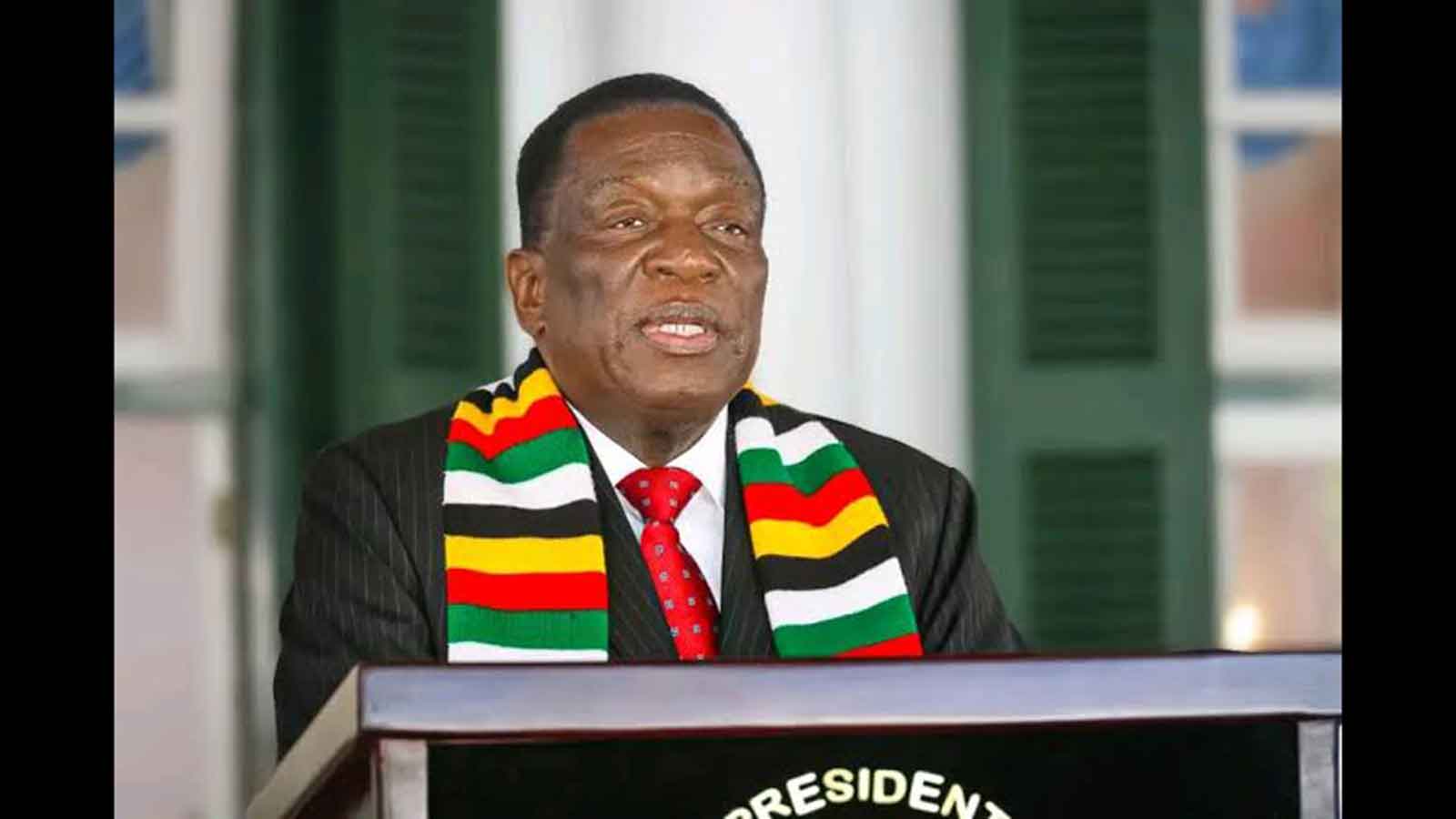
The ever-agile political grandmaster, President ED, decided to pre-emptively make a move before the tariffs came into effect. Colbert pooh-poohed the size of Zimbabwe’s economy, intimating that it did not amount to anything in the greater scheme of the world economy.
“Now a lot of people have been talking smack about Trump’s tariffs,” Colbert said during his monologue, “but guess what, Buttercup — they are working! Because we just learned Zimbabwe became the first country to officially cave. Oh yeah. That must’ve been very exciting news for Donald Trump . . . because it was definitely the first time he had ever heard of Zimbabwe!”
He continued: “In case you didn’t know, Zimbabwe has a GDP of US$35 billion a year. That’s almost as big as the greater metropolitan area of Poughkeepsie, New York — which, say it with me — is only the sixth-largest economy in the state of New York.”
While trade between Harare and Washington is understandably low because of US sanctions (ZDERA) that are still extant, it is certainly not negligible, considering that Zimbabwe shipped goods worth US$68 million to the North American country last year, while also buying goods worth US$43,8 million.
Yes, as a country, we might be doing significantly more business with China and the United Arab Emirates, but any disruption to our trade at a time the world is grappling with an omnicrisis that is affecting the global economy is a pebble in the shoe that we could best do without.
In any case, since the advent of the Second Republic, we have turned a new page in our foreign policy, where current politics mean we seek rapprochement with Washington. We seek cooperation, not confrontation, with the US, as we do with anyone across the world and beyond.
As Deng Xiaoping once said, it does not matter whether the cat is black or white, as long as it catches mice.
Zimbabwe: A house of stone
But it is disingenuous of Colbert, and anyone in this world for that matter, to claim that Zimbabwe is an unknown quantity. Though small, it is a country that punches way above its weight.
In fact, the story of Zimbabwe, whose name means the “House of Stone”, is aptly captured and summarised in Psalms 118:22-24: “The stone the builders rejected has become the cornerstone; the Lord has done this, and it is marvellous in our eyes. The Lord has done it this very day; let us rejoice today and be glad.”
If they do not live under rock, we surely expect Americans such as Colbert to know of a 41-year-old woman called Kirsty Coventry, who made history by becoming the first woman, first African and youngest candidate to be elected president of the International Olympic Committee on March 20. Forget FIFA’s Gianni Infantino, Kirsty is the most powerful figure in world sport at the moment.
Wait, there is more.
In her glittering career as an athlete, she became Africa’s most decorated Olympian of all time after winning seven medals across the 2004 Athens Games and the 2008 Beijing Games. She is also one of the world’s highest achieving female swimmers.
And get this, she is from Zimbabwe, the house of stone. Before there was Kirsty, there was a teenager from Bulawayo, Peter Ndlovu, who made history on August 19, 1992 by becoming the first African footballer to play in the new English Premier League when he featured for Coventry City against Tottenham.
He essentially paved the way for multitudes of talented footballers from this continent. Three years later, on March 24, 1995, his talent shone for the world to see when he became the first player to score a hat-trick for Coventry City FC against Liverpool at Anfield after Nowrich City FC’s Terry Allcock in 1962.
Guess what? He is from Zimbabwe, the house of stone.
Earlier, there was Bruce Grobbelaar, who holds the distinction of being the first African to win the UEFA Champions League (then called the European Cup) when he conquered the continent with Liverpool in 1984.
Last year, the limelight was on two athletes — Tapiwanashe Makarawu and Makanakaishe Charamba — who made us all proud when they both competed in the 200-metre final at the Paris Olympic Games.
No doubt, the same Colbert was probably watching when his fellow countryman, Noah Lyles, feigned a hamstring injury after Botswana speedster Letsile Tebogo showed him a clean pair of heels on his way to a historic win.
But, in all this, Tapiwa and Makanakaishe were confirmed to be among the eight fastest 200m athletes in the world.
And who can forget Uncle Bob, Cde Robert Mugabe, a consequential politician who loomed large in world politics by taking on Washington and London after spearheading the momentous and historic Land Reform Programme.
He refused to be intimidated and showed the world the headstrong determination and mettle that Zimbabweans are made of.
We are a people made of sterner stuff; that is the reason we take up key leadership roles in the world, including in business.
If you reflect on all this and fail to feel a patriotic fervour, then you are definitely not Zimbabwean.
As we celebrate 45 years of Uhuru, our accomplishments and milestones as a people should give us the belief that, notwithstanding present challenges, we will surely overcome.
Bishop out!


 Bongani Ndlovu